Hiring Models
Authority GuideRecruitment Agencies at Scale: Where the Model Works and Breaks
Agencies are often added one vacancy at a time, so a scale-up can accumulate significant dependency without ever making an explicit decision to outsource a large part of hiring. Different consultants learn the business repeatedly, candidate experience varies and fees rise broadly in line with volume. The model still fills roles, but the organisation may not be building a stronger hiring capability.
The short answer
Recruitment agencies remain highly effective for occasional specialist hiring, but they become a weaker primary model when hiring is continuous, agency spend rises with every appointment and employer messaging is spread across multiple suppliers. The point of change is not a fixed employee number. It is the moment when agency use becomes a structural operating model rather than selective support.
Why this matters
Agencies are often added one vacancy at a time, so a scale-up can accumulate significant dependency without ever making an explicit decision to outsource a large part of hiring. Different consultants learn the business repeatedly, candidate experience varies and fees rise broadly in line with volume. The model still fills roles, but the organisation may not be building a stronger hiring capability.
The central idea
The agency model is optimised for flexible access to external expertise, not continuous integration across an annual hiring plan. It works best when the requirement is occasional, urgent or unusually specialised. When the same type of hiring repeats throughout the year, the company should compare individual assignments with the economics and knowledge retention of dedicated capability.
How to apply it
1. Calculate total agency spend by role family, geography and business unit
Aggregating fees across the year exposes the real pattern of dependency. Individual placement fees rarely feel unreasonable in isolation; the annual total often tells a different story.
2. Identify which roles recur and which are genuine exceptions
Recurring hiring is a candidate for dedicated capability. Genuine exceptions, niche, confidential or unexpected, remain a good fit for the agency model.
3. Measure duplicate briefing, candidate ownership disputes and inconsistent messaging
The hidden cost of a wide agency panel is repetition and drift: the same brief explained many times, the same market approached in incompatible ways, and different versions of the employer proposition in flight.
4. Compare agency outcomes with the cost of dedicated internal or embedded capability
Model each recurring role family under an agency and a dedicated-capacity scenario using full cost, quality and time-to-hire, not just the headline fee.
5. Retain agencies where their specialism, network or flexibility remains distinctive
Reducing agency dependency does not mean removing agencies. Some specialists behave more like trusted advisers and remain the right answer for the work they know best.
Saiyō framework
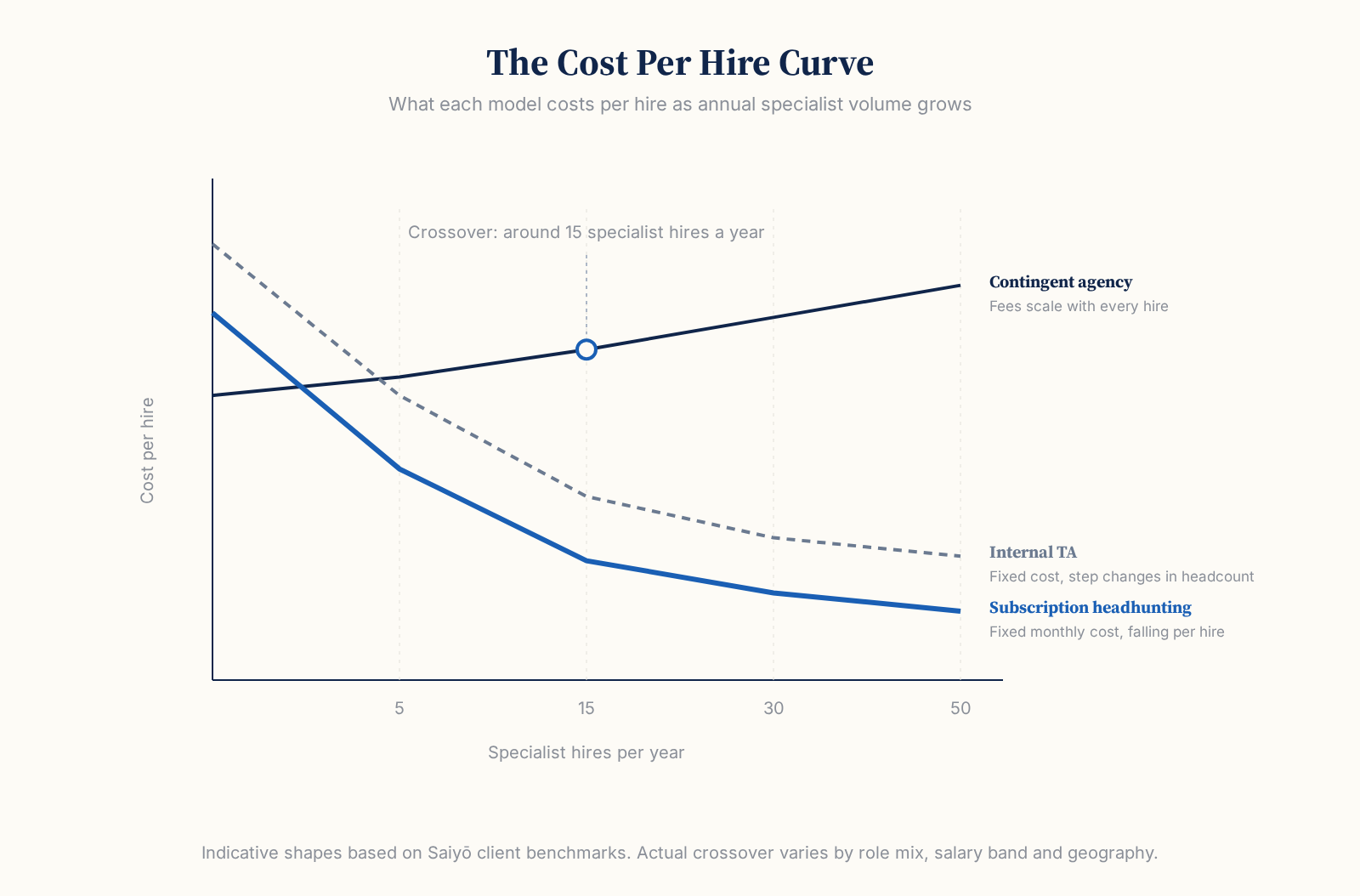
The Cost Per Hire Curve
The economics of hiring at 5, 15, 30 and 50 roles per year.
Indicative shapes based on Saiyō client benchmarks. Actual crossover varies by role mix, salary band and geography.
Where organisations usually go wrong
The most common failures are structural rather than a reflection of effort. Recognising the pattern early lets the operating model change before more activity is added.
- Treating every agency fee as an isolated cost rather than part of an annual pattern.
- Using too many suppliers without clear specialisation.
- Assuming agency volume automatically means wider market coverage.
- Allowing external recruiters to define the employer proposition differently.
- Removing agencies entirely when selective use would remain valuable.
Practical application for technology scale-ups
A scale-up should distinguish core hiring from exception hiring. Core hiring deserves an operating model that retains knowledge and provides predictable capacity, while agencies can remain a useful route for niche, confidential or unexpected requirements. This preserves the strengths of the agency model without allowing it to become the default answer to every internal capacity issue.
Where the idea has limits
Some specialist agencies behave more like trusted long-term advisers and may outperform broader outsourced models in their niche. A high fee is not automatically poor value if the role is critical and the agency provides differentiated access. The decision should reflect outcomes, not an ideological preference for internal or embedded delivery.
The Saiyō view
Saiyō does not believe recruitment agencies are broken. They are designed for a pattern of hiring that becomes less efficient when specialist demand is continuous. Scale-ups should keep strong agencies for the work they do best while moving recurring hiring into a model that integrates, retains knowledge and provides more predictable economics.
Key takeaways
- Agencies remain valuable for occasional, niche or unexpected specialist hiring.
- They become a weaker primary model once hiring is continuous and structural.
- The tipping point is a pattern of use, not an employee count.
- Move recurring hiring into dedicated capability; keep agencies for exceptions.
- Compare full annual cost, quality and time to hire, not per-role fees.
Frequently asked questions
See this in practice
Move from the concept to the way Saiyō delivers it.
Related questions
When should a company stop relying on recruitment agencies?
A company should reduce agency reliance when external support has become the default for recurring roles rather than a selective response to genuine exceptions. Warning signs include rising annual fees, repeated briefing, inconsistent candidate experience and an internal team that remains unable to build proactive capability. The answer is usually to rebalance the model, not eliminate every agency relationship.
Read the answerAnswerWhy do agency costs rise at scale?
Agency costs rise at scale because most fees are charged per successful hire, so total spend increases broadly in line with recruitment volume. There may be negotiated rates, but the commercial model remains transactional. As hiring becomes continuous, a subscription or internal capability can spread cost across a larger annual plan and lower effective cost per hire.
Read the answerAnswerHow many recruitment agencies should a company use?
A company should use enough agencies to cover genuinely distinct specialisms without creating duplicated effort or inconsistent representation. For most specialist hiring, a small panel with clear role ownership is stronger than a large uncontrolled supplier list. The correct number depends on geography, function and whether internal or embedded teams already provide core coverage.
Read the answerAnswerWhen is a recruitment agency still the best option?
A recruitment agency is often the best option for an unexpected vacancy, a genuinely niche requirement, a short-term hiring spike or a market where a specialist consultant has distinctive relationships. It can also be appropriate when annual hiring volume is too low to justify dedicated capability. The flexibility of paying for an individual outcome remains valuable in the right context.
Read the answer