Candidate Quality
Authority GuideThe Market First Method: How to Map a Talent Market
Co-founder and CEO
Many searches begin with a job description and a LinkedIn query, which immediately narrows the market to familiar titles, visible employers and expected keywords. That produces a quick shortlist but creates hidden bias, and causes teams to compete repeatedly for the same obvious candidates. A market-first search delays candidate selection until the wider landscape has been understood.
The short answer
A talent market should be mapped before candidates are approached, beginning with the business problem, target environments and evidence of success. The map should include direct competitors, adjacent markets, relevant geographies and individuals whose context makes their experience transferable. Its purpose is to give the hiring team confidence that the strongest realistic market has been understood before outreach begins.
Why this matters
Many searches begin with a job description and a LinkedIn query, which immediately narrows the market to familiar titles, visible employers and expected keywords. This can produce a quick shortlist, but it also creates hidden bias and causes teams to compete repeatedly for the same obvious candidates. A market-first search delays candidate selection until the wider landscape has been understood.
The central idea
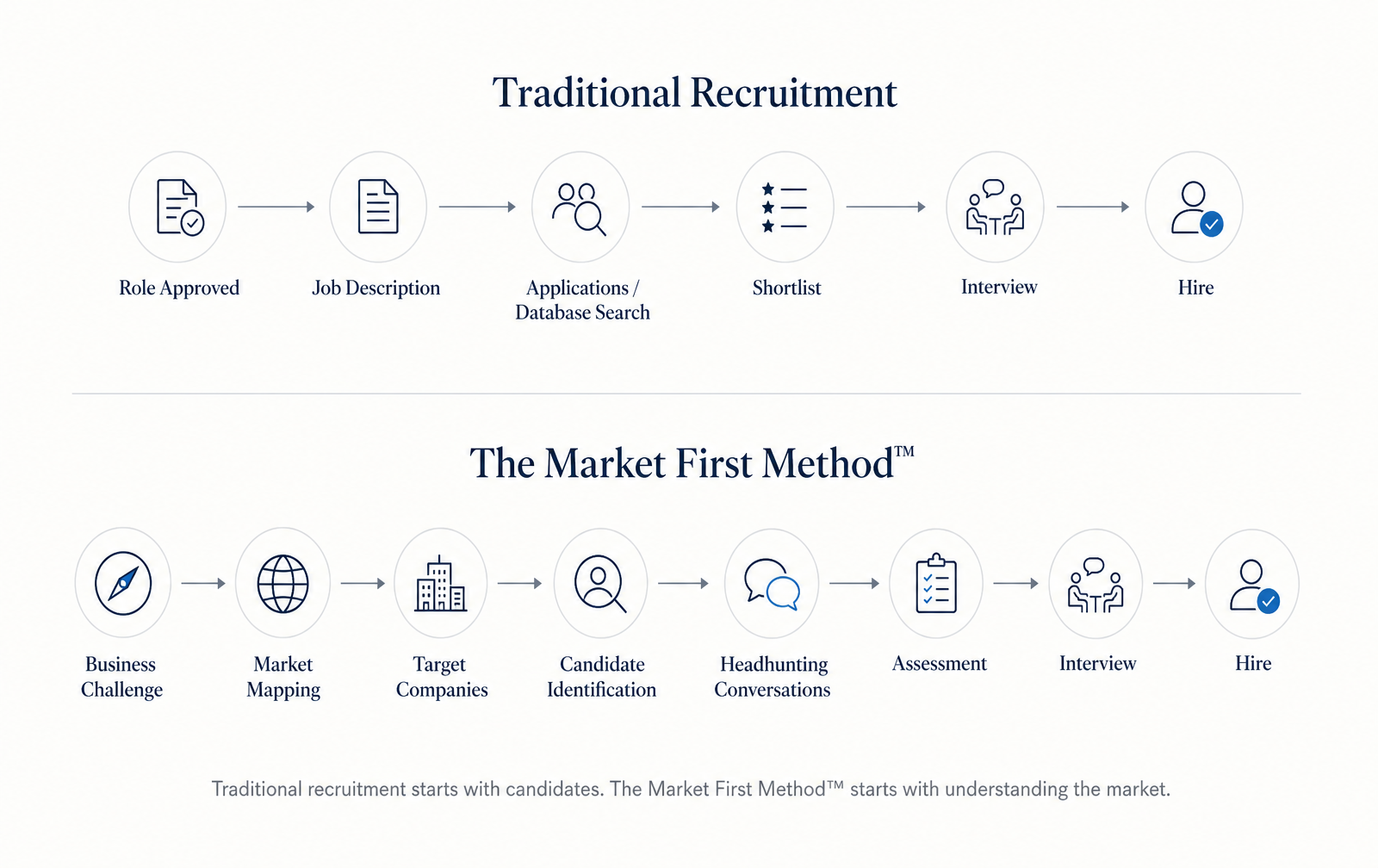
The Market First Method separates market understanding from candidate persuasion. It asks where relevant capability is built, which organisations have solved similar problems and what evidence should be visible before deciding who to approach. This creates a more objective search and improves the quality of advice given to hiring managers.
How to apply it
1. Translate the vacancy into a business problem and measurable outcomes
Before looking at profiles, describe what the role will change in the business and what evidence would prove it. That statement is the anchor for every later decision about who is and is not credible.
2. Identify direct competitors, adjacent categories and comparable-stage companies
Move beyond the obvious logo list. Adjacent categories often produce transferable capability, and companies at a comparable stage of growth tend to have solved comparable problems in relevant conditions.
3. Map functions, reporting lines, geographies and likely talent density
Understand where the relevant work actually happens inside those organisations. Reporting structure, region and team size reveal how much genuinely transferable experience the market contains, well before names are prioritised.
4. Build a longlist broad enough to test assumptions before narrowing it
The purpose of the longlist is calibration, not shortlisting. If it only contains people already known to the hiring team, the search cannot test whether that view of the market is right.
5. Prioritise using context, capability and evidence, not title alone
Job titles are noisy. Prioritise by what the person has actually done, in what environment, against what problem, and how visible the evidence of success is.
6. Record market feedback so the map improves throughout the search
Every conversation, decline and counter-offer is intelligence about the market. Capturing it turns the map into a living asset that improves the next search as well as the current one.
Saiyō framework
The Market First Method
Map the entire relevant talent market before writing a single job spec.
Where organisations usually go wrong
The most common failures are structural rather than a reflection of effort. Recognising the pattern early lets the operating model change before more activity is added.
- Starting with a list of familiar companies supplied by the hiring manager.
- Treating market mapping as a one-off list-building exercise.
- Excluding adjacent sectors before testing transferability.
- Using job titles as a substitute for understanding responsibility and context.
- Beginning outreach before the role has been calibrated against the market.
Practical application for technology scale-ups
For a specialist technology search, Saiyō would normally expect the research universe to include well over one hundred plausible individuals before outreach begins, although the correct number depends on role scarcity and geography. The final target list will be smaller, but the wider map creates confidence that the search has not followed only the obvious path. The map should remain a living asset that captures response, compensation, location and competitor intelligence.
Where the idea has limits
Market mapping should not become an excuse to delay engagement indefinitely. In fast-moving searches, research and outreach can overlap once the first market hypotheses are strong enough to test. The discipline lies in avoiding premature certainty, not in producing a perfect map before any conversation takes place.
The Saiyō view
Saiyō believes most hiring decisions improve when the team understands the market before becoming attached to individual candidates. A strong map challenges assumptions, broadens the addressable talent pool and gives hiring managers evidence about what is realistically available. The search should begin with the market, then use conversations to refine it.
Key takeaways
- Map the market before candidates, starting from the business problem and evidence of success.
- The Market First Method separates market understanding from candidate persuasion.
- A useful map includes competitors, adjacent categories, comparable-stage companies and relevant geographies.
- Prioritise by context, capability and evidence, not title.
- Treat the map as a living asset that improves as the search progresses.
Frequently asked questions
See this in practice
Move from the concept to the way Saiyō delivers it.
Related questions
What is talent market mapping?
Talent market mapping is the structured research process used to understand where relevant capability exists before a search begins. It identifies target organisations, adjacent talent pools, locations, reporting structures and individuals who may be able to solve the hiring challenge. The output is a decision-making asset, not simply a list of names.
Read the answerAnswerHow many candidates should be mapped before outreach begins?
There is no universal number, but a specialist search should map a market broad enough to test whether the obvious talent pool is genuinely the best one. For many technology roles this means researching more than one hundred plausible individuals before reducing the list to priority targets. The right number depends on scarcity, geography, seniority and how narrowly the role has been defined.
Read the answerAnswerWhich companies should be included in a talent map?
A talent map should include more than direct competitors. The strongest maps combine companies solving similar problems, businesses at a comparable stage of growth, adjacent categories with transferable capability and organisations known for developing the relevant function well. Including only familiar logos usually produces a narrow and expensive search.
Read the answerAnswerCan internal Talent Acquisition teams build talent maps?
Yes. Internal Talent Acquisition teams can build excellent talent maps when they have clear role calibration, dedicated research time and a consistent way to capture market intelligence. The challenge is usually capacity rather than capability, because operational demands interrupt sustained research. External headhunters can complement the team where speed, specialist coverage or direct engagement is needed.
Read the answer