Hiring Performance
Authority GuideHow to Reduce Cost per Hire Without Lowering the Bar
Co-founder and CEO
Cost-reduction programmes often focus on renegotiating agency rates, reducing recruiter headcount or restricting external support. These actions lower visible spend but can increase vacancies, hiring-manager time and failed searches. The more useful objective is to remove structural waste while protecting access to strong candidates.
The short answer
Cost per hire falls sustainably when a company improves its operating model, reuses market intelligence, reduces duplicated supplier activity and increases conversion through better calibration. It does not fall sustainably by cutting fees while leaving the underlying search unchanged. The hiring bar must remain fixed, with savings coming from scale, process quality and better allocation of specialist capability.
Why this matters
Cost-reduction programmes often focus on renegotiating agency rates, reducing recruiter headcount or restricting external support. These actions lower visible spend but can increase vacancies, hiring-manager time and failed searches. The more useful objective is to remove structural waste while protecting access to strong candidates.
The central idea
Cost per hire is the output of a system, not a standalone procurement metric. The system becomes more efficient when recurring hiring is planned annually, research is reused, roles are calibrated properly and each hiring model is applied to the work it suits. Quality controls must be measured alongside cost so savings do not hide a weaker talent pool.
How to apply it
1. Segment cost by role family, hiring source and level of complexity
A single average conceals the roles doing the damage. Segmentation exposes where the real cost concentration sits and where the biggest levers exist.
2. Identify duplicated agency, sourcing and interview activity
Duplicated work is the easiest structural saving in most scale-ups. Look for briefs explained twice, markets covered twice and interviews arranged twice for the same profile.
3. Improve role calibration before search activity begins
The most expensive searches are usually those that changed direction mid-flight. Time invested in calibration pays back in fewer wasted shortlists and faster offer conversion.
4. Move recurring specialist hiring into a scalable internal or embedded model
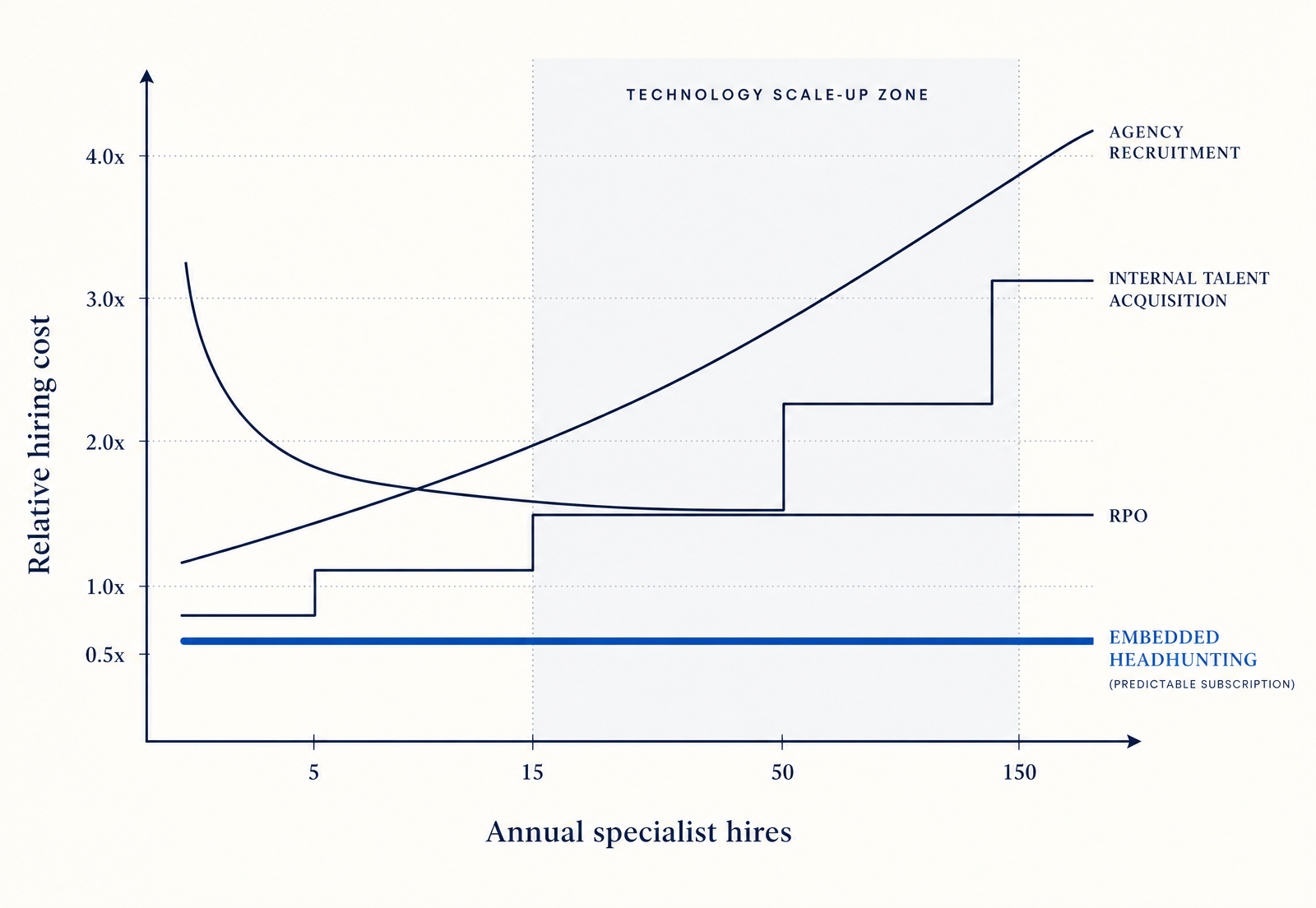
Where the same type of hire repeats every quarter, dedicated capability almost always beats repeated per-hire agency fees on total annual cost.
5. Retain selective external investment for true exceptions
Removing all external support to save money often creates a more expensive vacancy problem. Keep specialist support available for the roles that most justify it.
6. Track interview conversion, offer acceptance and retention alongside cost
A lower cost per hire combined with weaker conversion or retention is not a saving; it is a deferred cost. Pair every cost metric with a quality metric.
Saiyō framework
The Hiring Economics Curve
Relative cost per specialist hire across agency, internal TA, RPO and embedded headhunting as annual volume grows.
Where organisations usually go wrong
The most common failures are structural rather than a reflection of effort. Recognising the pattern early lets the operating model change before more activity is added.
- Reducing fees without changing the hiring process.
- Removing specialist support before internal capability exists.
- Using an average cost target that encourages avoidance of difficult roles.
- Ignoring hiring-manager and vacancy costs.
- Celebrating lower spend while time to hire and quality deteriorate.
Practical application for technology scale-ups
The fastest savings usually come from reducing fragmented agency use, improving shortlist calibration and increasing the proportion of roles delivered through planned annual capacity. Longer-term savings come from market intelligence that compounds, consistent scorecards and stronger direct candidate relationships. These changes reduce repeat work without asking the business to accept weaker candidates.
Where the idea has limits
Some hires will remain expensive because the market is narrow, the role is unusually important or the company lacks credibility with the target talent pool. A higher cost can be economically rational if it reduces delay or improves the probability of a transformational appointment. The objective is disciplined value, not a universally low number.
The Saiyō view
Saiyō believes scale should reduce recruitment cost without reducing search quality. Annual hiring credits, dedicated resource and market reuse create economies that are difficult to achieve through repeated individual agency assignments. The measure of success is lower cost per hire combined with a stronger shortlist, not lower cost in isolation.
Key takeaways
- Savings come from a better operating model, not from lower fees on unchanged searches.
- Segment cost by role family and remove duplicated work first.
- Move recurring specialist hiring into dedicated capability.
- Keep selective external investment for genuine exceptions.
- Every cost metric needs a quality metric alongside it.
Frequently asked questions
See this in practice
Move from the concept to the way Saiyō delivers it.
Related questions
How can we reduce cost per hire?
Reduce cost per hire by planning recurring demand, improving role calibration, reducing duplicated supplier activity and using a delivery model that creates economies of scale. The aim is to remove repeat work rather than simply negotiate lower fees. Track quality and speed at the same time so savings do not create a more expensive hiring problem elsewhere.
Read the answerAnswerDoes lowering recruitment fees reduce hiring cost?
Lowering recruitment fees reduces one visible component of hiring cost, but it does not necessarily reduce the total cost. If a cheaper approach takes longer, produces weaker candidates or requires more hiring-manager time, the business may spend more overall. The correct comparison includes vacancy delay, internal effort and replacement risk.
Read the answerAnswerWhen is internal TA cheaper than agencies?
Internal TA is often cheaper than agencies when hiring demand is continuous enough to keep the team productively deployed and the roles are within its capability. It can become more expensive during hiring slowdowns or where specialist searches still require significant external support. Full employer cost, technology and operations should be included in the comparison.
Read the answerAnswerHow does hiring volume affect cost per hire?
Higher hiring volume can reduce cost per hire when fixed capability, technology and market knowledge are spread across more successful appointments. It can also increase cost if the company relies on per-hire agency fees or adds fragmented capacity without improving conversion. Economies of scale depend on the operating model.
Read the answer