Candidate Quality
Authority GuideMeasuring Candidate Quality
Co-founder and CEO
Candidate quality is frequently discussed but rarely defined, which allows hiring managers and recruiters to apply different standards throughout the same search. Well-known employers, polished interviews and claimed quota attainment become convenient proxies for future success, and teams end up confusing confidence with evidence.
The short answer
Candidate quality should be measured through evidence of role-relevant capability, context, interview conversion, offer acceptance and eventual performance, not through CV prestige or candidate volume. The strongest process defines quality before the search begins and applies the same scorecard to every source, then tests quality again at shortlist, interview and post-hire stages.
The central idea
Quality is contextual rather than universal. A person can be exceptional in one environment and poorly matched to another because company stage, resources, sales motion, leadership style or customer complexity differ. The role scorecard must describe the outcomes, competencies and context required, then gather evidence against each one.
How to apply it
1. Define the outcomes the hire must deliver within twelve to eighteen months
Write the outcomes down before profiles are reviewed. This prevents employer logos and interview polish being used as substitutes for evidence the hire can produce results in your environment.
2. Identify the competencies and environmental context required to deliver them
Separate what the person must be able to do from the conditions they must be able to operate in. Both belong in the scorecard, so previous success in a very different context is neither ignored nor overrated.
3. Use structured candidate write-ups before interview
Every shortlisted candidate arrives with a written summary against the scorecard, so interviewers walk in with the same context and can test hypotheses rather than gather basics.
4. Assign evidence areas across the interview process
Map competencies and outcomes to specific interview stages so no dimension is left untested and none is assessed three times by accident. This is also what makes debriefs faster.
5. Calibrate interviewer ratings and resolve contradictions
When interviewers disagree, treat the disagreement as data. A structured debrief against the scorecard usually reveals whether the split is about evidence, standard or fit.
6. Review early performance and retention against the original assessment
Six and twelve-month reviews are the point at which the hiring team learns whether its original judgement was accurate. Saiyō's interview-to-placement ratio averages 5:1, which is useful evidence that submissions are calibrated before client time is invested.
Where organisations usually go wrong
- Using employer logos as a substitute for understanding performance.
- Relying on self-reported achievements without context.
- Changing the standard after meeting an appealing candidate.
- Treating cultural fit as unstructured personal preference.
- Failing to review whether shortlisted candidates were genuinely market-leading.
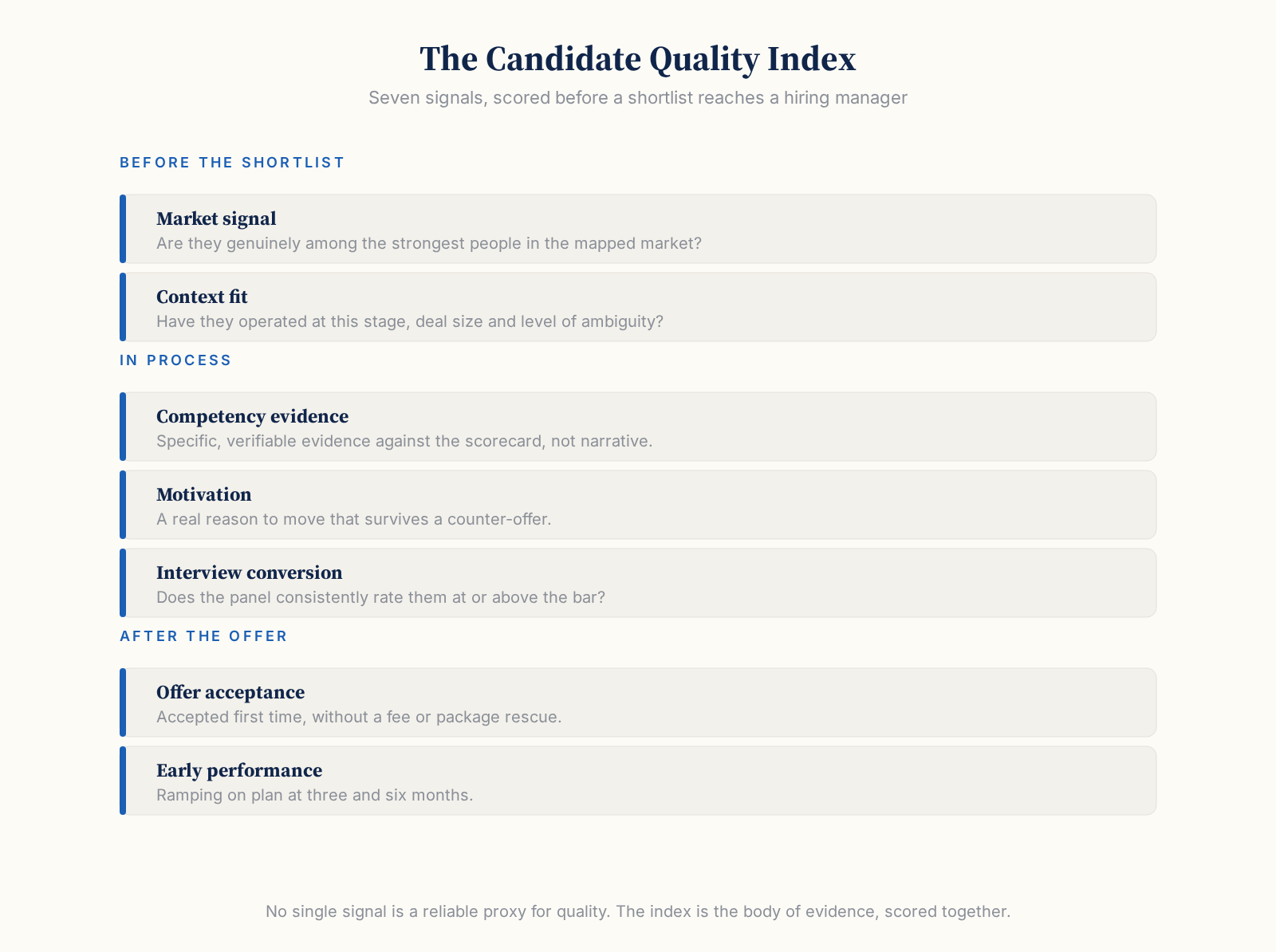
Saiyō framework
The Candidate Quality Index
A calibrated shortlist quality score across signal, evidence and fit.
Practical application for technology scale-ups
The interview-to-placement ratio should not be optimised in isolation, but an excessively high number can indicate weak assessment or unclear requirements. Quality reporting combines this conversion with offer acceptance, retention and hiring-manager evidence to describe a connected system rather than an isolated metric.
Where the idea has limits
No assessment process can predict future performance perfectly, and early outcomes can be influenced by onboarding, management and changing business conditions. Metrics should be used to improve judgement rather than claim certainty.
The Saiyō view
Saiyō believes quality begins before the candidate is contacted. A well-mapped market, contextual assessment and detailed candidate presentation create a higher standard than processing large numbers of applicants and hoping interviews reveal the answer. The purpose of professional headhunting is to improve the quality of hiring decisions, not simply produce more candidates.
Key takeaways
- Define quality before the search, not during the shortlist.
- Quality is contextual: same competencies, different environments.
- Structured write-ups make interviewers test hypotheses, not gather basics.
- Interview-to-placement ratio is diagnostic, not a headline KPI.
- Post-hire review closes the loop on hiring judgement.
Frequently asked questions
See this in practice
Move from the concept to the way Saiyō delivers it.
Related questions
How do you measure candidate quality?
Measure candidate quality by defining role outcomes and competencies in advance, then tracking how well shortlisted and hired candidates meet that evidence over time. Useful indicators include interview conversion, offer acceptance, early performance and retention. Candidate source, employer brand and CV polish should not be treated as quality measures on their own.
Read the answerAnswerIs interview-to-placement ratio a useful metric?
Interview-to-placement ratio is useful because it shows how accurately candidates are being assessed before client interview, but it should be interpreted with context. A very high ratio may indicate weak calibration or unnecessary interviewing, while a very low ratio could reflect an overly narrow shortlist. Use it alongside market coverage and post-hire quality.
Read the answerAnswerWhat makes a high-quality shortlist?
A high-quality shortlist contains a small number of candidates who each meet the essential evidence, represent credible alternatives and reflect the strongest realistic market. It should not be a collection of similar CVs selected from the easiest channel. The hiring manager should understand the strengths, risks and context of each person before interview.
Read the answerAnswerHow many candidates should be interviewed before a hire?
There is no fixed number, but most specialist processes should not require large interview volumes when the market and candidates have been assessed properly before submission. Interviewing five credible candidates for one placement can be a healthy benchmark in many contexts, although scarcity and seniority change the picture. The aim is enough evidence to compare strong options without using interviews as the main sourcing filter.
Read the answer