Candidate Quality
Authority GuideThe Accessibility Gap: Understanding Market Access in Hiring
Co-founder and CEO
Hiring teams can appear extremely busy while repeatedly reaching the same visible section of the market. Applications, recruiter databases and LinkedIn searches create useful pipelines, but they can also create false confidence because activity is easy to measure and inaccessible talent remains invisible. The Accessibility Gap provides language for that hidden limitation.
The short answer
The Accessibility Gap is the difference between the talent a hiring model can realistically reach and the stronger market that exists beyond those channels. It grows when companies rely on applications, familiar networks or high-volume written outreach for roles where the best people are settled and difficult to engage. Closing it requires better market coverage, more relevant approaches and direct conversations, not simply more recruitment activity.
Why this matters
Hiring teams can appear extremely busy while repeatedly reaching the same visible section of the market. Applications, recruiter databases and LinkedIn searches create useful pipelines, but they can also create false confidence because activity is easy to measure and inaccessible talent remains invisible. The Accessibility Gap provides language for that hidden limitation.
The central idea
Every recruitment channel has a natural reach, and no single channel provides complete access to a specialist market. A mature hiring strategy combines channels deliberately and measures whether the process reached the relevant market rather than how many people were processed. Professional headhunting is most valuable where the gap between visible and available talent is commercially significant.
How to apply it
1. Define the realistic addressable talent market for the role
Set a defensible view of how many relevant people plausibly exist for the role, in which companies and geographies. Without that anchor, every downstream metric measures activity rather than coverage.
2. Record which parts of that market each channel actually reaches
Segment the market by how it can be contacted: inbound, referrals, recruiter sourcing, direct headhunting. Most channels reach only a portion, and being explicit about that reveals where the gap sits.
3. Measure engagement by segment, not only in aggregate
Reporting outreach volume hides the picture. Reporting response and conversation rates by segment shows where the process is genuinely landing and where it is being ignored.
4. Identify where strong candidates remain invisible or unresponsive
A silent segment is not an empty one. It usually means the channel and message combination is wrong for that group, and that a different mode of engagement is required.
5. Change the market, message or channel before increasing volume
The instinct is to send more messages. The better move is to change who is being approached, how, or by whom, and then re-measure. Volume is a lever of last resort.
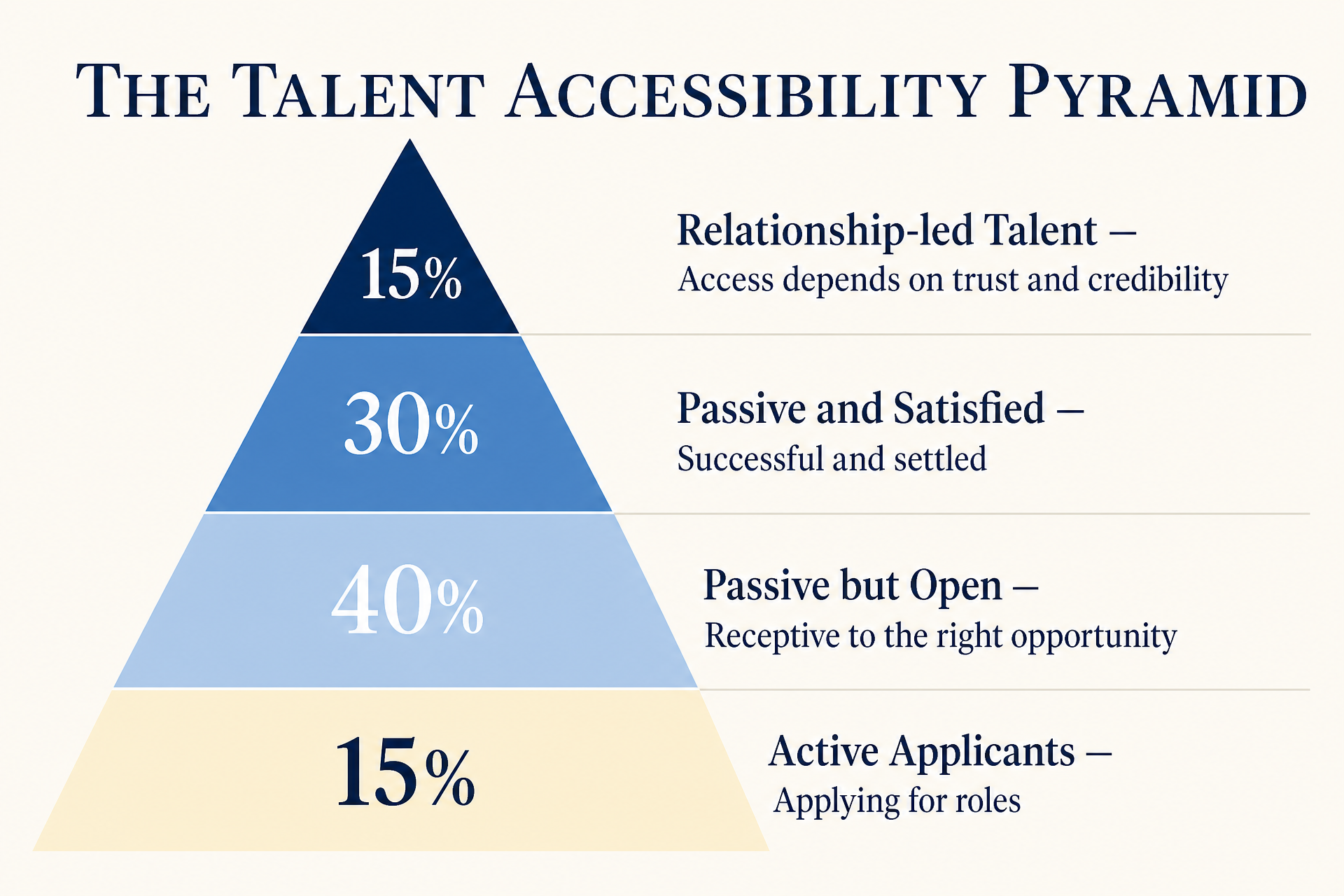
Saiyō framework
The Talent Accessibility Pyramid
The best candidates rarely apply. Access is layered.
Indicative distribution based on analysis of Gallup, LinkedIn and wider talent-market research. Actual accessibility varies by role, seniority, geography and market conditions.
Where organisations usually go wrong
The most common failures are structural rather than a reflection of effort. Recognising the pattern early lets the operating model change before more activity is added.
- Equating profile visibility with candidate accessibility.
- Assuming a low response rate can always be solved by sending more messages.
- Reporting total outreach without showing market coverage.
- Ignoring people who require a conversation because written outreach is easier to scale.
- Using one channel for every role and seniority level.
Practical application for technology scale-ups
Talent Leaders can make the Accessibility Gap visible by segmenting the market into active, reachable passive and highly inaccessible groups, then tracking how many relevant individuals entered a genuine conversation. This does not require perfect data, but it does require a defined research universe and a distinction between profiles found, people contacted and people meaningfully engaged. The resulting picture is far more useful than a single outreach count.
Where the idea has limits
The Accessibility Gap should not be used to justify intrusive or poorly researched contact. Access must still be earned through relevance, professionalism and respect for the individual. Some people will remain inaccessible because the opportunity is not compelling, the timing is wrong or they simply do not wish to engage.
The Saiyō view
Saiyō believes most difficult searches are not suffering from a lack of recruiter activity but from a lack of access to the right market. The useful question is not how many people were contacted, but how much of the credible market was understood and how many of the strongest people entered a real conversation. That is the difference between candidate reach and market coverage.
Key takeaways
- The Accessibility Gap is the distance between the talent a channel can reach and the wider market that exists beyond it.
- Every channel reaches only a slice of a specialist market; no single channel is complete.
- Segment the market and measure coverage, not aggregate outreach.
- Change who, how and by whom before adding volume.
- Professional headhunting is most valuable where the gap is commercially significant.
Frequently asked questions
See this in practice
Move from the concept to the way Saiyō delivers it.
Related questions
What is the Accessibility Gap in recruitment?
The Accessibility Gap is the difference between the candidates a recruitment process can reach and the wider group of relevant people who exist in the market. It is usually largest for specialist and leadership roles because many strong candidates are not applying and do not respond to conventional outreach. The gap can be closed through market mapping, multi-channel engagement and professional headhunting conversations.
Read the answerAnswerHow do you measure talent market coverage?
Talent market coverage is measured by defining the realistic addressable market and tracking how much of it was researched, prioritised and meaningfully engaged. Useful measures include target companies covered, relevant individuals identified, direct conversations held and reasons high-priority people declined. The goal is evidence that the search explored the credible market rather than a convenient subset.
Read the answerAnswerWhy does more outreach not always improve candidate quality?
More outreach improves candidate quality only when it expands the relevant market or improves engagement with strong people. Sending additional messages to the same visible profiles increases activity but may not create any new access. Quality improves when research changes who is approached, the message becomes more relevant or a direct conversation replaces low-context outreach.
Read the answerAnswerWhich recruitment channels reach the most passive talent?
No single channel consistently reaches all passive talent. Referrals and professional networks create trust, LinkedIn and email create visibility, and direct headhunting conversations are often required for people who rarely respond to written approaches. The strongest strategy combines channels around the behaviour of the target market.
Read the answer