Embedded Headhunting
Authority GuideWhat is embedded recruitment?
Co-founder and CEO
Download the guide
Free PDF, 8 pages. Share it with your team.
Listen to this guide
Embedded recruitment, also called embedded talent acquisition, places dedicated recruiters inside your hiring function so they operate as part of the team. Technology hiring has changed significantly over the last decade, but the hiring models many businesses rely on have changed very little, and Saiyō's version of embedded recruitment answers that by bringing the proactive search methodology of a specialist headhunting firm inside the operational framework of an embedded Talent Acquisition team.
The short answer
Embedded recruitment is a hiring model in which dedicated recruiters work inside a company's talent function on a flat subscription rather than filling vacancies from outside it for a fee per hire. It is also called embedded talent acquisition. Saiyō's version of it is embedded headhunting, meaning proactive outbound search rather than inbound processing: senior headhunters run end-to-end search on named roles, combining the reach of a specialist headhunt firm with the operational integration, candidate experience and reporting of an internal team.
Why Embedded Headhunting exists
Most hiring models were designed around one of two assumptions.
The first is that the right candidates will apply if the opportunity is attractive enough. This works well when hiring volumes are low, employer brands are strong or suitable talent is actively looking for a new role.
The second is that external recruiters can fill the gaps by introducing passive candidates when required. This can be highly effective for individual appointments but becomes increasingly expensive and difficult to manage as hiring volumes grow.
Technology scale-ups often find themselves somewhere between those two models.
Hiring is no longer occasional, so relying heavily on recruitment agencies becomes commercially challenging. At the same time, building a larger internal Talent Acquisition team does not automatically solve the problem because operational responsibilities inevitably increase alongside hiring volume. Stakeholder management, interview scheduling, employer branding, reporting and candidate experience all compete for the same finite resource.
The result is that proactive headhunting often becomes the activity that receives the least attention, despite having the greatest impact on candidate quality.
Embedded Headhunting was developed to address that imbalance. It allows businesses to retain the consistency and operational integration of an internal Talent Acquisition function while introducing dedicated headhunters whose primary responsibility is identifying, engaging and assessing the strongest talent available in the market.
A different way of thinking about hiring
Every recruitment process has to answer the same fundamental question.
Where do we begin?
For most hiring teams, the answer is straightforward. A role is approved, a job description is finalised and the search begins by reviewing applications, searching LinkedIn Recruiter or approaching candidates already identified through existing networks.
We believe there is a better starting point.
Before considering individual candidates, every specialist search should begin by understanding the market itself. Which organisations have solved similar problems? Where has comparable growth already taken place? Which teams have built the capabilities you are looking for? Which individuals have already demonstrated success in an environment similar to your own?
Only once those questions have been answered should candidate engagement begin.
We call this The Market First Method™.
It is a simple principle, but one that fundamentally changes the quality of every decision that follows. Starting with the market removes much of the bias that naturally develops when searches begin with familiar companies, existing databases or the first candidates who happen to become visible. Instead, the objective becomes identifying the strongest talent available, whether they were previously known to the hiring team or not.
It also changes the conversation with hiring managers. Rather than asking whether a shortlist contains enough candidates, the discussion becomes whether it accurately represents the market. That is a much higher standard because it shifts the focus away from filling vacancies and towards making informed hiring decisions.
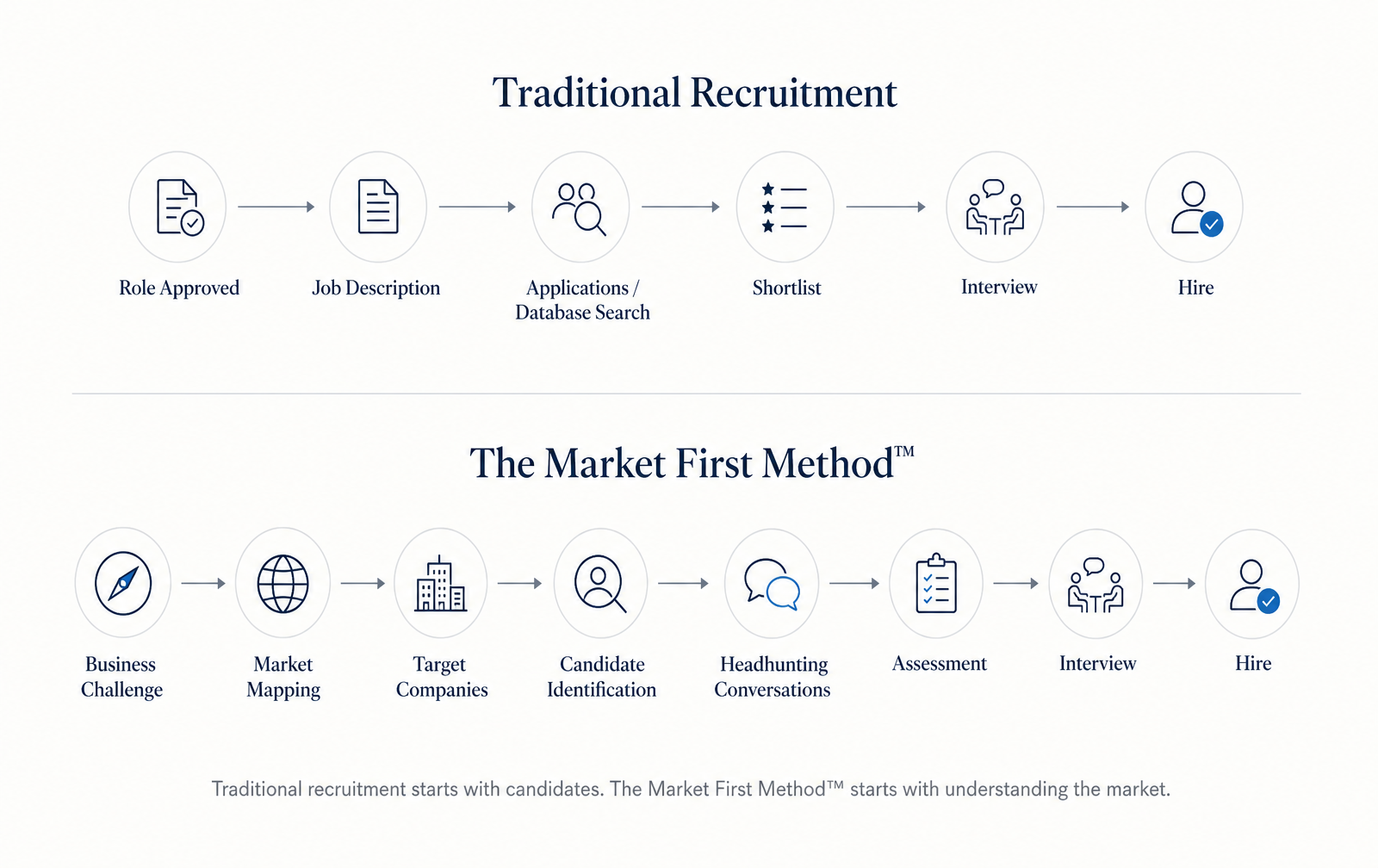
Saiyō framework
The Market First Method
Map the entire relevant talent market before writing a single job spec.
What is Embedded Headhunting?
Embedded Headhunting is a hiring model that combines the proactive search capability of a specialist headhunting firm with the operational integration of an embedded Talent Acquisition team.
Unlike a traditional recruitment agency, embedded headhunters do not operate as external suppliers working independently of your business. They become part of your hiring function, working within your ATS, following your interview process and representing your employer brand throughout every stage of the candidate journey.
Unlike many embedded recruitment or RPO providers, the primary focus is not recruitment administration.
It is proactive search.
The operational aspects of recruitment remain essential. Interview scheduling, stakeholder management, offer management, reporting, candidate communication and employer branding all contribute to an effective hiring process. Embedded headhunters undertake these activities because they are fundamental to delivering a consistent experience for candidates and hiring managers alike.
The difference is where the greatest amount of time and expertise is invested.
Every search begins by identifying the strongest talent available in the market before reviewing who has applied. Once that market has been mapped and the best passive candidates are engaged, inbound applications are assessed against exactly the same standard.
The objective is not simply to fill a vacancy.
It is to ensure the best person available is hired.
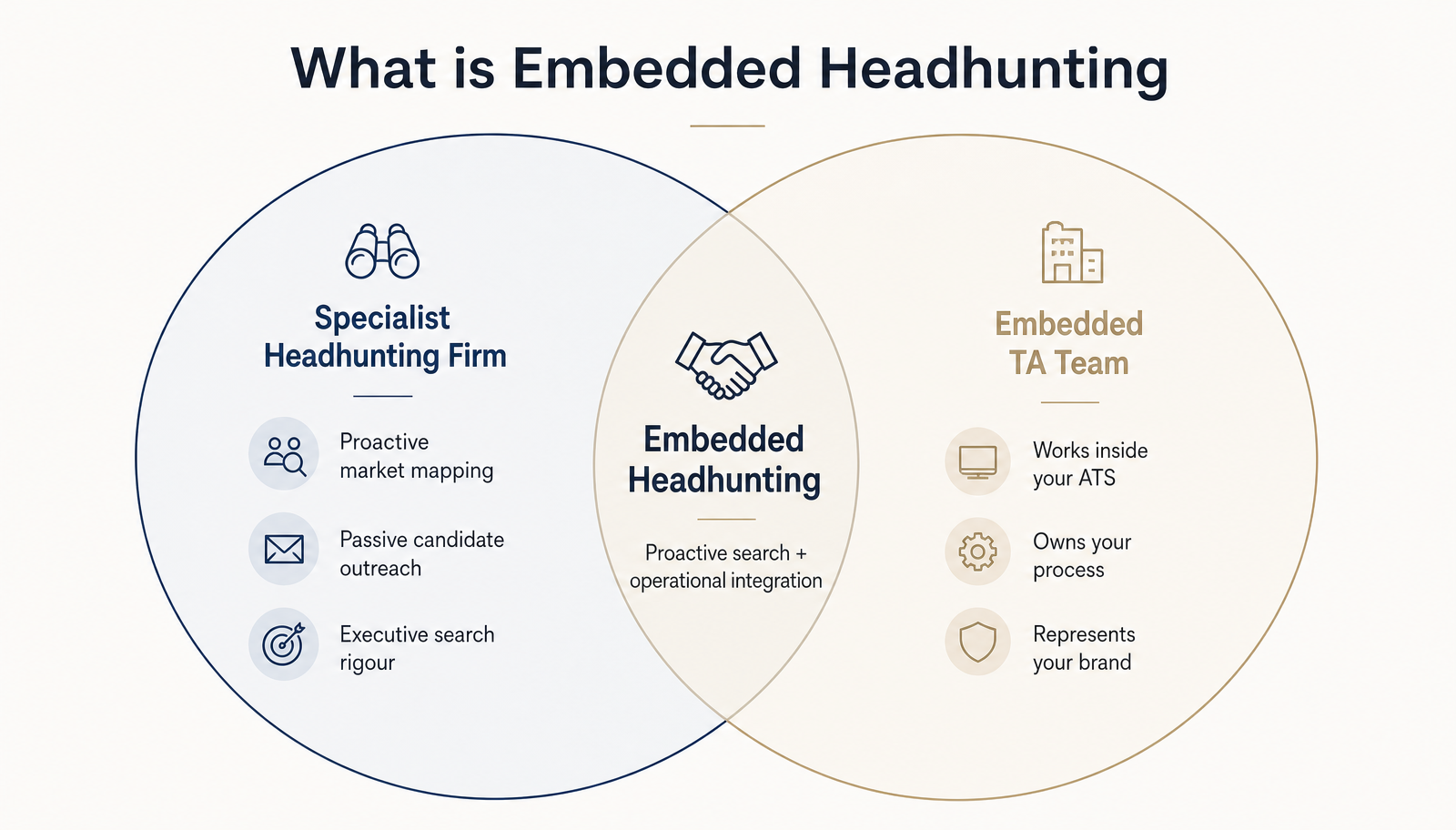
Saiyō framework
Embedded Headhunting Explained
The intersection of a specialist headhunting firm and an embedded Talent Acquisition team.
The Talent Accessibility Pyramid
One assumption sits behind almost every recruitment process.
If the role is attractive enough, the right people will apply.
Sometimes they do. More often, they don't.
The strongest candidates are usually succeeding in their current organisation. They are well rewarded, engaged in interesting work and rarely spending their evenings searching job boards or responding to recruiter outreach.
That doesn't mean they are impossible to hire. It simply means they need to be approached differently.
Rather than viewing candidates as either active or passive, we believe accessibility exists on a spectrum.
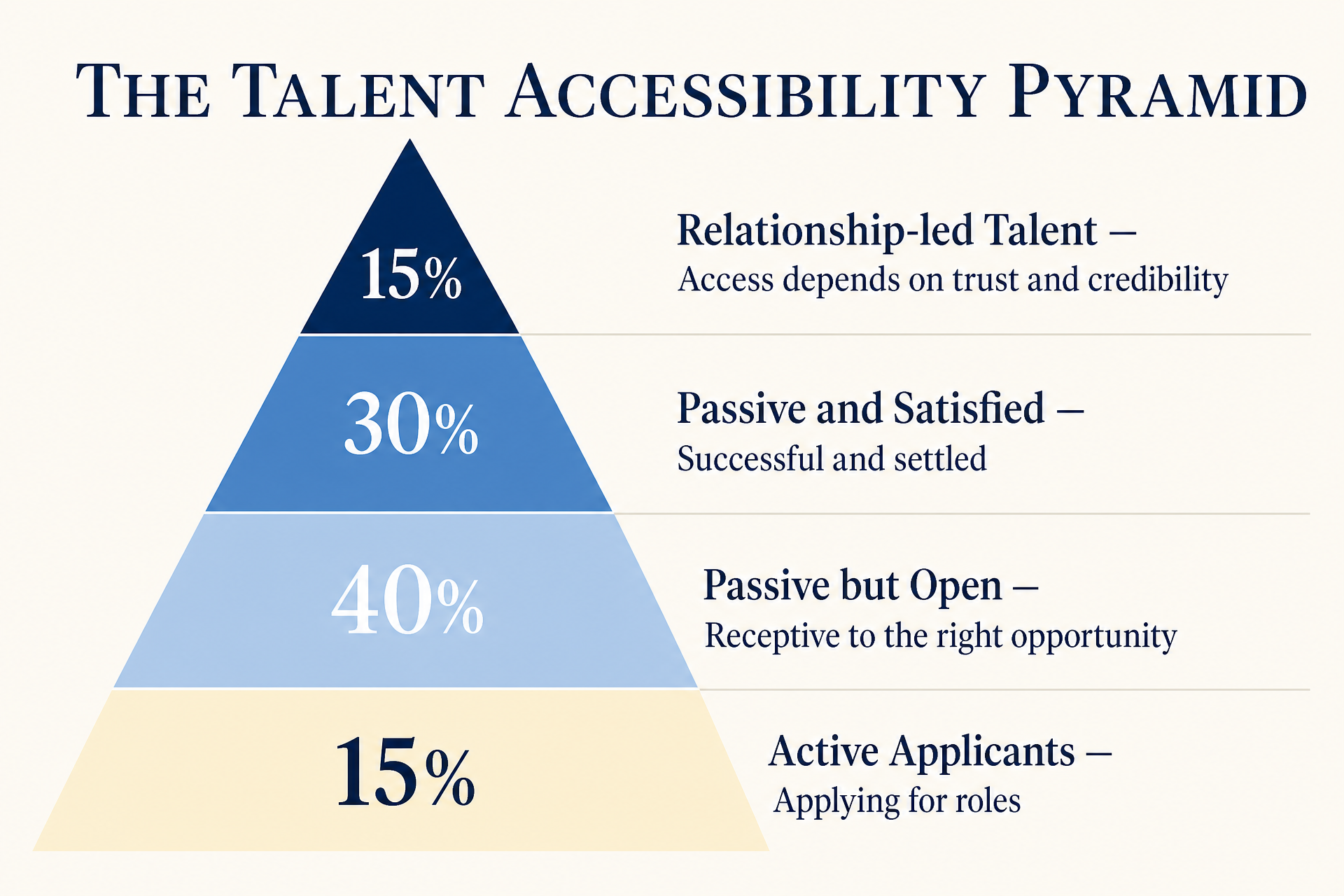
Saiyō framework
The Talent Accessibility Pyramid
The best candidates rarely apply. Access is layered.
Indicative distribution based on analysis of Gallup, LinkedIn and wider talent-market research. Actual accessibility varies by role, seniority, geography and market conditions.
Around 75%+ of the employed talent market is not actively applying. The hiring challenge is not finding more applicants. It is increasing the proportion of the market you can credibly access.
Passive does not mean accessible either. Research among hiring managers suggests only around a third of passive candidates respond to sourcing activity at all, so identifying someone on LinkedIn is not the same as having access to them.
For the senior, specialist technology roles we focus on, we would expect the proportion reachable through inbound alone to be lower again. That is an inference from our own searches rather than a published figure, but it is the practical reality behind most difficult hires.
The Accessibility Gap
Every hiring channel provides access to a different part of the talent market.
Job boards naturally attract people who are actively looking for a new opportunity. Employee referrals introduce people already connected to your organisation. LinkedIn Recruiter and outbound email campaigns extend that reach into parts of the passive market. Each of these channels has value, but they do not all provide access to the same people.
The strongest candidates often sit beyond the reach of traditional recruitment activity. They are successful in their current role, well rewarded and focused on the business they already work for. They are rarely browsing job boards and many have little reason to engage with unsolicited recruiter messages.
This is what we describe as The Accessibility Gap™.
It is the gap between the talent your current hiring model can realistically access and the talent that exists within the wider market.
Most organisations respond to difficult hiring by increasing recruitment activity. More vacancies are advertised, more LinkedIn messages are sent, additional agencies are engaged and larger volumes of candidates are processed.
The problem is that increased activity does not automatically increase access to better talent.
The more useful question is not how to generate more recruitment activity. It is how to consistently reach the people your current hiring model cannot.
Saiyō framework
The Talent Accessibility Pyramid
The best candidates rarely apply. Access is layered.
Indicative distribution based on analysis of Gallup, LinkedIn and wider talent-market research. Actual accessibility varies by role, seniority, geography and market conditions.
How Embedded Headhunting works
Embedded Headhunting follows a consistent sequence regardless of role or geography.
Every search begins with comprehensive market mapping. Competitors are identified, target organisations are agreed and the market is analysed before any outreach begins. This typically involves mapping well over one hundred potential candidates to ensure the market has been properly understood.
Candidate identification comes next. Experience alone is rarely enough. Context matters equally. The strongest candidates have usually solved similar problems in comparable environments and demonstrated the behaviours required to succeed at the next stage of growth.
Only then does proactive headhunting begin.
LinkedIn and email remain useful channels, but meaningful conversations remain the most effective way of engaging exceptional talent. Professional headhunting is about building trust, understanding motivation and presenting opportunities that genuinely change careers.
Once candidates enter the recruitment process, the embedded headhunter becomes responsible for delivering the same operational excellence expected from an internal Talent Acquisition team. Interview scheduling, stakeholder management, candidate communication, offer management and employer branding all remain part of the service.
Operational delivery supports the headhunting. It does not replace it.
Why technology scale-ups are moving towards Embedded Headhunting
Hiring has become significantly more complex over the last decade, yet many of the operating models available to Talent Acquisition teams have remained largely unchanged.
Technology companies now expand internationally much earlier in their lifecycle. Specialist roles have become increasingly difficult to fill, competition for experienced talent is global and hiring plans change far more frequently than they did even five years ago.
When priorities collide, proactive headhunting is often the activity that suffers. Operational delivery always takes precedence because interviews need scheduling, candidates need feedback and hiring managers need support.
Increasing internal headcount improves operational capacity but does not necessarily improve access to better candidates. Increasing agency spend may improve access to passive talent but becomes increasingly expensive. RPO solves operational challenges but was primarily designed around enterprise hiring environments.
Embedded Headhunting developed because technology scale-ups needed a model that combined these strengths rather than forcing a compromise between them.
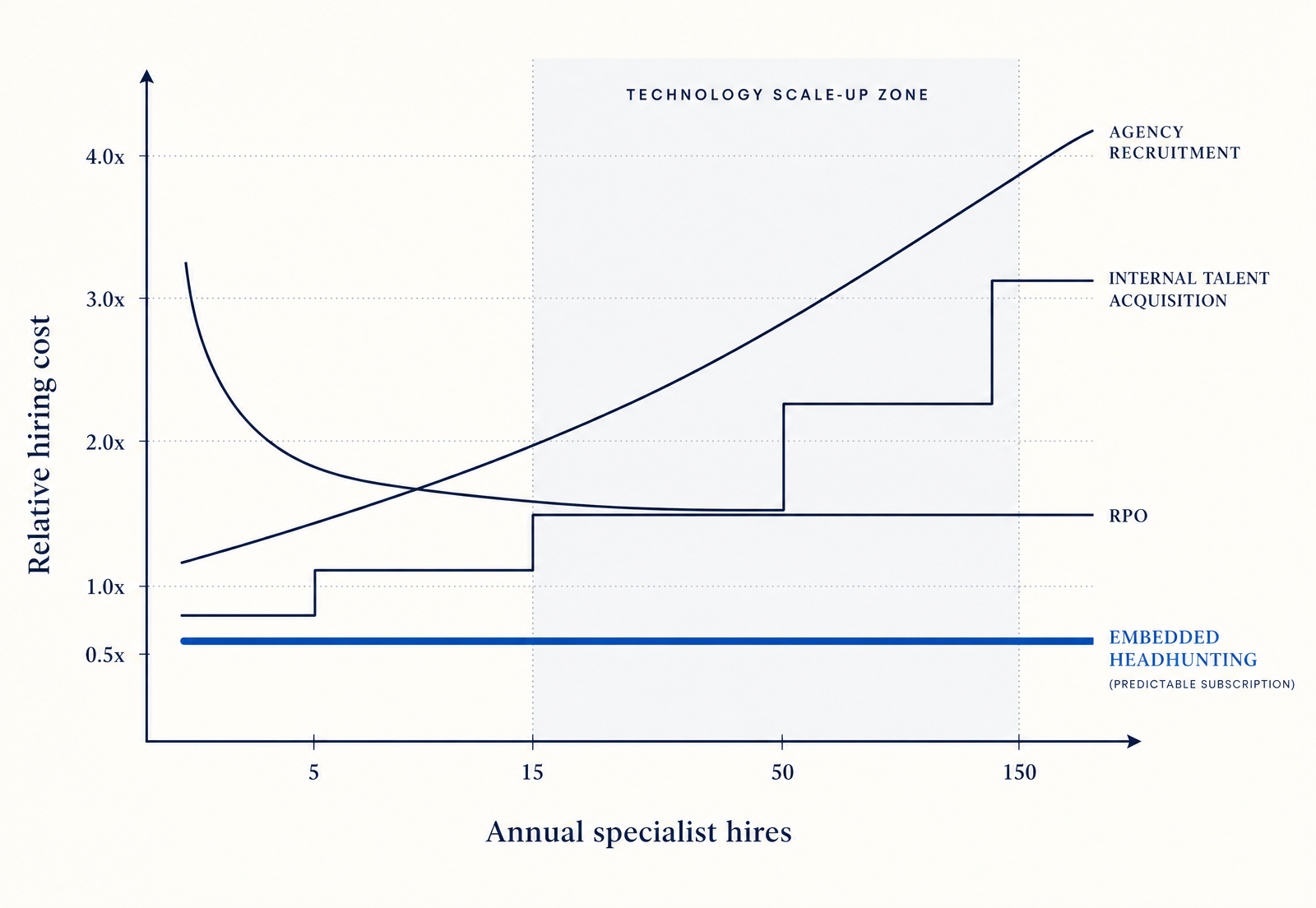
Saiyō framework
The Hiring Economics Curve
Relative cost per specialist hire across agency, internal TA, RPO and embedded headhunting as annual volume grows.
The future of hiring
Artificial intelligence is transforming recruitment, and rightly so. It is making sourcing, administration, research and reporting significantly more efficient.
What it is not doing is replacing judgement.
Exceptional hiring decisions still depend on understanding context, ambition, motivation and the subtleties that emerge through conversation rather than data alone. Technology should remove repetitive work so that experienced hiring professionals can spend more time understanding markets, advising hiring managers and influencing career decisions.
We believe the future belongs to organisations that combine intelligent technology with experienced human judgement. Embedded Headhunting reflects that philosophy by using technology to enhance productivity while keeping conversations, relationships and market expertise at the centre of every search.
Final thoughts
Embedded Headhunting is often described as another recruitment model. We see it differently.
It reflects a broader shift in how technology companies think about hiring. As businesses scale, recruitment stops being a series of individual vacancies and becomes an operational capability that directly influences growth. At that point, the objective is no longer to process more candidates or generate more recruitment activity. It is to build consistent access to the strongest people in the market while maintaining the quality, pace and candidate experience expected from an internal Talent Acquisition function.
That is why we believe every specialist search should begin with understanding the market rather than reviewing candidates. Once you have confidence that the market has been properly mapped, every subsequent decision becomes better informed. Candidate identification becomes more objective, outreach becomes more targeted and hiring managers gain greater confidence that the strongest available people are genuinely being considered.
Whether an organisation ultimately chooses Embedded Headhunting, executive search, internal Talent Acquisition or another approach is less important than selecting a model that reflects the realities of its hiring environment. Every model has a role to play. The challenge is recognising when the organisation has reached the point where a different approach will produce better results.
Key takeaways
- Every specialist search should begin by mapping the market, not by reviewing the candidates already visible.
- Talent accessibility is a spectrum. The strongest candidates sit above what job boards, referrals and standard outreach can reach.
- Embedded headhunting differs from agencies, RPO and internal TA, it combines proactive search with operational integration inside your team.
- Subscription economics make the model predictable and typically cheaper per hire across the 5–150 specialist hires/year range.
- AI is transforming recruitment operations, but judgement, market expertise and real conversations remain the differentiators on senior hires.
Frequently asked questions
See this in practice
Move from the concept to the way Saiyō delivers it.
Related reading
How much does embedded recruitment cost?
What embedded recruitment costs as a category, how the pricing compares with contingency agencies, RPO and internal talent acquisition, and when a subscription is the wrong answer.
ReadEmbedded recruitment vs RPO: what is the difference?
Traditional RPO excels at standardised operations at enterprise scale. Most technology scale-ups have a different problem: specialist market access.
ReadEmbedded recruitment vs recruitment agency: which is better?
Recruitment agencies remain effective for occasional specialist hiring but weaken as the primary model when hiring becomes continuous and structural.
ReadHow do you reach passive candidates who are not applying?
The strongest candidates rarely enter the recruitment market because their current role already works. Reaching them takes market understanding, credibility and real conversations.
ReadWhat is the difference between sourcing and headhunting?
Professional headhunting is not defined by the tools used or the messages sent. It is the discipline of reaching exceptional people who would never otherwise enter a recruitment process.
ReadRelated questions
How does embedded recruitment work?
Embedded Headhunting combines proactive headhunting with the operational integration of an internal Talent Acquisition team. Rather than working as an external agency, embedded headhunters become part of your hiring function, leading specialist search while working within your ATS, following your hiring process and representing your employer brand throughout the candidate journey.
Read the answerAnswerWhen should a scale-up use an embedded recruitment partner?
Embedded Headhunting is most valuable when specialist hiring becomes a continuous business capability rather than a series of individual recruitment projects. For many technology companies, this happens during the scale-up phase, when hiring volumes increase, internal Talent Acquisition teams become more operational and agency dependency becomes expensive and inconsistent.
Read the answerAnswerHow is embedded recruitment different from a recruitment agency?
Embedded Headhunting is a subscription model in which specialist headhunters work inside your hiring function, whereas agencies typically work on a contingent, per-placement basis. The embedded model provides dedicated capacity, deeper integration and proactive market search rather than competing for the same active candidates.
Read the answerAnswerIs embedded recruitment the same as RPO?
No. Although both Embedded Headhunting and Recruitment Process Outsourcing (RPO) provide dedicated recruitment support, they were developed to solve different hiring challenges. RPO is designed for operational scale, typically in large organisations hiring at significant volume across multiple functions. Embedded Headhunting focuses on helping technology scale-ups consistently identify and hire specialist talent by combining proactive headhunting with the operational integration of an internal Talent Acquisition team.
Read the answerAnswerCan embedded recruitment replace an internal TA team?
In most cases, no. Embedded Headhunting is designed to strengthen an internal Talent Acquisition function, not replace it. It adds dedicated specialist search capability while the internal team retains ownership of employer brand, recruitment operations and candidate experience.
Read the answerAnswerHow much does embedded recruitment cost?
Embedded Headhunting is usually priced as an annual subscription rather than a fee for each successful hire. The total investment depends on expected hiring volume, the level of dedicated resource required and the complexity of the roles being recruited. For technology companies hiring specialist talent continuously, subscription pricing often provides greater commercial predictability and a lower overall cost per hire than paying agency fees for every appointment.
Read the answer