Technology Scale-up Hiring
Authority GuideBuilding an Internal Talent Acquisition Function
Co-founder and CEO
Companies often hire their first recruiter when agency spend becomes painful, then expect one person to source, coordinate, report, advise, manage technology and improve employer brand at the same time. The function becomes overloaded before its operating model has been defined. As a result, internal TA can become a reactive service desk despite being one of the most strategically important teams in a scale-up.
The short answer
A technology scale-up should build internal Talent Acquisition once hiring is recurring enough to justify permanent ownership of strategy, employer brand, process and stakeholder relationships. The function should not be measured only by how many vacancies it fills. Its role is to create a hiring operating system, decide which capability belongs internally and bring in specialist support where market access or temporary capacity is needed.
Why this matters
Companies often hire their first recruiter when agency spend becomes painful, then expect one person to source, coordinate, report, advise, manage technology and improve employer brand at the same time. The function becomes overloaded before its operating model has been defined. As a result, internal TA can become a reactive service desk despite being one of the most strategically important teams in a scale-up.
The central idea
Internal TA should own the system rather than personally perform every recruitment activity. Ownership includes workforce planning, hiring standards, employer brand, process design, data and provider strategy. Specialist headhunting, research or operational support can be flexed around that core without weakening internal accountability.
How to apply it
1. Forecast annual hiring by function, location, seniority and difficulty
A capacity plan built on a forecast is stronger than one built on last month's vacancies. Segment demand so it is clear which parts of the plan an internal team can genuinely absorb.
2. Define the outcomes TA owns and the activities that support them
Separate what TA is accountable for from what it personally executes. Ownership of hiring quality does not require ownership of every keystroke in the process.
3. Build the core team around stakeholder partnership, process and hiring quality
The strongest first hires focus on the operating model, calibration and hiring-manager relationships. Sourcing and operations can be layered in or partnered around that spine.
4. Decide which sourcing, headhunting and operations capability should be internal, embedded or external
Do not default every activity to permanent headcount. Some capabilities are cheaper and better delivered as an embedded or specialist partnership around a lean internal owner.
5. Create consistent scorecards, reporting and candidate-experience standards
A shared standard is what makes the mix coherent. Without it, internal, embedded and external delivery produce different candidate experiences and incompatible data.
6. Review capacity quarterly as hiring demand changes
Hiring plans move fast in scale-ups. Quarterly review avoids both permanent overhead during a slowdown and firefighting during a peak.
Saiyō framework
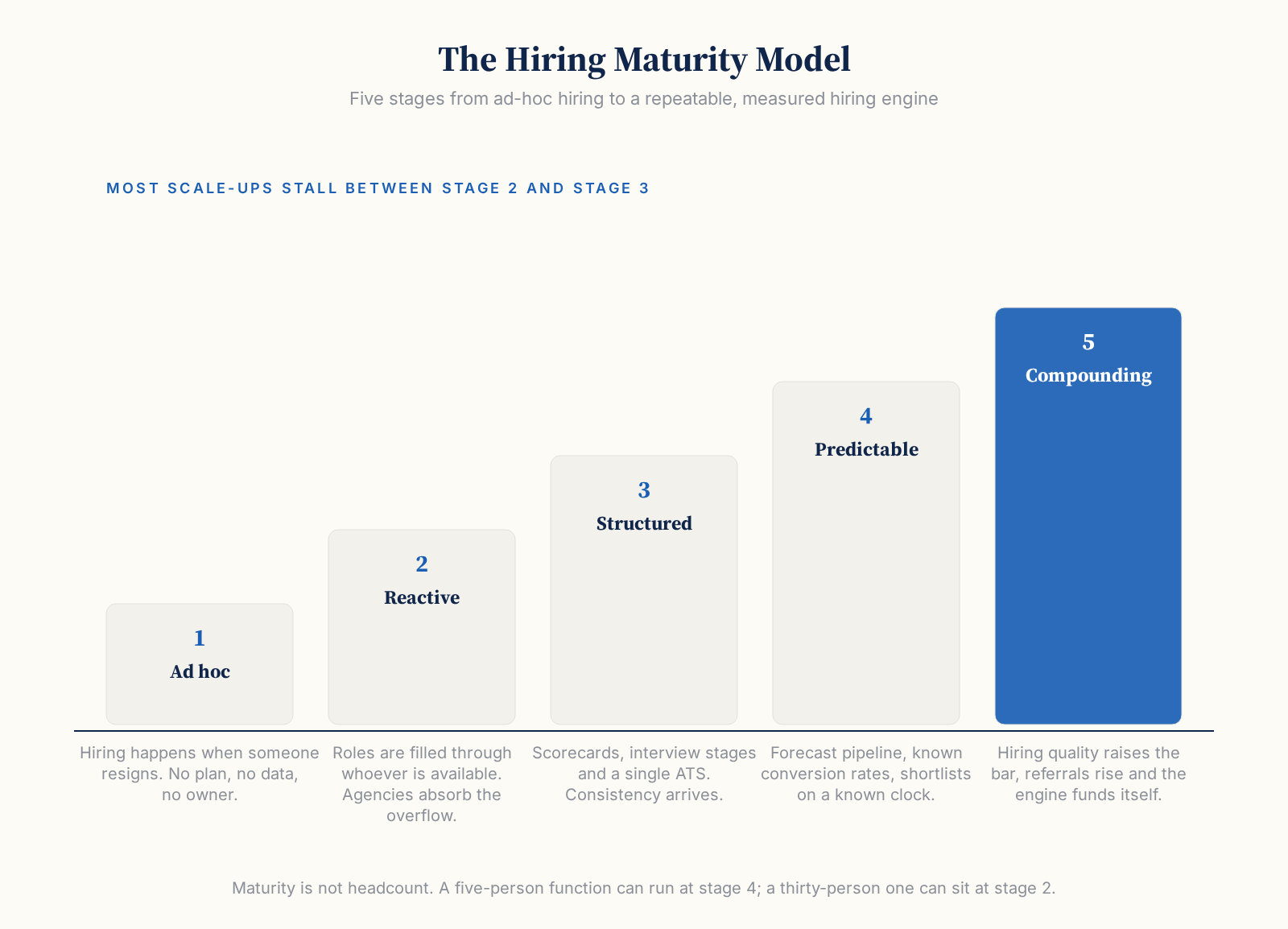
The Hiring Maturity Model
Five stages from ad-hoc hiring to a repeatable, measured hiring engine.
Where organisations usually go wrong
The most common failures are structural rather than a reflection of effort. Recognising the pattern early lets the operating model change before more activity is added.
- Hiring one recruiter to solve every part of the function.
- Building the team around current vacancies rather than the annual plan.
- Measuring internal TA only by agency savings.
- Allowing operational work to remove proactive market activity.
- Adding permanent headcount for short-term hiring peaks.
Practical application for technology scale-ups
A 250 to 1,000 employee technology company will often need a small central TA function with strong business partnership, clear operational support and access to specialist search capability. The exact headcount depends on role complexity, geography, process maturity and the proportion of hiring that requires proactive engagement. Recruiter-to-hire ratios should therefore be treated as planning assumptions rather than universal rules.
Where the idea has limits
An internal function is not automatically more effective than external support and can become expensive during a hiring slowdown. Early-stage businesses with inconsistent demand may be better served by a lean internal owner and flexible external capacity. The structure should evolve with the company rather than becoming a fixed symbol of maturity.
The Saiyō view
Saiyō believes internal Talent Acquisition should remain the owner of hiring strategy and experience. The strongest teams are not necessarily the largest; they are the teams that apply specialist capability deliberately and avoid forcing generalists to do everything. Embedded Headhunting should make a good internal team stronger, not replace it.
Key takeaways
- Build internal TA once hiring is recurring enough to justify permanent ownership.
- TA should own the system, not personally execute every activity.
- Design around the annual plan, not last month's vacancies.
- Combine internal capability with embedded specialist search where the market is difficult.
- Review capacity quarterly; treat recruiter-to-hire ratios as planning assumptions.
Frequently asked questions
See this in practice
Move from the concept to the way Saiyō delivers it.
Related questions
When should I hire my first internal recruiter?
Hire the first internal recruiter when hiring is recurring, leadership time is being consumed by coordination and the company needs consistent ownership of process, employer brand and agency relationships. The decision should be based on the next twelve months of demand rather than a temporary spike. If hiring remains highly variable, a lean internal owner supported by flexible external capability may be safer.
Read the answerAnswerHow many recruiters does a 300-person SaaS company need?
A 300-person SaaS company may need anywhere from one strong Talent Acquisition lead to a small team, depending on annual hiring volume, geography, role difficulty and operational support. A company hiring 25 straightforward roles has a different requirement from one hiring 60 enterprise sales, product and leadership positions internationally. Plan capacity from the hiring portfolio rather than employee count alone.
Read the answerAnswerWhat should internal Talent Acquisition own?
Internal Talent Acquisition should own hiring strategy, workforce-plan translation, employer brand, process standards, candidate experience, data, technology and provider governance. It does not need to execute every research, scheduling or headhunting task itself. Clear ownership allows external and embedded partners to strengthen the function without fragmenting accountability.
Read the answerAnswerShould a Head of Talent recruit or lead the function?
A Head of Talent may continue to recruit selected senior or sensitive roles, but their primary responsibility should be leading the hiring system. That includes capacity planning, stakeholder alignment, team development, data, process and provider strategy. If most of their time is spent filling individual vacancies, the function is likely under-resourced or insufficiently structured.
Read the answer