Hiring Models
Authority GuideRPO for Technology Scale-ups: Strengths, Limits and Alternatives
RPO is often treated as the natural next step once agency spend becomes too high, even though the model was largely developed for complex enterprise recruitment environments. Scale-ups can inherit implementation overhead, governance and process structures that are disproportionate to their size while still struggling to reach highly passive talent. The decision should start with the hiring problem rather than the desire to replace agencies.
The short answer
Traditional RPO can be effective when a company needs standardised recruitment operations at significant scale, but many technology scale-ups have a different problem. Their hiring volume is meaningful but concentrated in specialist roles where proactive market access matters as much as process efficiency. For those organisations, a lighter embedded or headhunt-first model may provide a better balance of integration, flexibility and candidate quality.
Why this matters
RPO is often treated as the natural next step once agency spend becomes too high, even though the model was largely developed for complex enterprise recruitment environments. Scale-ups can inherit implementation overhead, governance and process structures that are disproportionate to their size while still struggling to reach highly passive talent. The decision should start with the hiring problem rather than the desire to replace agencies.
The central idea
RPO creates value through operational consistency, scalable resource and governance. Embedded Headhunting creates value through specialist market access combined with operational integration. The overlap is real, but the centre of gravity is different, which is why scale-ups should examine role mix and hiring complexity before selecting either model.
How to apply it
1. Assess whether the primary challenge is operational scale, specialist access or both
Answer the diagnostic question before shortlisting providers. Solutions built for one problem rarely solve the other well.
2. Segment hiring by high-volume repeatable roles and scarce specialist roles
Volume roles favour standardised operations. Specialist roles favour search-led capability. A single model rarely covers both well without compromise.
3. Evaluate implementation requirements, management overhead and contract flexibility
Enterprise RPO can bring implementation and governance structures that are heavy for a scale-up. Include those costs in the comparison, not just recruiter day rates.
4. Compare the provider's sourcing methodology rather than relying on the embedded label
'Embedded' has become an umbrella term. Ask specifically how the provider builds a market, engages passive talent and maintains search quality across roles.
5. Set outcome measures that reflect candidate quality as well as process efficiency
Service levels alone can be met while quality slips. Include shortlist strength, offer acceptance and first-year performance in the measurement set.
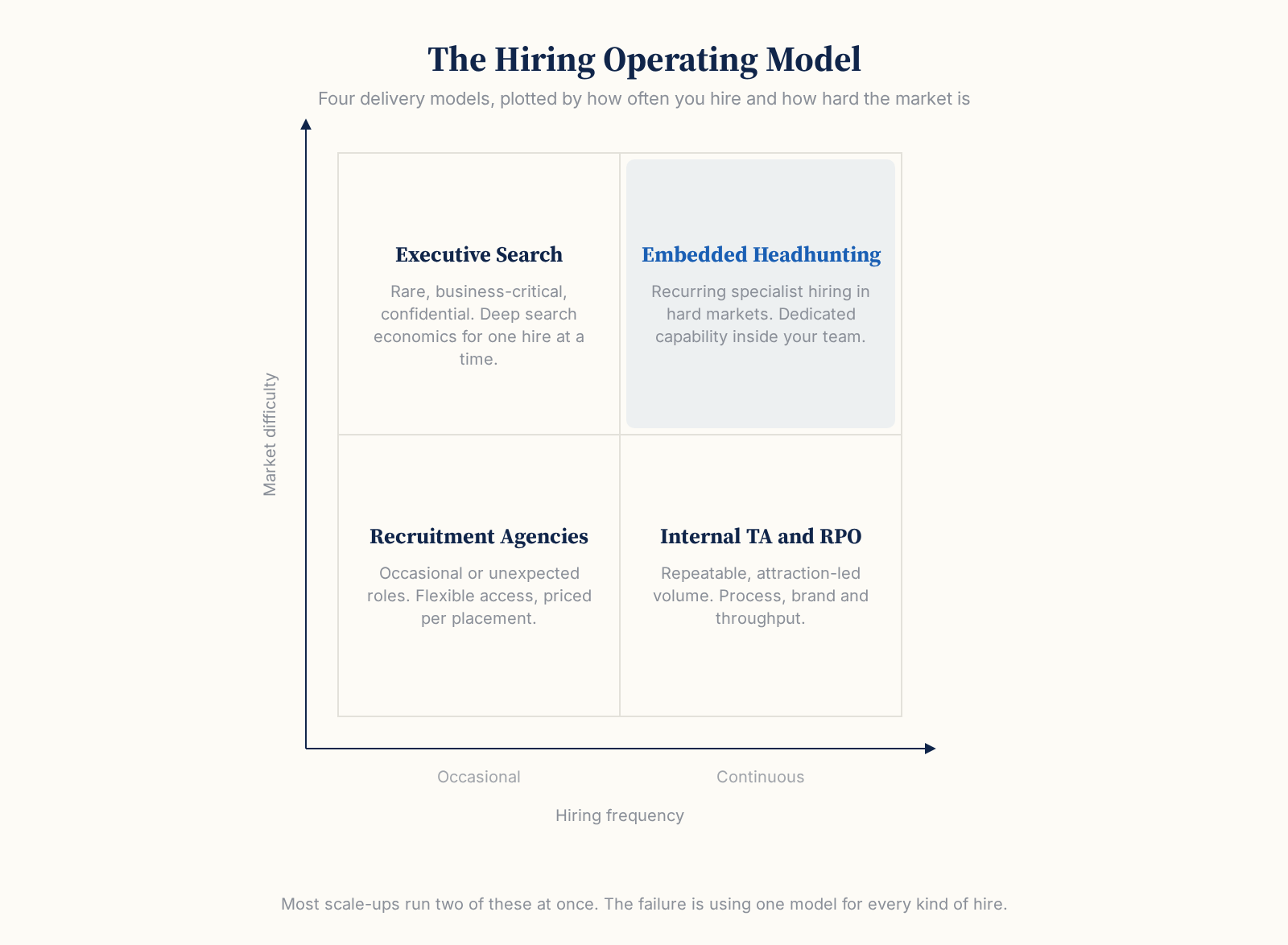
Saiyō framework
The Hiring Operating Model
Four mutually-exclusive delivery models: internal TA, agency, RPO and embedded headhunting.
Where organisations usually go wrong
The most common failures are structural rather than a reflection of effort. Recognising the pattern early lets the operating model change before more activity is added.
- Assuming all embedded recruitment providers offer professional headhunting.
- Selecting an enterprise RPO model for a relatively small specialist hiring plan.
- Focusing on recruiter headcount rather than methodology and capability.
- Using operational service levels as the only evidence of hiring success.
- Entering a rigid contract without testing how resource flexes with changing demand.
Practical application for technology scale-ups
A scale-up considering RPO should ask how the provider will build a market, engage people who do not respond to written outreach and maintain senior search quality across multiple roles. It should also understand who manages implementation, what happens when hiring slows and whether the team can operate inside existing systems without adding unnecessary layers. These questions reveal whether the proposed solution is an operating partner or simply additional recruitment capacity.
Where the idea has limits
Large or rapidly maturing scale-ups may genuinely benefit from RPO, particularly where global governance, large-volume hiring and process standardisation are becoming central concerns. A headhunt-first embedded model is not designed to process thousands of highly repeatable roles. The correct choice depends on the balance between operational scale and talent scarcity.
The Saiyō view
Saiyō sees RPO as an important enterprise model rather than an enemy. The limitation is fit: a Fortune 500 operating system is not automatically the right answer for a Series B to pre-IPO technology company hiring senior and specialist talent. Scale-ups need an anti-RPO alternative when search quality, flexibility and direct market access matter more than building a large outsourced recruitment operation.
Key takeaways
- RPO is built for operational scale; embedded headhunting is built for specialist access.
- Diagnose the hiring problem before shortlisting providers.
- Enterprise RPO governance can be disproportionate for a scale-up.
- Interrogate methodology, not the 'embedded' label.
- Measure candidate quality and retention alongside process metrics.
Frequently asked questions
See this in practice
Move from the concept to the way Saiyō delivers it.
Related questions
Is RPO suitable for a Series B company?
RPO can suit a Series B company when hiring volume is substantial, roles are repeatable and the business needs operational standardisation across several teams or regions. It is less likely to fit when the main challenge is a smaller number of senior and specialist roles requiring professional headhunting. Many Series B businesses need embedded capability without the full infrastructure of enterprise RPO.
Read the answerAnswerWhat does RPO cost compared with embedded recruitment?
RPO pricing varies with scope, implementation, technology, recruiter headcount and management requirements, while embedded recruitment is often priced around dedicated capacity or annual hiring commitments. RPO may become efficient at very large volume, but implementation and governance can be significant. A scale-up should compare total annual cost, flexibility and role quality rather than monthly resource rates alone.
Read the answerAnswerWhy do scale-ups struggle with traditional RPO?
Scale-ups can struggle with traditional RPO because the model may introduce enterprise processes, fixed structures and generalist recruitment capacity into an environment where priorities change quickly and specialist search is critical. The service can be operationally strong while still failing to reach the people the business most wants to hire. Fit depends on whether the provider's methodology matches the role mix.
Read the answerAnswerWhen is RPO the right choice?
RPO is the right choice when recruitment operations need to be standardised and scaled across significant, repeatable hiring demand. It is particularly useful where governance, reporting, process consistency and variable recruiter capacity are central requirements. The model is strongest when operational scale is the primary problem rather than specialist market access.
Read the answer