Hiring Models
Can embedded recruitment replace an internal TA team?
Co-founder and CEO
The short answer
In most cases, no. Embedded Headhunting is designed to strengthen an internal Talent Acquisition function, not replace it. It adds dedicated specialist search capability while the internal team retains ownership of employer brand, recruitment operations and candidate experience.
In most cases, no. Embedded recruitment is designed to strengthen an internal Talent Acquisition team rather than replace it, adding dedicated specialist search capability while the internal team keeps ownership of employer brand, recruitment operations and candidate experience. Embedded recruitment is also called embedded talent acquisition, and Saiyō's version of it is embedded headhunting, meaning proactive outbound search rather than inbound processing. Most technology scale-ups already have talented internal recruiters who understand the business and manage the process exceptionally well, so the objective is to let them focus where they create the greatest value while the strongest people in the market are consistently identified and engaged.
One of the biggest misconceptions surrounding Embedded Headhunting is that it represents another outsourcing model. In reality, the opposite is often true. The objective is to become part of the existing Talent Acquisition function rather than replace it.
Internal Talent Acquisition remains one of the most valuable investments a technology company can make
As organisations grow, internal Talent Acquisition becomes increasingly important.
Internal recruiters develop a detailed understanding of the business, build trusted relationships with hiring managers and ensure candidates experience a consistent recruitment process. They understand company culture, communicate the employer brand authentically and retain knowledge that improves hiring over time.
These strengths are difficult for any external recruitment provider to replicate.
For organisations hiring continuously, building an internal Talent Acquisition capability is often one of the most valuable long-term investments they can make.
The challenge is that the responsibilities of Talent Acquisition have expanded significantly over the last decade
Recruitment teams are no longer responsible only for finding candidates. They manage employer branding, recruitment technology, interview coordination, stakeholder engagement, recruitment reporting, candidate experience, offer management and workforce planning. These responsibilities are fundamental to an effective hiring function, but they inevitably reduce the time available for proactive specialist search.
This is not a question of capability.
It is a question of focus.
Why proactive headhunting often becomes the first casualty of growth
One of the recurring patterns we have observed within technology scale-ups is that the more successful the internal Talent Acquisition team becomes, the less time it has available for proactive market engagement.
As hiring volumes increase, operational priorities naturally take precedence.
- Hiring managers require support.
- Candidates need feedback.
- Interviews need coordinating.
- Offers need managing.
- Leadership teams require recruitment reporting.
- Employer branding initiatives continue to evolve.
Each of these activities adds value.
Collectively, however, they leave less time for mapping talent markets, conducting proactive headhunting and building relationships with highly inaccessible candidates.
This helps explain why many organisations continue to rely heavily on recruitment agencies despite investing in internal Talent Acquisition.
The issue is rarely that the internal team lacks the ability to identify exceptional people.
More often, they lack the capacity to do so consistently while simultaneously managing everything else expected of a modern Talent Acquisition function.
Embedded Headhunting changes the allocation of specialist work
Rather than replacing the internal team, Embedded Headhunting changes where specialist expertise is applied.
Internal Talent Acquisition continues to own the recruitment function.
- Employer branding remains internal.
- Recruitment technology remains internal.
- Hiring processes remain internal.
- Stakeholder relationships remain internal.
Embedded headhunters integrate into that environment while assuming responsibility for the activities that require sustained market focus.
- Market mapping
- Competitor analysis
- Proactive headhunting
- Talent engagement
- Structured assessment of specialist candidates before they enter the recruitment process
Because the embedded headhunter also works inside the client's ATS and follows the existing recruitment process, there is no disconnect between search and delivery. Candidates experience one hiring journey rather than moving between multiple recruitment providers.
For hiring managers, the process feels like an extension of their own Talent Acquisition team rather than an outsourced service.
The strongest hiring functions combine complementary strengths
Technology companies often frame recruitment decisions as a choice between building internally or buying externally.
In reality, the strongest hiring functions usually combine both.
Internal Talent Acquisition provides continuity, cultural understanding and operational leadership.
Embedded Headhunting contributes dedicated market expertise, proactive search capability and access to highly inaccessible talent.
Recruitment agencies continue to provide additional flexibility for occasional niche appointments or unexpected spikes in hiring demand.
Executive search remains appropriate for selected senior leadership appointments.
Each model contributes something different.
The objective is not to replace one with another.
It is to create a hiring ecosystem where each element performs the role it was designed to fulfil.
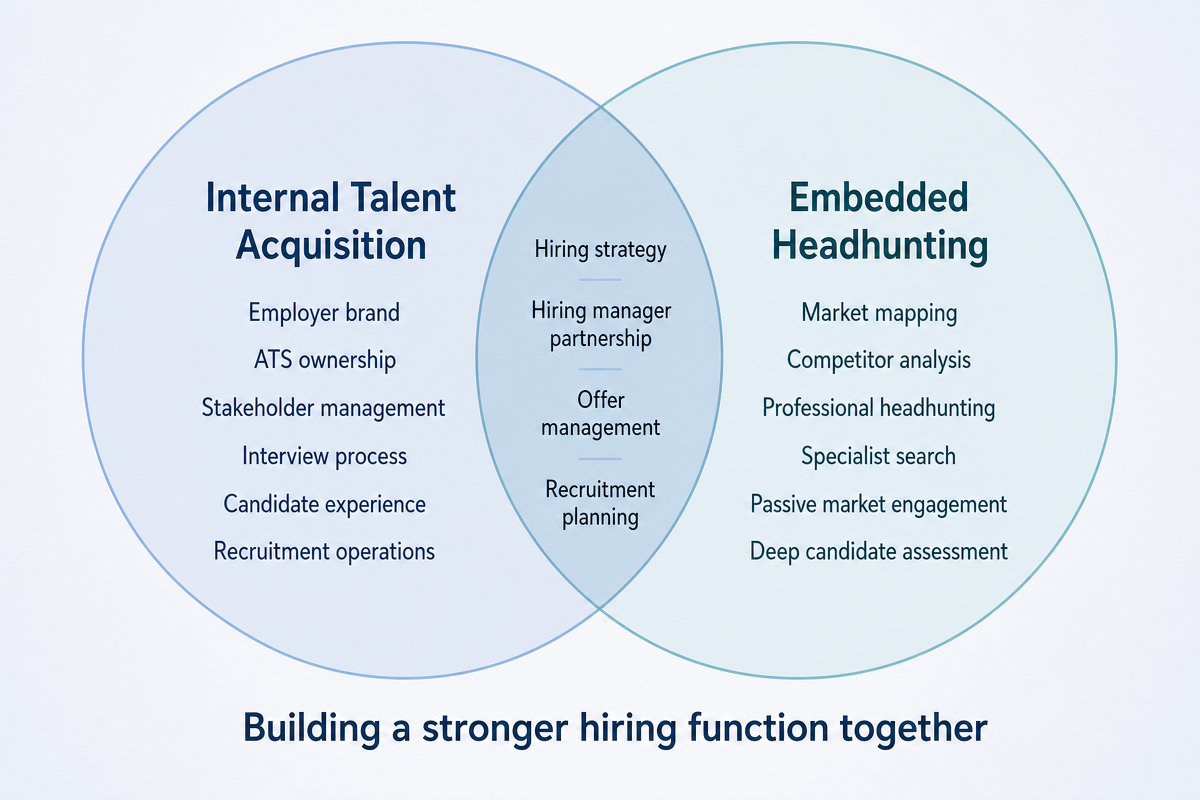
Saiyō framework
Complementary Capability Model
Internal Talent Acquisition and Embedded Headhunting are stronger together than either is alone.
Building capability rather than dependency
One of the less obvious advantages of Embedded Headhunting is that market knowledge remains inside the organisation.
Traditional recruitment assignments often begin from the same starting point. Markets are researched, candidates are identified and relationships are rebuilt each time a new vacancy appears.
Embedded models work differently.
Because the same headhunters remain integrated with the business over an extended period, knowledge accumulates rather than being recreated.
Competitor maps become richer.
Candidate relationships deepen.
Hiring managers spend less time repeatedly briefing external recruiters.
Future searches become faster because much of the market intelligence already exists.
The objective is not simply to fill today's vacancies.
It is to strengthen the organisation's long-term hiring capability.
The Saiyō View
We believe the strongest Talent Acquisition teams are not those with the largest number of recruiters.
They are the teams that apply specialist expertise where it creates the greatest impact.
Internal Talent Acquisition should remain focused on building an exceptional hiring function, protecting employer brand and delivering an outstanding candidate experience.
Embedded Headhunting strengthens that capability by ensuring proactive specialist search receives the time, attention and expertise it requires.
Our objective is not to replace internal Talent Acquisition.
It is to help great Talent Acquisition teams become even more effective.
Explored in depth
This topic is explored in more depth within What is embedded recruitment?.
Frequently asked questions
See this in practice
Move from the concept to the way Saiyō delivers it.
Related questions
How does embedded recruitment work?
Embedded Headhunting combines proactive headhunting with the operational integration of an internal Talent Acquisition team. Rather than working as an external agency, embedded headhunters become part of your hiring function, leading specialist search while working within your ATS, following your hiring process and representing your employer brand throughout the candidate journey.
Read the answerAnswerWhen should a scale-up use an embedded recruitment partner?
Embedded Headhunting is most valuable when specialist hiring becomes a continuous business capability rather than a series of individual recruitment projects. For many technology companies, this happens during the scale-up phase, when hiring volumes increase, internal Talent Acquisition teams become more operational and agency dependency becomes expensive and inconsistent.
Read the answerAnswerHow is embedded recruitment different from a recruitment agency?
Embedded Headhunting is a subscription model in which specialist headhunters work inside your hiring function, whereas agencies typically work on a contingent, per-placement basis. The embedded model provides dedicated capacity, deeper integration and proactive market search rather than competing for the same active candidates.
Read the answerAnswerIs embedded recruitment the same as RPO?
No. Although both Embedded Headhunting and Recruitment Process Outsourcing (RPO) provide dedicated recruitment support, they were developed to solve different hiring challenges. RPO is designed for operational scale, typically in large organisations hiring at significant volume across multiple functions. Embedded Headhunting focuses on helping technology scale-ups consistently identify and hire specialist talent by combining proactive headhunting with the operational integration of an internal Talent Acquisition team.
Read the answerAnswerHow much does embedded recruitment cost?
Embedded Headhunting is usually priced as an annual subscription rather than a fee for each successful hire. The total investment depends on expected hiring volume, the level of dedicated resource required and the complexity of the roles being recruited. For technology companies hiring specialist talent continuously, subscription pricing often provides greater commercial predictability and a lower overall cost per hire than paying agency fees for every appointment.
Read the answer