Embedded Headhunting
When should a scale-up use an embedded recruitment partner?
Co-founder and CEO
The short answer
Embedded Headhunting is most valuable when specialist hiring becomes a continuous business capability rather than a series of individual recruitment projects. For many technology companies, this happens during the scale-up phase, when hiring volumes increase, internal Talent Acquisition teams become more operational and agency dependency becomes expensive and inconsistent.
A scale-up should bring in an embedded recruitment partner when specialist hiring becomes a continuous business capability rather than a series of individual projects. Embedded recruitment, also called embedded talent acquisition, gives you dedicated hiring capacity inside the business, and Saiyō's version of it is embedded headhunting, meaning proactive outbound search rather than inbound processing. For many technology companies the trigger arrives during the scale-up phase, when specialist hiring accelerates, internal Talent Acquisition teams become increasingly operational and relying on recruitment agencies becomes expensive and difficult to manage consistently.
The decision is rarely based on company size alone. It is influenced by hiring volume, the complexity of the roles being recruited, the importance of employer brand and the level of confidence the business needs in reaching the strongest people available in the market.
Understanding that point of transition is the key to deciding whether Embedded Headhunting is the right operating model.
Every hiring model has a stage where it performs best
There is no single hiring model that suits every business. A founder making their first commercial hire faces a very different challenge from a global SaaS company recruiting fifty Enterprise Account Executives across multiple regions. Expecting both organisations to use the same approach would make little sense.
Most technology companies naturally move through several stages as they grow. In the earliest stages, founders typically make many of the key hires themselves. Existing networks, referrals and occasional agency support are often enough because hiring volumes remain relatively low and every appointment receives significant leadership attention.
As the business grows, an internal Talent Acquisition function usually begins to emerge. Recruitment becomes more structured, employer branding improves and the organisation develops repeatable hiring processes that support a larger number of vacancies.
Eventually, however, another transition begins to take place. Hiring becomes continuous. Leadership teams expect predictable recruitment outcomes. Specialist positions become increasingly difficult to fill. Commercial expansion creates pressure to recruit across multiple countries and functions at the same time. At this stage, recruitment stops being an operational task and becomes a strategic capability. That is typically where Embedded Headhunting creates the greatest value.
The challenge is rarely a lack of effort
One of the biggest misconceptions surrounding difficult hiring is that organisations assume the problem is a lack of recruitment activity. When key positions remain open, the instinctive response is often to advertise more widely, engage additional agencies or increase outbound sourcing activity.
These actions are understandable. They are also often addressing the wrong problem. As technology companies scale, Talent Acquisition teams naturally spend more time coordinating interviews, managing stakeholders, supporting hiring managers, improving candidate experience and reporting on recruitment performance. All of these activities are essential, but they compete for the same time and resource that proactive market search requires.
The consequence is that the activity most likely to improve candidate quality is often the first to become constrained. This is rarely a reflection of capability. It is usually a reflection of capacity. Embedded Headhunting was developed to solve exactly this challenge by introducing dedicated headhunting capability without separating it from the existing hiring function.
There are usually five signs a business has reached this point
Although every organisation grows differently, there are several indicators that suggest traditional recruitment models may no longer be providing the level of access, consistency or commercial efficiency the business requires.
- Recruitment agencies become a permanent feature of hiring rather than an occasional specialist resource. If agency spend continues to increase each year despite investing in an internal Talent Acquisition team, it is often a sign that the organisation has developed a structural dependency rather than solving the underlying hiring challenge.
- Proactive search becomes increasingly difficult to sustain. Internal recruiters spend more time managing recruitment processes than engaging exceptional people in the market. Hiring remains busy, but candidate quality begins to plateau because the strongest individuals are rarely entering the process.
- Specialist roles consistently take longer to fill than expected. This is particularly common across enterprise sales, product leadership, customer success, engineering and senior commercial positions where highly experienced candidates rarely become active job seekers.
- Hiring managers begin to lose confidence in the recruitment process. They receive candidates, but increasingly question whether they represent the strongest people available in the market or simply the strongest people who happened to apply.
- Recruitment begins to influence broader business performance. Revenue targets become dependent on hiring Enterprise Account Executives. Product delivery depends on recruiting experienced technical leaders. Customer retention relies on strengthening Customer Success. At this point, recruitment is no longer supporting growth. It is determining the pace at which growth can happen.
The Hiring Economics Curve™
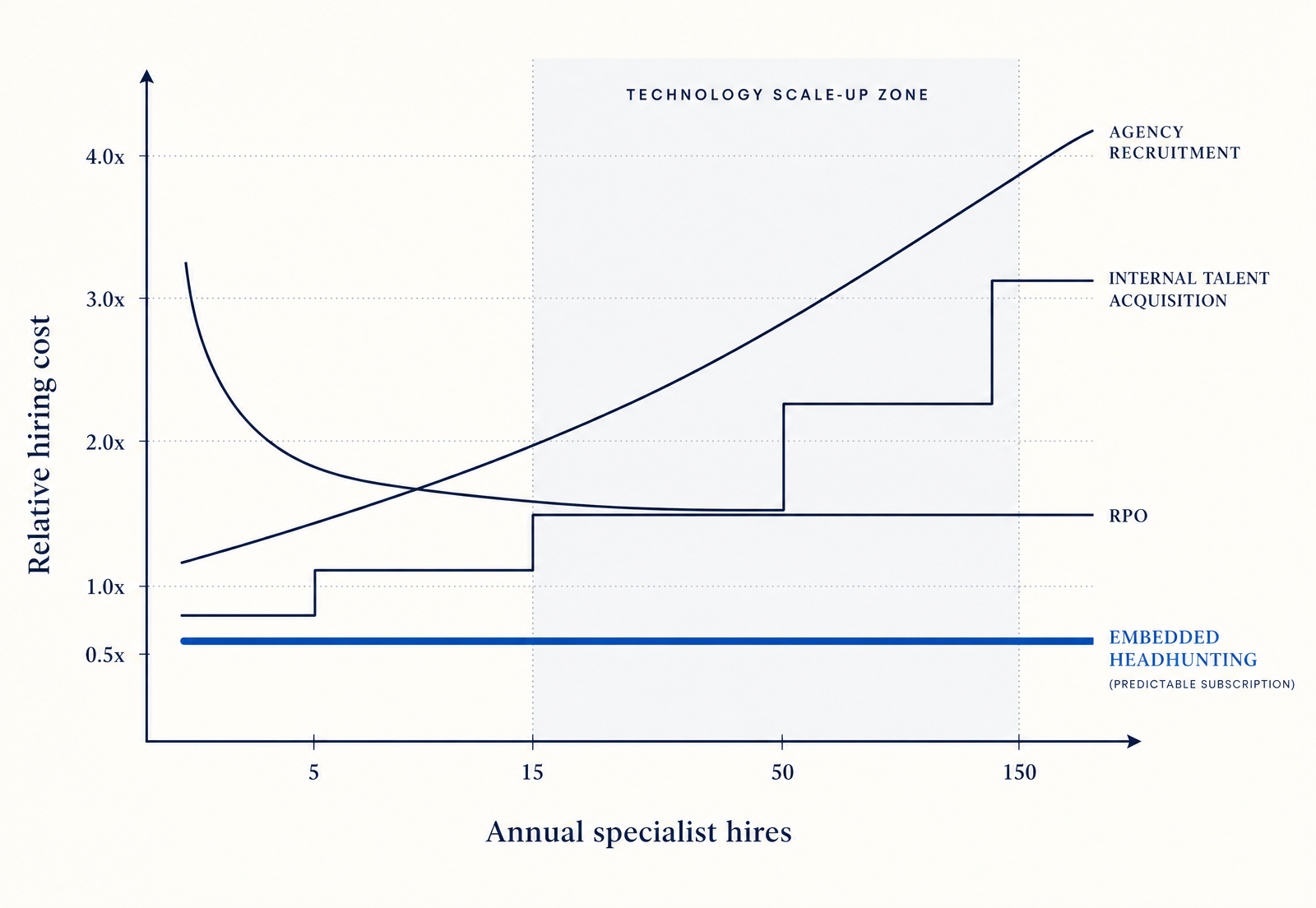
One of the reasons Embedded Headhunting has become increasingly popular among technology scale-ups is that the economics of recruitment change as hiring volume increases. In the early stages of growth, paying a recruitment agency to fill occasional specialist roles is often entirely rational. The flexibility outweighs the cost because hiring remains relatively infrequent.
As annual recruitment volumes increase, that equation begins to change. Agency fees scale broadly in proportion to the number of hires being made. Internal Talent Acquisition teams require additional permanent headcount to support increasing demand. Executive search remains appropriate for highly targeted leadership appointments but was never designed to support continuous specialist hiring across multiple functions. RPO provides operational scale, although its structure and commercial model are often better suited to enterprise organisations than fast-moving technology businesses.
Saiyō framework
The Hiring Economics Curve
Relative cost per specialist hire across agency, internal TA, RPO and embedded headhunting as annual volume grows.
Embedded Headhunting sits between these approaches. Rather than paying for individual recruitment assignments, organisations invest in dedicated specialist hiring capability over a defined period. That capability becomes part of the existing Talent Acquisition function while maintaining the proactive market search traditionally associated with executive search. The result is greater commercial predictability without compromising candidate quality or employer brand.
Embedded Headhunting is not the right answer for every business
One of the reasons recruitment advice often feels unhelpful is because every provider naturally recommends the model they happen to sell. The reality is more balanced. Businesses making only a handful of specialist hires each year are often well served by referrals, internal recruitment or carefully selected agency partners. Introducing an embedded model before hiring has become strategically important is unlikely to deliver meaningful additional value.
Similarly, large global enterprises recruiting thousands of employees through highly standardised processes may benefit more from enterprise-scale RPO solutions built specifically for that environment. Embedded Headhunting exists to solve a different challenge. It is designed for organisations where specialist hiring is continuous, commercially significant and increasingly dependent on accessing people who are unlikely to enter a traditional recruitment process.
For many technology companies, this represents a distinct stage of organisational maturity rather than simply another recruitment option.
The Saiyō View
We believe the decision to adopt Embedded Headhunting should never be driven by company size alone. The better question is whether hiring has become an operational capability that directly influences business performance. Once specialist recruitment begins determining revenue growth, product delivery, customer success or international expansion, the hiring model itself becomes a strategic decision.
At that point, many technology scale-ups discover that neither expanding internal recruitment indefinitely nor increasing agency spend provides the right balance of market access, operational integration and commercial predictability. That is the point Embedded Headhunting was designed to address.
Explored in depth
This topic is explored in more depth within What is embedded recruitment?.
Frequently asked questions
See this in practice
Move from the concept to the way Saiyō delivers it.
Related questions
How does embedded recruitment work?
Embedded Headhunting combines proactive headhunting with the operational integration of an internal Talent Acquisition team. Rather than working as an external agency, embedded headhunters become part of your hiring function, leading specialist search while working within your ATS, following your hiring process and representing your employer brand throughout the candidate journey.
Read the answerAnswerHow is embedded recruitment different from a recruitment agency?
Embedded Headhunting is a subscription model in which specialist headhunters work inside your hiring function, whereas agencies typically work on a contingent, per-placement basis. The embedded model provides dedicated capacity, deeper integration and proactive market search rather than competing for the same active candidates.
Read the answerAnswerIs embedded recruitment the same as RPO?
No. Although both Embedded Headhunting and Recruitment Process Outsourcing (RPO) provide dedicated recruitment support, they were developed to solve different hiring challenges. RPO is designed for operational scale, typically in large organisations hiring at significant volume across multiple functions. Embedded Headhunting focuses on helping technology scale-ups consistently identify and hire specialist talent by combining proactive headhunting with the operational integration of an internal Talent Acquisition team.
Read the answerAnswerCan embedded recruitment replace an internal TA team?
In most cases, no. Embedded Headhunting is designed to strengthen an internal Talent Acquisition function, not replace it. It adds dedicated specialist search capability while the internal team retains ownership of employer brand, recruitment operations and candidate experience.
Read the answerAnswerHow much does embedded recruitment cost?
Embedded Headhunting is usually priced as an annual subscription rather than a fee for each successful hire. The total investment depends on expected hiring volume, the level of dedicated resource required and the complexity of the roles being recruited. For technology companies hiring specialist talent continuously, subscription pricing often provides greater commercial predictability and a lower overall cost per hire than paying agency fees for every appointment.
Read the answer