Hiring Performance
Authority GuideThe Economics of Technology Hiring
Co-founder and CEO
Recruitment budgets are often fragmented across salaries, agency fees, executive search, technology and hiring-manager time, making the true cost difficult to see. Finance teams then compare visible provider fees while ignoring delayed revenue, lost productivity and replacement risk. This encourages short-term cost decisions that can make the overall hiring system more expensive.
The short answer
Technology hiring economics should be assessed using total annual investment, cost per successful hire, speed, quality and the business cost of vacancies remaining open. A lower recruiter fee is not necessarily a lower hiring cost if the role takes longer, strong candidates never enter the process or the hire fails. The correct model balances predictable capacity with access to the level of talent the growth plan requires.
Why this matters
Recruitment budgets are often fragmented across salaries, agency fees, executive search, technology and hiring-manager time, making the true cost difficult to see. Finance teams then compare visible provider fees while ignoring delayed revenue, lost productivity and replacement risk. This encourages short-term cost decisions that can make the overall hiring system more expensive.
The central idea
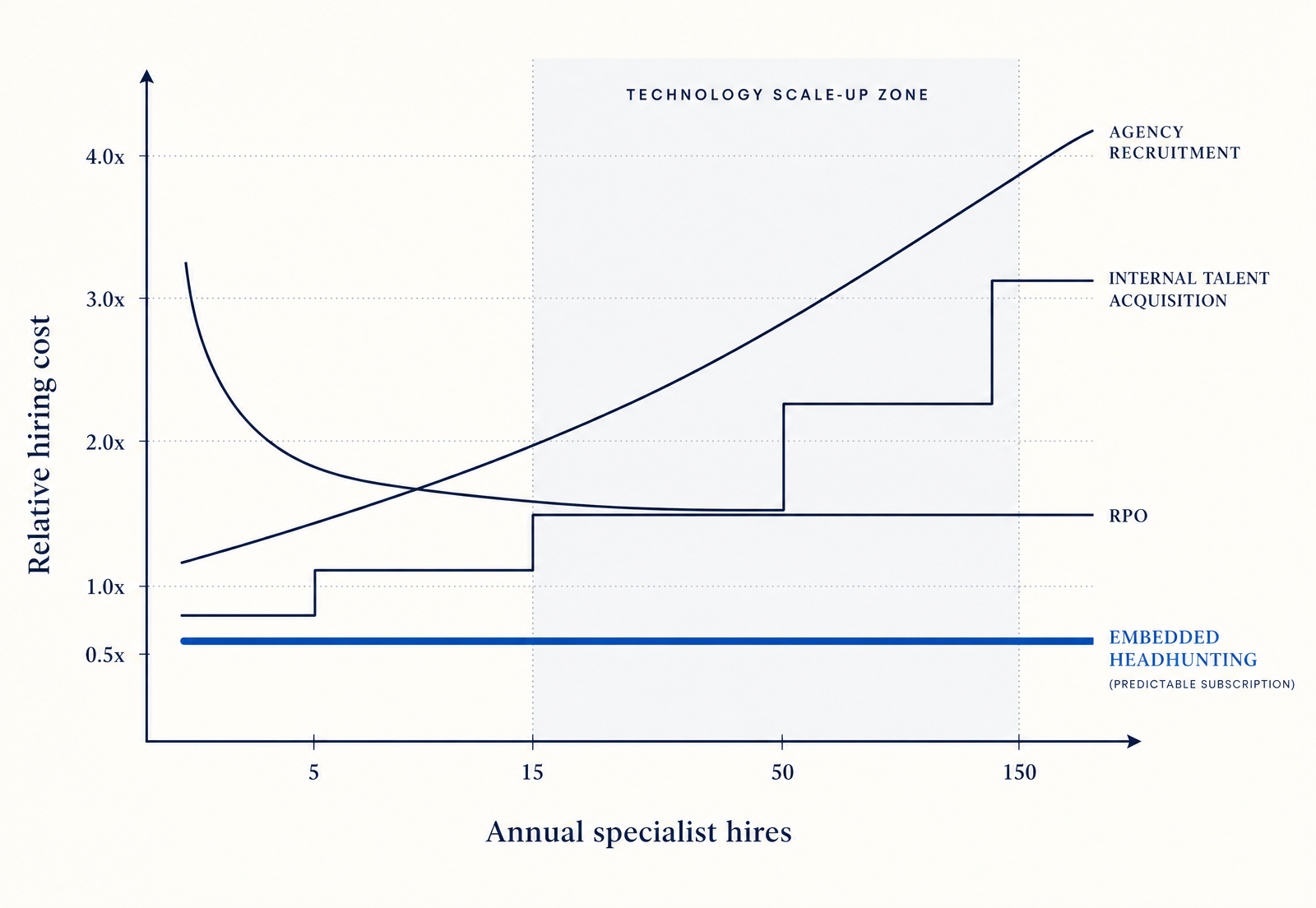
The economics of hiring change as volume grows and role complexity increases. Agency flexibility is valuable at low volume, internal capacity creates ownership, RPO can scale repeatable operations and embedded models can spread specialist search cost across a continuous plan. The best comparison uses scenarios rather than a single cost-per-hire number.
How to apply it
1. Calculate direct internal and external recruitment spend
Aggregate every line: internal salaries, agency fees, executive search, technology, referral bonuses. The base number is more revealing than any individual invoice.
2. Include technology, employer costs, management overhead and duplicated supplier activity
Add the hidden layers: tooling, hiring-manager time, coordination overhead and the cost of the same role being briefed to multiple suppliers. Together they usually reshape the picture.
3. Estimate vacancy cost for revenue, product and customer-critical roles
For roles that carry revenue or product impact, the cost of the role remaining open is often larger than the cost of filling it. Make that number visible, even as an estimate.
4. Compare models across low, expected and high hiring scenarios
Each model scales differently. Testing agency, internal, RPO and embedded scenarios at multiple hiring volumes reveals where each becomes more or less efficient.
5. Track quality and retention so cost reductions are not achieved by lowering the bar
Falling cost per hire alongside falling shortlist strength or falling retention is not a saving. Pair every cost metric with a quality metric.
Saiyō framework
The Hiring Economics Curve
Relative cost per specialist hire across agency, internal TA, RPO and embedded headhunting as annual volume grows.
Where organisations usually go wrong
The most common failures are structural rather than a reflection of effort. Recognising the pattern early lets the operating model change before more activity is added.
- Comparing an agency fee with a recruiter salary without including full scope.
- Using one average cost per hire across radically different roles.
- Ignoring the cost of unfilled roles and failed hires.
- Assuming permanent internal capacity is always cheaper.
- Treating recruitment as a procurement category rather than a growth capability.
The cost of hiring late is the number nobody budgets for
Every growing company reaches a point where opportunity outpaces capacity. Pipeline builds faster than the team can work it, territories go uncovered, renewals slip because customer success is stretched, and a product milestone quietly moves a quarter. None of that appears in the recruitment budget, which is exactly why late hiring looks free until you measure it.
Leadership vacancies are the sharpest version of the same problem. A missing revenue or product leader does not just leave work undone: decisions stall, priorities blur, the people below the gap start to drift and hiring quality in that function falls because nobody senior is calibrating it. The cost accumulates quietly and compounds monthly, while the saving from leaving the role open is visible immediately. That asymmetry is why companies delay, and why delay so often turns into a rushed appointment made under pressure.
Why predictability has become a Finance requirement
Workforce spend is one of the largest and most volatile lines a technology CFO manages, and contingency hiring makes it more volatile still. Costs arrive exactly when hiring accelerates, which is exactly when cash is already under pressure, and they arrive in lumps nobody forecast. The response is usually approval friction: every role becomes a negotiation, hiring slows at the moment growth requires it to speed up, and the business pays for the delay in a currency Finance never sees.
A predictable model changes the conversation rather than just the invoice. When hiring capacity is a known monthly figure, Finance can model runway with confidence, Talent can commit to delivery, and the two teams stop arguing about whether the next role is affordable. Predictability is not primarily a saving. It is what makes hiring plannable.
From recruitment spend to hiring investment
Treated as spend, recruitment is a cost to minimise: buy reactively, buy late, buy the cheapest option that closes the role. Treated as investment, it becomes capability you build ahead of demand: markets mapped before roles open, relationships maintained with people who are not ready to move yet, and a hiring system that improves with use. The second version costs more in a quiet quarter and considerably less across a year.
The practical step is small. Talent and Finance should agree a handful of scenarios before the year begins, each showing hiring volume, role mix, internal capacity, expected external cost and the point at which a different operating model becomes more efficient. That single exercise turns recruitment from a series of unplanned fees into an investment decision attached to the growth plan.
Where the idea has limits
Hiring economics cannot be reduced to a perfectly precise formula because the value of a strong hire and the cost of delay vary significantly. Estimates should be transparent and used for comparison rather than presented as certainty. Commercial efficiency matters, but it should not become a reason to underinvest in roles that determine business performance.
The Saiyō view
Saiyō believes cost per hire is useful only when considered alongside candidate quality, time to hire and market access. The objective is not to make recruitment as cheap as possible, but to make the economics predictable while consistently reaching stronger people. That is why annual hiring commitments and economies of scale sit at the centre of the Embedded Headhunting model.
Key takeaways
- Assess hiring using total annual investment, speed, quality and vacancy cost together.
- Cost per hire is a system output, not a procurement metric.
- Model low, expected and high scenarios, not a single number.
- Pair every cost metric with a quality and retention metric.
- Recruitment is a growth capability, not a procurement category.
- The cost of hiring late is usually larger than the cost of hiring well, and nobody budgets for it.
Frequently asked questions
See this in practice
Move from the concept to the way Saiyō delivers it.
Related questions
How should a technology company budget for recruitment?
A technology company should budget for recruitment by combining expected internal team cost, external provider spend, technology, operational support and a contingency for difficult or unplanned roles. The budget should be linked to the annual hiring plan and modelled across more than one volume scenario. Critical roles should also include an estimate of the business cost of delay.
Read the answerAnswerWhat is a good cost per hire for specialist technology roles?
There is no universal good cost per hire for specialist technology roles because seniority, geography, scarcity and delivery model change the economics significantly. A useful benchmark is one that is lower than the realistic alternatives while still producing strong market coverage, interview conversion and retention. The number should be segmented by role family rather than averaged across the whole company.
Read the answerAnswerHow should recruitment ROI be measured?
Recruitment ROI should compare total hiring investment with the outcomes created, including roles filled, speed, candidate quality, offer acceptance, retention and business impact. For commercial or product-critical roles, the cost of delay should be included even if it is estimated. A complete view is more useful than dividing recruiter spend by hires alone.
Read the answerAnswerIs agency spend an operating cost or a growth investment?
Agency spend is an operating cost in accounting terms, but strategically it may be a growth investment when it fills a role that directly affects revenue, product delivery or customer outcomes. The distinction matters because the cheapest source is not always the best economic choice. The investment should still be governed and compared with alternatives.
Read the answer