Hiring Models
Authority GuideEmbedded recruitment vs RPO: what is the difference?
Co-founder and CEO
Embedded recruitment, also called embedded talent acquisition, places dedicated recruiters inside your hiring function, and Saiyō's version of it is embedded headhunting, meaning proactive outbound search rather than inbound processing. RPO, by contrast, outsources and standardises the recruitment process itself. RPO is often treated as the natural next step once agency spend becomes too high, even though the model was largely developed for complex enterprise environments, so scale-ups can inherit implementation overhead, governance and process structures that are disproportionate to their size while still struggling to reach highly passive talent.
The short answer
The difference is what each model is built to solve. RPO provides standardised recruitment operations at significant scale, usually across large hiring programmes, while embedded recruitment provides a smaller, dedicated team inside a scale-up whose priority is proactive market access on specialist roles. Where hiring volume is meaningful but concentrated in hard roles, a lighter embedded or headhunt-first model tends to give a better balance of integration, flexibility and candidate quality.
The difference in one paragraph
Recruitment Process Outsourcing takes ownership of a recruitment process and runs it to a standard, at scale, usually across a large and repeatable hiring programme. Embedded recruitment puts a small dedicated team inside your hiring function and holds it accountable for the roles you actually struggle to fill. Both sit inside your business and both replace agency dependency, so the labels sound interchangeable. The economics and the day-to-day work are not.
RPO economics were designed for a different size of company
RPO was built for organisations hiring at industrial volume, and the maths reflects that. There is an implementation phase, a technology and governance layer, a service management layer above the recruiters and a contract long enough to amortise all of it. Spread across roughly 500 or more hires a year, that overhead is small per hire and buys something valuable: consistency, reporting and the ability to absorb enormous volume without the process falling apart.
Spread across 30 or 50 specialist hires, the same overhead is no longer small. The fixed base becomes a meaningful share of the total, the governance layer slows decisions that used to take a morning, and the contract length outlives the hiring plan that justified it. Scale-ups end up buying a Fortune 500 operating system to solve a Series C problem, and then discover that the hardest roles on the plan are still open.
Be clear about when RPO is the right answer
Above roughly 500 hires a year, RPO is usually the correct model and embedded recruitment is not a serious substitute. At that volume the problem genuinely is operational: compliance across regions, consistent candidate handling, workforce reporting a board can rely on, and the ability to flex recruiter capacity by the dozen. A headhunt-first embedded team is not built to process thousands of repeatable roles, and pretending otherwise would be dishonest.
There is a second case worth stating just as plainly. For a genuine one-off hire with no ongoing need behind it, a contingency agency is the right answer. You pay once, you carry no fixed cost, and nothing about a subscription improves on that. Embedded recruitment only earns its keep when hiring is continuous enough for the capability to compound.
What a scale-up is actually buying
Between those two extremes sits the company most of this page is written for: 5 to 150 specialist hires a year, concentrated in leadership, GTM and AI roles where the strongest people are not applying to anything. The constraint is not process throughput. It is market access. The shortlist is thin because the recruiters working the role can only reach the part of the market that is visible, and the visible part is the smallest part.
Embedded recruitment answers that with integration rather than infrastructure. The team works inside your systems, your brand and your hiring rhythm, attends the same standups, learns which hiring managers move quickly and which need help, and carries market knowledge from one search into the next. Saiyō's version adds the search discipline: markets are mapped before roles open, and people who would never answer an advert are approached directly and repeatedly.
Why the commercial shape matters more than the day rate
Hiring plans in technology companies are not stable. Funding lands early or late, a region opens sooner than planned, a product launch slips a quarter and takes twelve roles with it. Contingency pricing punishes the good version of that story, because every acceleration arrives as an unbudgeted invoice. Long RPO contracts punish the bad version, because the fixed base keeps running when hiring pauses.
A subscription with hiring credits behaves differently. Finance gets one predictable line rather than a series of shocks, credits move across roles and months as the plan changes, and Talent keeps sourcing momentum through a pause instead of restarting from zero afterwards. That last point is underrated: pipeline built during a quiet quarter is what makes the next quarter fast.
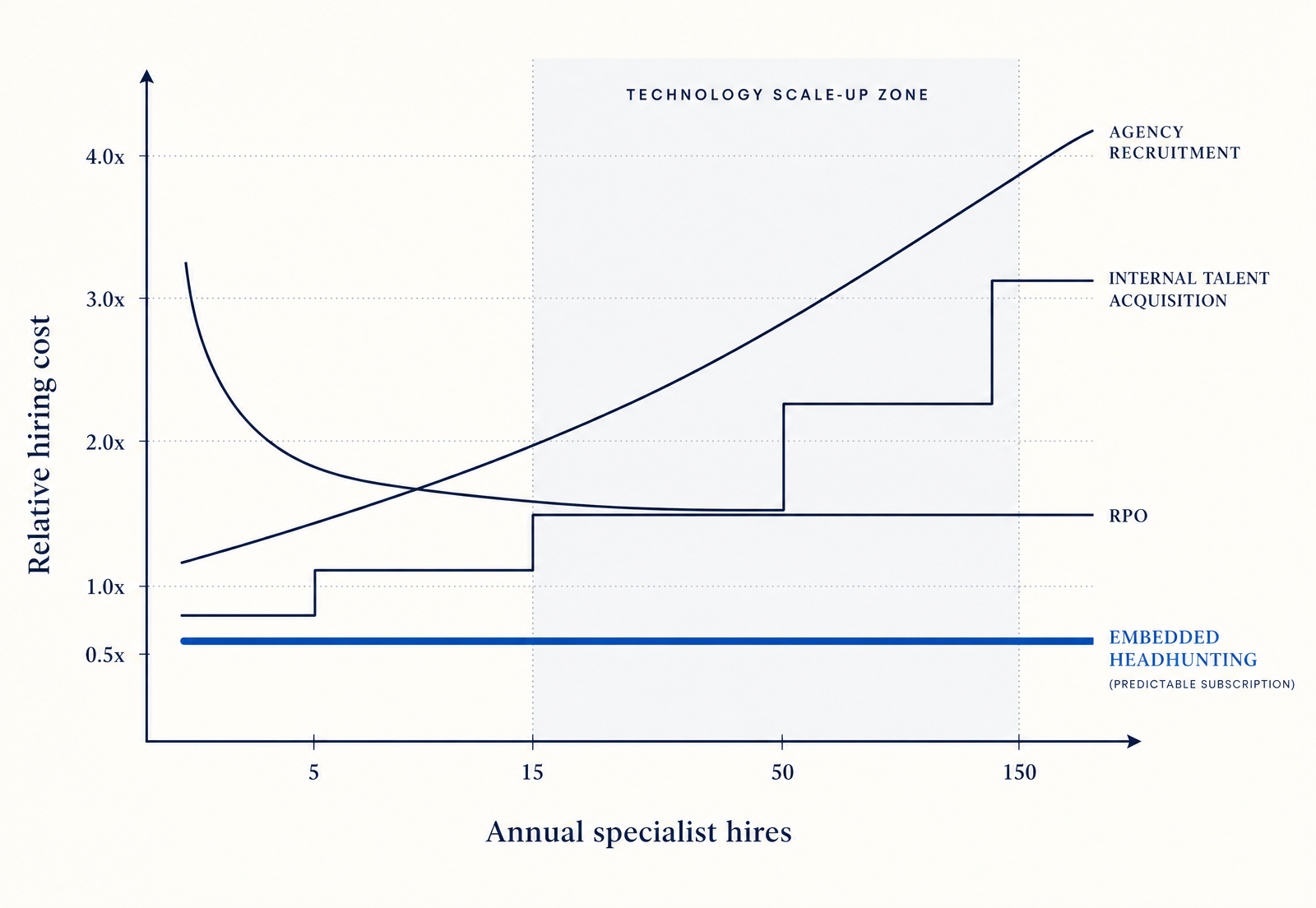
Saiyō framework
The Hiring Economics Curve
Relative cost per specialist hire across agency, internal TA, RPO and embedded headhunting as annual volume grows.
The compounding argument
The most important difference between a per-hire relationship and a continuous one is what happens on the second, fifth and twentieth search. Recruiters who already know your product, your competitors and the difference between the two AEs you hired last year do not spend the first three weeks learning. They know which competitor is about to lose people, which candidates said no last time and why, and which of those conversations is now worth restarting.
That accumulated knowledge is why continuous partnerships tend to get faster and more accurate over time while transactional relationships reset with every brief. Saiyō shortlists are typically delivered in under 10 days because the market work has usually already been done, not because anyone is working faster.
How to choose between them
1. Diagnose the problem before shortlisting providers
Decide whether your primary constraint is operational scale, specialist access, or both. Models built for one rarely solve the other well, and no procurement process recovers from getting this wrong at the start.
2. Segment the hiring plan
Split the plan into high-volume repeatable roles and scarce specialist roles. Volume favours standardised operations. Scarcity favours search-led capability. Many companies genuinely need both, and should buy them separately rather than expecting one supplier to be excellent at both.
3. Cost the whole model, not the recruiter rate
Include implementation, technology, management overhead, contract length and the cost of roles staying open. A cheaper recruiter day rate inside a heavier model is not a saving.
4. Interrogate the sourcing methodology, not the label
Embedded has become an umbrella term covering everything from contract recruiters to genuine headhunting. Ask how the provider builds a market, engages people who ignore written outreach, and maintains search quality across several roles at once.
5. Measure quality alongside process
Service levels can be met while shortlist strength quietly falls. Track shortlist quality, offer acceptance and first-year performance next to time to hire, or you will optimise the wrong thing.
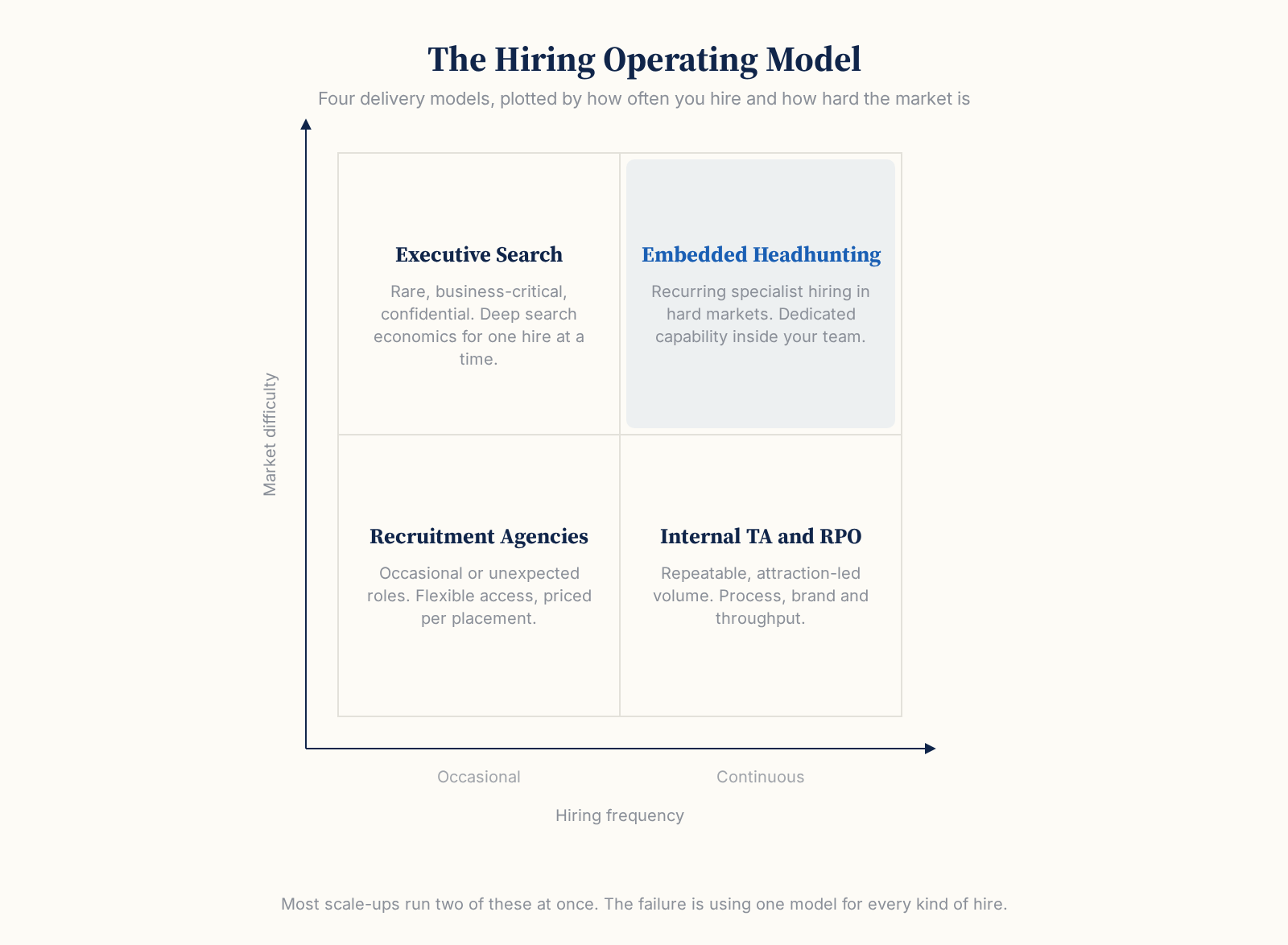
Saiyō framework
The Hiring Operating Model
Four mutually-exclusive delivery models: internal TA, agency, RPO and embedded headhunting.
Where organisations usually go wrong
The common failures are structural rather than a reflection of effort. Recognising the pattern early lets the operating model change before more activity is added on top of it.
- Choosing an enterprise RPO model for a specialist hiring plan of a few dozen roles.
- Assuming every provider using the word embedded actually headhunts.
- Comparing monthly recruiter rates instead of total annual cost and contract flexibility.
- Counting recruiter headcount rather than testing methodology and market coverage.
- Treating operational service levels as evidence that hiring is working.
- Signing a long contract without testing what happens when hiring slows.
Where this argument has limits
A rapidly maturing scale-up can outgrow embedded recruitment. When global governance, workforce compliance and large repeatable volume become the dominant concerns, RPO stops being oversized and starts being appropriate. Equally, a company with a capable internal Talent Acquisition team, a stable plan and roles that genuinely attract strong inbound interest may not need either model. The honest answer depends on volume, role scarcity and how much of the market is reachable without a direct approach.
The Saiyō view
RPO is not the enemy. It is an enterprise model being sold, often sincerely, to companies who are not enterprises yet. The question is not which model is better in the abstract but which problem you are solving: standardising a large recruitment operation, or reaching people who will never apply. For Series A to pre-IPO technology companies hiring leadership, GTM and AI talent, that second problem is nearly always the one that decides the year, which is why we built the model the way we did.
Key takeaways
- RPO is built for operational scale at roughly 500 hires a year and above. Below that the fixed overhead and contract length work against you.
- Embedded recruitment gives a scale-up in-team integration without the enterprise cost base.
- For a genuine one-off hire with no ongoing need, a contingency agency is still the right answer.
- Diagnose the constraint, segment the hiring plan, then choose the model.
- Interrogate methodology rather than the embedded label, and measure candidate quality alongside process metrics.
Frequently asked questions
See this in practice
Move from the concept to the way Saiyō delivers it.
Related questions
Is RPO suitable for a Series B company?
RPO can suit a Series B company when hiring volume is substantial, roles are repeatable and the business needs operational standardisation across several teams or regions. It is less likely to fit when the main challenge is a smaller number of senior and specialist roles requiring professional headhunting. Many Series B businesses need embedded capability without the full infrastructure of enterprise RPO.
Read the answerAnswerWhat does RPO cost compared with embedded recruitment?
RPO pricing varies with scope, implementation, technology, recruiter headcount and management requirements, while embedded recruitment is often priced around dedicated capacity or annual hiring commitments. RPO may become efficient at very large volume, but implementation and governance can be significant. A scale-up should compare total annual cost, flexibility and role quality rather than monthly resource rates alone.
Read the answerAnswerWhy do scale-ups struggle with traditional RPO?
Scale-ups can struggle with traditional RPO because the model may introduce enterprise processes, fixed structures and generalist recruitment capacity into an environment where priorities change quickly and specialist search is critical. The service can be operationally strong while still failing to reach the people the business most wants to hire. Fit depends on whether the provider's methodology matches the role mix.
Read the answerAnswerWhen is RPO the right choice?
RPO is the right choice when recruitment operations need to be standardised and scaled across significant, repeatable hiring demand. It is particularly useful where governance, reporting, process consistency and variable recruiter capacity are central requirements. The model is strongest when operational scale is the primary problem rather than specialist market access.
Read the answer