Hiring Performance
Authority GuideHow to Reduce Time to Hire for Specialist Roles
Co-founder and CEO
Companies often treat time to hire as a recruiter productivity problem even though much of the elapsed time sits outside sourcing. Roles pause while requirements change, interviewers become unavailable, feedback is delayed and offers are developed too late. For highly inaccessible talent, these delays are especially damaging because strong candidates have little reason to tolerate uncertainty.
The short answer
Specialist time to hire improves when market mapping begins early, decision criteria are agreed before outreach and interviews move with clear ownership and urgency. Adding more candidates or recruiters does not automatically make the process faster. The greatest delays usually come from unclear calibration, slow stakeholder decisions and searches that begin only after the role becomes urgent.
Why this matters
Companies often treat time to hire as a recruiter productivity problem even though much of the elapsed time sits outside sourcing. Roles pause while requirements change, interviewers become unavailable, feedback is delayed and offers are developed too late. For highly inaccessible talent, these delays are especially damaging because strong candidates have little reason to tolerate uncertainty.
The central idea
Time to hire is created by the whole hiring system. A faster search requires early market preparation, realistic calibration, a compact interview process and decisions made close to the evidence. The process should move quickly without lowering assessment quality or rushing candidates into poorly considered offers.
How to apply it
1. Define outcomes, scorecard and compensation before launch
Roles that launch with unresolved requirements almost always pause mid-flight. Settling outcomes, evidence and compensation up-front removes the most common source of avoidable delay.
2. Map the market and prepare target talent before approval where possible
Where the plan is known, research can begin ahead of approval. That converts approval day into engagement day, rather than the start of a cold search.
3. Set interview stages, owners and decision deadlines in advance
Design the process before candidates enter it. Adding stages mid-search is a reliable way to lose momentum with the strongest people.
4. Provide structured candidate information before each interview
Interviewers arriving cold produce inconsistent evidence and slow decisions. A short structured brief per candidate compresses debrief and preserves quality.
5. Collect feedback quickly and resolve disagreement against the scorecard
Slow feedback is where days are quietly lost. A shared scorecard turns debate into a comparison against evidence rather than an open-ended discussion.
6. Start offer alignment before the final stage rather than after it
The final stage should confirm an offer that has already been prepared. Beginning compensation and closing discussions after the last interview adds days at the highest-risk moment of the process.
Saiyō framework
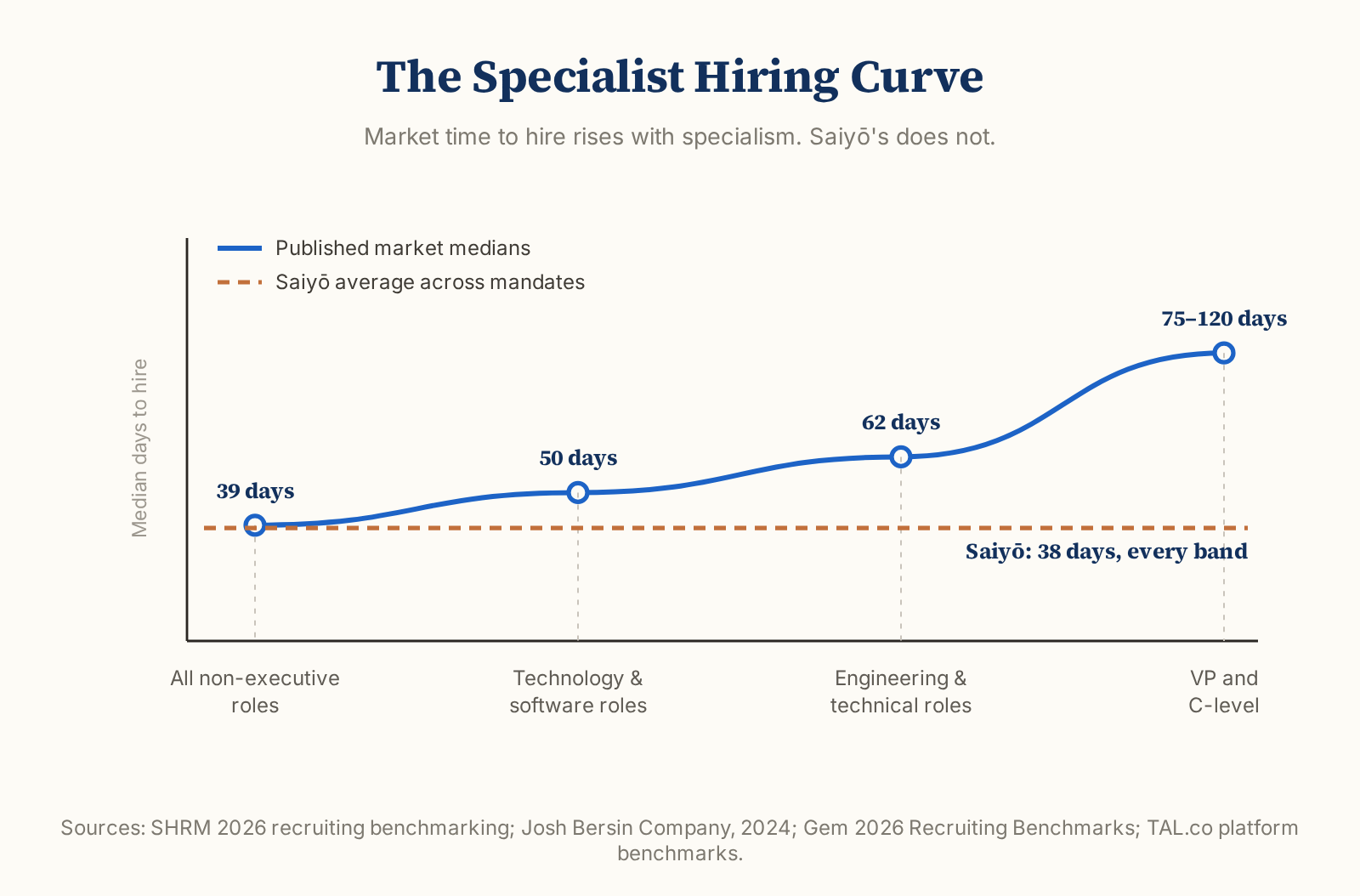
The Specialist Hiring Curve
Market time to hire rises with specialism. It does not have to.
Market figures: SHRM 2026 recruiting benchmarking (39 days, all non-executive roles); Josh Bersin Company, 2024 (technology and software, circa 50 days); Gem 2026 Recruiting Benchmarks (engineering and technical, circa 62 days); TAL.co platform benchmarks (VP and C-level, 75 to 120 days). The 38-day figure is Saiyō's own average across mandates. Actual timings vary by market, location and compensation band.
Where organisations usually go wrong
The most common failures are structural rather than a reflection of effort. Recognising the pattern early lets the operating model change before more activity is added.
- Launching a search with an uncalibrated job description.
- Adding interview stages after candidates enter the process.
- Allowing hiring managers to treat feedback as optional.
- Waiting for a perfect shortlist before beginning interviews.
- Confusing speed with reducing diligence.
Practical application for technology scale-ups
Saiyō's average time to hire is 38 days, supported by a process that starts with the market, uses detailed candidate write-ups and keeps one owner accountable from first conversation to accepted offer. That number should not be treated as a universal promise for every role, but it demonstrates that specialist search can move quickly when research and process operate together. The correct target should reflect role scarcity and the company's decision speed.
Where the idea has limits
Some searches should take longer because the market is exceptionally narrow, relocation is involved or the appointment requires board-level alignment. Artificially compressing these processes can increase candidate risk and weaken assessment. The objective is to remove avoidable delay, not to force every role into the same timeline.
The Saiyō view
Saiyō believes faster hiring starts before the vacancy is advertised. Market readiness, decisive stakeholders and consistent candidate ownership matter more than the raw number of recruiters assigned. A high-quality process should feel considered to the candidate and urgent to the organisation at the same time.
Key takeaways
- Most specialist time to hire is lost outside sourcing.
- Calibrate outcomes, scorecard and compensation before launch.
- Prepare the market and the process before candidates enter.
- Fast feedback and a shared scorecard resolve debate against evidence.
- Start offer alignment before the final stage, not after it.
Frequently asked questions
See this in practice
Move from the concept to the way Saiyō delivers it.
Related questions
What is a good time to hire for specialist roles?
A good time to hire for a specialist role is fast enough to maintain candidate momentum while allowing proper market coverage and assessment. There is no universal target, but many organisations should be able to complete a well-run specialist process within several weeks rather than several months. Role scarcity, notice periods and geography should be separated from avoidable internal delay.
Read the answerAnswerWhy do specialist roles take so long to fill?
Specialist roles take longer because the relevant market is smaller, strong candidates are less accessible and hiring teams often refine the requirement after the search begins. Internal delays in scheduling, feedback and offer approval then compound the market difficulty. The solution requires better calibration and decision discipline, not only more sourcing.
Read the answerAnswerHow can Series B SaaS companies hire faster?
Series B SaaS companies hire faster when they translate the growth plan into priority roles early, prepare market maps before vacancies become urgent and keep interview processes compact. Decision-makers must agree the scorecard, compensation and closing proposition in advance. Flexible embedded capacity can then scale search without adding permanent headcount for every peak.
Read the answerAnswerDoes adding more recruiters reduce time to hire?
Adding recruiters reduces time to hire only when capacity is the real constraint and the additional people have the capability required for the roles. If the process is unclear, decisions are slow or the market is inaccessible, more recruiters can create duplicated activity without improving speed. The bottleneck should be identified first.
Read the answer