Candidate Quality
What does a professional headhunter actually do?
Co-founder and CEO
The short answer
A professional headhunter helps organisations make better hiring decisions by systematically identifying, engaging and assessing exceptional people who are unlikely to enter a conventional recruitment process. Their role is not simply to introduce candidates, it is to ensure hiring decisions are made against the strongest talent available in the market.
A professional headhunter helps organisations make better hiring decisions by systematically identifying, engaging and assessing exceptional people who are unlikely to enter a conventional recruitment process. Rather than waiting for candidates to apply, professional headhunters build an understanding of the market, identify where the strongest talent is most likely to exist and create meaningful conversations with individuals who would otherwise remain inaccessible. Their role is not simply to introduce candidates. It is to ensure hiring decisions are made against the strongest talent available in the market.
This is an important distinction because many activities commonly described as headhunting today are, in reality, different forms of proactive recruitment. While both involve contacting candidates directly, professional headhunting follows a structured methodology designed to improve the quality of hiring decisions rather than simply increase candidate activity.
Professional headhunting starts long before the first candidate is contacted
One of the biggest misconceptions about headhunting is that it begins with outreach.
In reality, the first conversation is usually one of the final stages of the process.
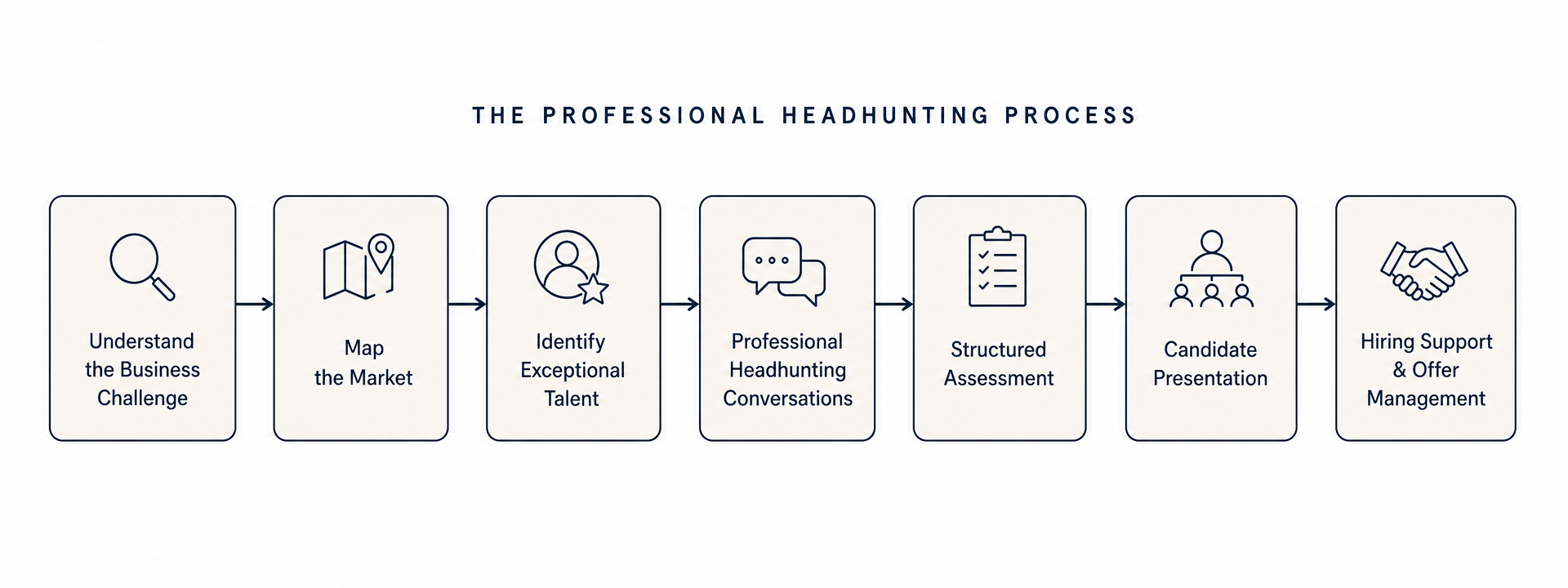
Professional headhunters begin by understanding the business challenge behind the vacancy. Before identifying individuals, they seek to understand why the role exists, what success looks like, how the organisation is expected to evolve and which capabilities will genuinely influence business performance over the coming years.
Only once that context has been established does research begin.
Rather than searching for candidates immediately, the market itself is analysed. Competitors are mapped, adjacent industries are explored and organisations with comparable challenges are identified. The objective is to understand where relevant expertise is most likely to exist before deciding who should be approached.
At Saiyō, this philosophy is known as The Market First Method™ because every search begins with understanding the market rather than reviewing candidates.
Market mapping is one of the most valuable parts of the process
The work most people never see is often the work that creates the greatest value.
Professional headhunters invest significant time building a comprehensive picture of the available talent market before outreach begins. This involves identifying relevant organisations, understanding reporting structures, recognising patterns of career progression and evaluating where transferable experience may exist.
The result is not simply a list of names.
It is a structured view of the market that allows hiring decisions to be based on evidence rather than familiarity.
Without this stage, organisations often recruit from the same companies, approach the same visible candidates and compete for the same limited talent pools as everyone else.
Market mapping broadens perspective before narrowing focus.
Identifying candidates requires judgement, not just search tools
Modern technology has made finding professional profiles considerably easier.
Artificial intelligence can suggest relevant candidates within seconds. Recruitment platforms can search millions of online profiles. Contact information is more accessible than ever before.
Finding people is no longer the difficult part.
Determining who is genuinely capable of succeeding is where professional judgement becomes valuable.
A professional headhunter evaluates far more than job titles or years of experience. They consider the context in which somebody has succeeded, the stage of business they have worked within, the complexity of the challenges they have solved and the likelihood that those experiences will translate into success within a different organisation.
Two candidates with almost identical CVs may represent completely different levels of suitability once that context is understood.
Technology accelerates research.
Experience improves judgement.
Conversations remain the defining skill
Professional headhunting is built on conversations rather than messages.
Written outreach can introduce an opportunity, but exceptional people rarely make career decisions because they receive a well-written LinkedIn message or email. Most are already successful, well rewarded and focused on the organisation they currently work for.
The purpose of a professional headhunter is not to persuade somebody to leave their employer.
It is to create an informed conversation.
That conversation explores far more than salary expectations. It considers long-term ambitions, leadership aspirations, cultural preferences, appetite for risk and the circumstances under which somebody might genuinely improve their career by making a move.
These discussions often take place before a candidate has even decided whether they are interested in changing jobs.
That is one of the reasons experienced headhunters continue to place considerable value on telephone conversations. They create trust, encourage open discussion and provide a level of understanding that written communication rarely achieves on its own.
Assessment is where expertise becomes visible
Identifying talented people is only one part of the role.
Professional headhunters are also responsible for helping organisations understand why a particular individual is likely to succeed.
That requires structured assessment.
Experience is examined alongside behaviours, motivations, leadership style, commercial understanding and evidence of solving comparable business challenges. References, achievements and career progression all contribute to a broader understanding of the individual behind the CV.
The objective is not to decide who should be hired.
That decision always belongs to the employer.
Instead, the headhunter reduces uncertainty by providing a richer understanding of each candidate than would normally be available through a CV alone.
The quality of that assessment often determines the quality of the hiring decision.
Professional headhunters represent both the client and the candidate
One aspect of headhunting that is frequently overlooked is representation.
Professional headhunters spend much of their time helping candidates evaluate opportunities objectively while ensuring organisations are presented accurately and consistently.
This responsibility extends well beyond arranging interviews.
Questions are answered honestly.
Expectations are managed.
Concerns are explored.
Feedback is shared constructively.
Both sides of the recruitment process receive advice designed to improve the likelihood of a successful long-term appointment rather than simply completing a placement.
This balance is particularly important when engaging highly experienced professionals who often have multiple career options available.
Technology has changed the tools, not the discipline
Artificial intelligence is already transforming recruitment.
Research is becoming faster.
Administration is increasingly automated.
Candidate data is more accessible.
These developments make professional headhunters significantly more productive.
What they do not replace is judgement.
Understanding people, recognising potential, interpreting context and influencing important career decisions remain deeply human skills. Technology should allow professional headhunters to spend less time gathering information and more time applying experience where it creates the greatest value.
The discipline evolves.
Its purpose remains remarkably consistent.
The Professional Headhunting Process
Saiyō framework
The Professional Headhunting Process
A structured seven-stage methodology designed to improve hiring decisions, not simply generate candidates.
The Saiyō View
We believe the role of a professional headhunter has evolved.
Twenty years ago, access to candidate information was often the primary source of competitive advantage. Today, information is widely available. Competitive advantage comes from understanding markets more deeply, assessing people more accurately and creating conversations that would never otherwise have taken place.
Professional headhunting is therefore less about finding candidates than reducing uncertainty.
Its purpose is to help organisations make hiring decisions with greater confidence by ensuring they understand the strongest talent available before deciding who should join their business.
Explored in depth
This topic is explored in more depth within What is the difference between sourcing and headhunting?.
Frequently asked questions
See this in practice
Move from the concept to the way Saiyō delivers it.
Related questions
How does embedded recruitment work?
Embedded Headhunting combines proactive headhunting with the operational integration of an internal Talent Acquisition team. Rather than working as an external agency, embedded headhunters become part of your hiring function, leading specialist search while working within your ATS, following your hiring process and representing your employer brand throughout the candidate journey.
Read the answerAnswerHow is embedded recruitment different from a recruitment agency?
Embedded Headhunting is a subscription model in which specialist headhunters work inside your hiring function, whereas agencies typically work on a contingent, per-placement basis. The embedded model provides dedicated capacity, deeper integration and proactive market search rather than competing for the same active candidates.
Read the answerAnswerWhat is the difference between sourcing and headhunting?
Yes. Professional headhunting is a specialist discipline within the wider field of recruitment, but the two are not the same thing. Recruitment describes the broad process of attracting, assessing and hiring people through many channels. Professional headhunting is a specific methodology designed to identify, engage and assess exceptional people who are unlikely to enter a conventional recruitment process.
Read the answerAnswerWhy do headhunters still cold call candidates?
Professional headhunters continue to cold call because conversations remain one of the most effective ways to engage highly experienced professionals who are unlikely to enter a conventional recruitment process. Written outreach creates awareness, but a thoughtful conversation creates the understanding and trust that career decisions are built on.
Read the answerAnswerIs LinkedIn outreach the same as headhunting?
No. LinkedIn outreach and professional headhunting are closely related, but they are not the same thing. LinkedIn is a communication channel. Professional headhunting is a methodology. The distinction is not the platform being used. It is the objective, the methodology and the part of the talent market the recruiter is trying to reach.
Read the answerAnswerWhat makes a good headhunter?
A good headhunter is defined by the ability to understand talent markets, identify exceptional people, assess capability accurately and create conversations that would not otherwise happen. The strongest headhunters help organisations make better hiring decisions because they reduce uncertainty long before interviews begin.
Read the answerAnswerWhat is the difference between executive search and headhunting?
Executive search and headhunting are not the same thing. Executive search describes a type of assignment and the advisory service built around it. Headhunting describes a methodology for finding and engaging people who are hard to reach through conventional recruitment. The two often overlap, but they solve different problems.
Read the answer