Candidate Quality
What makes a good headhunter?
Co-founder and CEO
The short answer
A good headhunter is defined by the ability to understand talent markets, identify exceptional people, assess capability accurately and create conversations that would not otherwise happen. The strongest headhunters help organisations make better hiring decisions because they reduce uncertainty long before interviews begin.
A good headhunter is not defined by the size of their network or the number of people they know. They are defined by their ability to understand talent markets, identify exceptional people, assess capability accurately and create conversations that would never otherwise happen.
The strongest headhunters help organisations make better hiring decisions because they reduce uncertainty long before interviews begin.
Many people assume that successful headhunters rely on extensive personal networks built over many years.
Relationships certainly matter.
Experience matters even more.
Professional headhunting is less about knowing who to call and more about knowing where exceptional talent is most likely to exist, how to engage it and how to assess it objectively.
Market understanding comes before candidate knowledge
One of the most valuable skills a professional headhunter develops is the ability to understand a market quickly.
Before candidates are identified, experienced headhunters seek to understand how an industry works, which organisations are performing well, where innovation is happening and which businesses have already solved challenges similar to those facing the client.
Only once that market understanding exists does candidate identification begin.
This is one of the reasons experienced headhunters often outperform recruiters with much larger contact databases.
A database reflects who you already know.
Market understanding helps you discover who you should know.
The strongest hiring decisions rarely come from familiarity alone.
They come from understanding the wider talent landscape before narrowing the search.
Great headhunters are naturally curious
Professional headhunting rewards curiosity.
The best practitioners rarely stop at the first answer.
They ask why a company is growing faster than its competitors.
They explore how a sales leader consistently exceeds target.
They want to understand why a Product Director succeeded in one environment but struggled in another.
This curiosity extends beyond candidates.
It applies equally to clients.
A vacancy is rarely the real problem.
Behind every job description sits a business challenge.
- Revenue needs to increase.
- A new market needs to be entered.
- Customer retention needs to improve.
- Technology needs to scale.
Understanding that commercial context allows the headhunter to identify people capable of solving the underlying problem rather than simply matching a list of responsibilities.
Assessment is more valuable than sourcing
Technology has dramatically reduced the difficulty of sourcing candidates.
Finding relevant LinkedIn profiles now takes minutes rather than days.
Artificial intelligence continues to make research even faster.
The competitive advantage has shifted.
The difficult part is no longer identifying people.
It is assessing them.
Experienced headhunters evaluate context as much as experience.
They look beyond job titles.
They consider company stage, commercial complexity, leadership environment, decision-making responsibility, cultural fit and evidence that somebody has already solved comparable problems.
Two candidates can appear almost identical on paper while representing very different levels of future performance.
Assessment reduces that uncertainty.
Credibility creates better conversations
Exceptional professionals rarely need another recruiter to tell them opportunities exist.
Many receive regular approaches from agencies, internal recruiters and executive search firms.
The difference between an ignored message and a meaningful conversation often comes down to credibility.
Good headhunters understand the market they recruit within.
They know the organisations involved.
They understand the challenges the client is trying to solve.
They ask thoughtful questions rather than delivering scripted sales pitches.
Candidates quickly recognise the difference.
Credibility encourages curiosity.
Curiosity creates conversations.
Conversations create hiring opportunities.
Listening matters more than talking
There is a common misconception that successful headhunters are persuasive communicators.
Communication is important.
Listening is often more valuable.
The strongest headhunters spend much of their time understanding rather than convincing.
They explore motivations.
They ask about career ambitions.
They understand why somebody joined their current employer and what would genuinely improve the next stage of their career.
These conversations often reveal information that neither the client nor the candidate had fully considered.
Professional headhunting is not about persuading somebody to move.
It is about helping both parties make a better-informed decision.
Great headhunters think in markets, not vacancies
Perhaps the biggest difference between experienced headhunters and less experienced recruiters is perspective.
Many recruiters think in terms of individual vacancies.
Professional headhunters think in terms of markets.
Every search contributes to a broader understanding of an industry.
Relationships develop over time.
Competitor knowledge grows.
Patterns emerge.
Future searches become faster and more informed because the market has already been studied.
This cumulative knowledge becomes one of the most valuable assets a headhunter develops during their career.
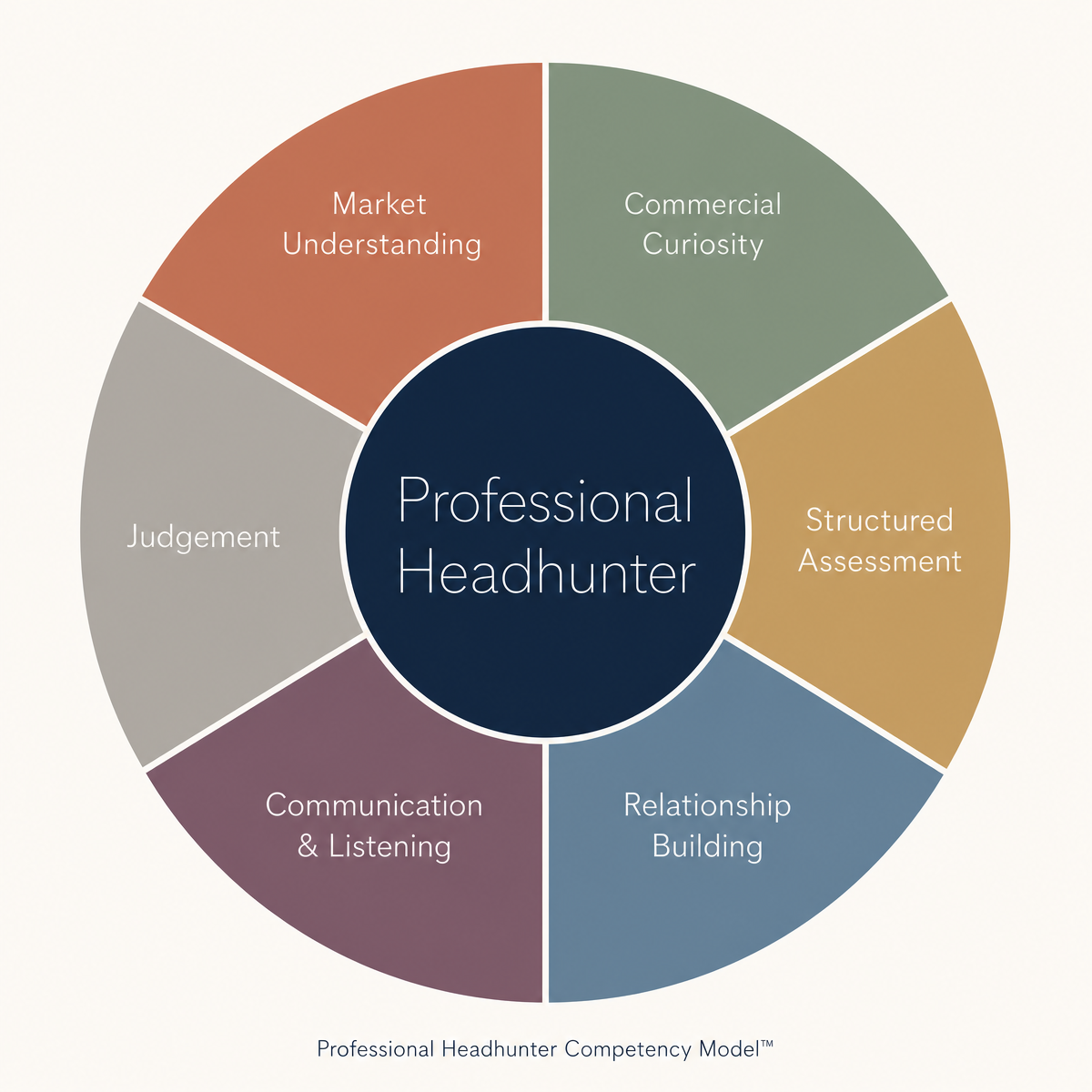
Professional Headhunter Competency Model
Saiyō framework
Professional Headhunter Competency Model
Great headhunting is the combination of six capabilities rather than excellence in any single one.
Professional headhunting is the combination of these capabilities rather than excellence in any single one.
Experience still matters
Recruitment technology has improved enormously.
Artificial intelligence will continue to transform the profession over the coming decade.
These developments are positive.
They remove administration.
They accelerate research.
They improve productivity.
What they do not replace is experience.
Knowing which questions to ask, recognising potential, understanding markets and reducing uncertainty remain deeply human capabilities developed through years of observing successful and unsuccessful hiring decisions.
Technology changes how professional headhunters work.
Experience continues to influence how well they work.
The Saiyō View
We believe the best professional headhunters are not simply recruiters with larger networks.
They are market specialists.
They understand industries deeply, approach hiring commercially and help organisations make more confident decisions by combining structured research, thoughtful assessment and meaningful conversations.
Their value is measured less by the number of candidates they introduce and more by the quality of the hiring decisions they help create.
Explored in depth
This topic is explored in more depth within What is the difference between sourcing and headhunting?.
Frequently asked questions
See this in practice
Move from the concept to the way Saiyō delivers it.
Related questions
What does a professional headhunter actually do?
A professional headhunter helps organisations make better hiring decisions by systematically identifying, engaging and assessing exceptional people who are unlikely to enter a conventional recruitment process. Their role is not simply to introduce candidates, it is to ensure hiring decisions are made against the strongest talent available in the market.
Read the answerAnswerWhat is the difference between sourcing and headhunting?
Yes. Professional headhunting is a specialist discipline within the wider field of recruitment, but the two are not the same thing. Recruitment describes the broad process of attracting, assessing and hiring people through many channels. Professional headhunting is a specific methodology designed to identify, engage and assess exceptional people who are unlikely to enter a conventional recruitment process.
Read the answerAnswerWhy do headhunters still cold call candidates?
Professional headhunters continue to cold call because conversations remain one of the most effective ways to engage highly experienced professionals who are unlikely to enter a conventional recruitment process. Written outreach creates awareness, but a thoughtful conversation creates the understanding and trust that career decisions are built on.
Read the answerAnswerIs LinkedIn outreach the same as headhunting?
No. LinkedIn outreach and professional headhunting are closely related, but they are not the same thing. LinkedIn is a communication channel. Professional headhunting is a methodology. The distinction is not the platform being used. It is the objective, the methodology and the part of the talent market the recruiter is trying to reach.
Read the answerAnswerWhat is the difference between executive search and headhunting?
Executive search and headhunting are not the same thing. Executive search describes a type of assignment and the advisory service built around it. Headhunting describes a methodology for finding and engaging people who are hard to reach through conventional recruitment. The two often overlap, but they solve different problems.
Read the answer