Candidate Quality
Authority GuideWhat is the difference between sourcing and headhunting?
Co-founder and CEO
The difference between sourcing and headhunting is one of purpose rather than tooling: both may start with a search, but only one is designed to persuade someone who was not looking. The word headhunting is used more frequently today than at any point in the history of recruitment and has become so broad that it now means different things to different people, which is why the distinction is worth setting out clearly.
The short answer
Sourcing identifies and contacts people who match a brief, usually at volume and from searchable places such as databases, job boards and professional networks. Headhunting maps a market, targets a small number of exceptional people who are succeeding where they are, and creates the context that lets them consider a genuinely better move. Sourcing fills a pipeline; headhunting reaches people who would never enter one.
Why the definition of headhunting matters more than ever
The word headhunting is used more frequently today than at any point in the history of recruitment.
Job adverts describe recruiters as headhunters. LinkedIn profiles are filled with references to headhunting. Recruitment agencies regularly position themselves as headhunting specialists, regardless of whether they focus on executive appointments, contingency recruitment or outbound sourcing.
The difficulty is that the term has gradually become so broad that it now means different things to different people.
For some, headhunting simply describes contacting candidates who have not applied for a role. For others, it refers exclusively to executive search. Increasingly, the rise of LinkedIn Recruiter, sourcing technology and AI has blurred the distinction even further. Sending personalised outreach messages is often described as headhunting, despite requiring a fundamentally different approach from the discipline traditionally associated with professional search.
This matters because language shapes expectations.
If every form of outbound recruitment is described as headhunting, organisations lose the ability to distinguish between very different hiring methodologies. Activities that produce very different outcomes begin to appear interchangeable, making it more difficult for hiring leaders to decide which approach is most appropriate for the challenge they are trying to solve.
We believe professional headhunting deserves a clearer definition.
Not because the terminology itself is important, but because the methodology behind it remains one of the most effective ways of identifying and engaging exceptional people who would otherwise never enter a recruitment process.
Headhunting is not defined by the tools
One of the most significant changes in recruitment over the last fifteen years has been the rapid expansion of sourcing technology.
Professional networks have become searchable. Contact information is easier to obtain. Artificial intelligence can identify suitable candidates in seconds and automate many of the repetitive tasks that once consumed a recruiter's day.
These developments have transformed recruitment.
They have not transformed the purpose of headhunting.
Technology changes how information is gathered. It does not change how exceptional people make career decisions.
This is an important distinction because many organisations now define headhunting by the tools being used rather than the outcome being achieved. If a recruiter sends a personalised LinkedIn message to somebody who has not applied, that activity is frequently described as headhunting.
We would argue it is something different. It is proactive recruitment.
Professional headhunting begins at a different point. It begins with understanding a market, identifying individuals capable of solving a specific business problem and creating conversations that would never otherwise have taken place.
The technology is simply the mechanism that supports that work. It is not the discipline itself.
Recruitment and headhunting solve different problems
Recruitment and headhunting are often presented as competing approaches.
In reality, they exist to solve different hiring challenges.
Recruitment is primarily concerned with connecting organisations to people who are already accessible through the recruitment market. That may involve advertising, referrals, recruiter networks, LinkedIn sourcing or outbound messaging. These approaches are highly effective when suitable candidates are already willing to engage with new opportunities.
Professional headhunting exists for a different reason.
Its purpose is to reach individuals who are unlikely to become visible through those channels. These are often people who are performing well, progressing within their careers and have little reason to explore alternative opportunities unless somebody creates a compelling reason to do so.
This distinction is subtle, but important.
The objective of professional headhunting is not simply to contact passive candidates. It is to influence access to parts of the market that conventional recruitment struggles to reach.
The Headhunting Spectrum
One of the reasons confusion exists is that recruitment activity sits on a spectrum rather than within clearly defined categories.
Every hiring method provides access to a different proportion of the available talent market. Some methods naturally reach active candidates. Others extend into increasingly inaccessible parts of the market.
Professional headhunting sits at the far end of that spectrum because it is specifically designed to engage individuals who would not normally participate in recruitment activity.
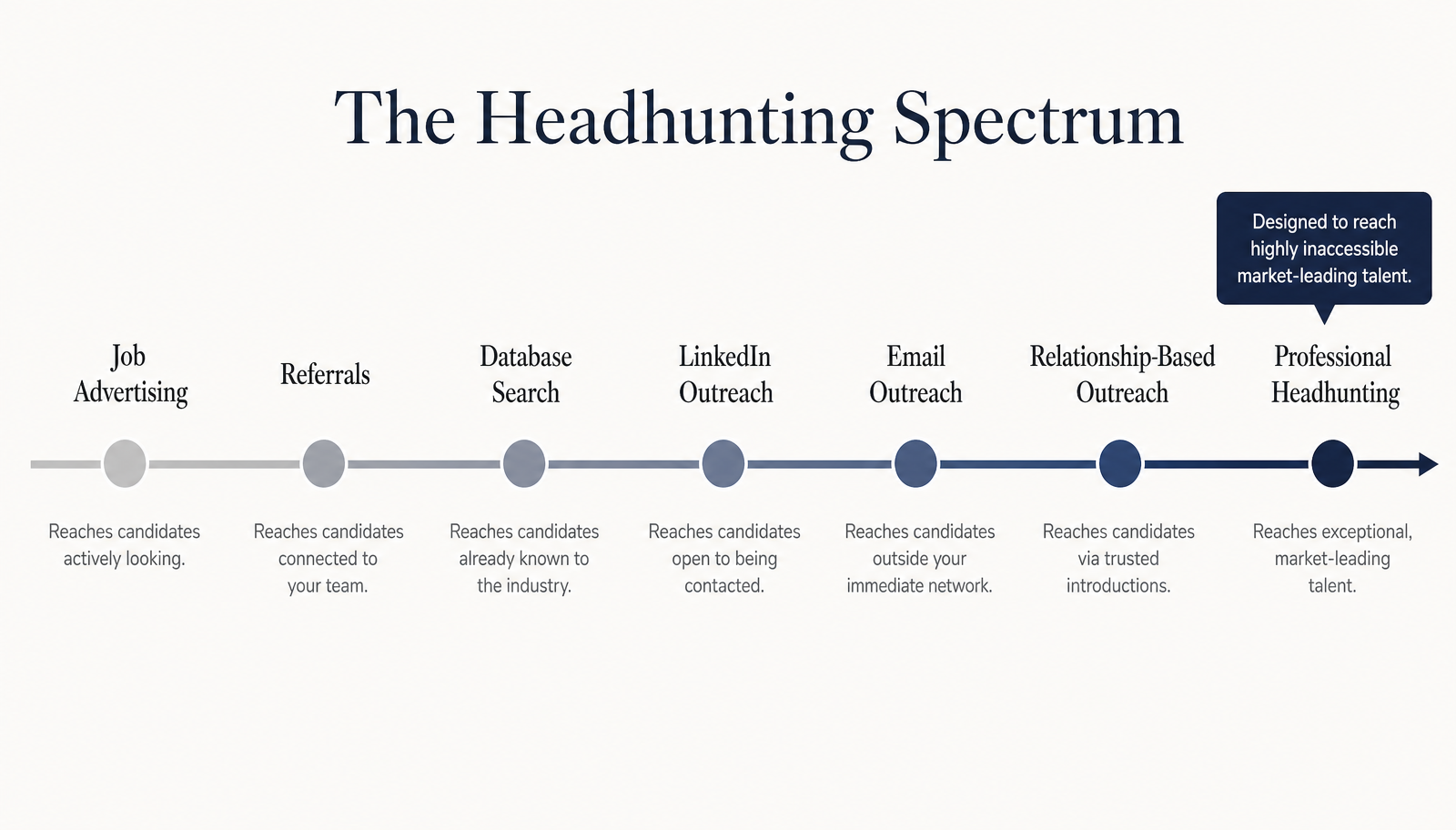
Saiyō framework
The Headhunting Spectrum
Every hiring method reaches a different part of the market. Professional headhunting sits at the far end of the spectrum.
The purpose of this framework is not to suggest that one hiring method replaces another. Each has value.
The important point is that they do not all provide access to the same people. Treating them as interchangeable often leads organisations to overestimate how much of the market they are genuinely reaching.
Why conversations remain the defining characteristic of professional headhunting
One of the questions we are frequently asked is whether artificial intelligence will eventually replace professional headhunters.
Our answer is almost always the same.
Artificial intelligence will make professional headhunters significantly more productive. It will not replace the conversations that determine whether exceptional people decide to change their careers.
This is because career decisions are rarely driven by information alone.
Highly successful professionals are not waiting for another recruiter to tell them a vacancy exists. They already have more opportunities than they are likely to pursue.
What influences them is context.
- Why does this opportunity matter?
- Why now?
- Why this leadership team?
- Why this company rather than another?
- How does this move improve the next five years of my career rather than simply the next twelve months?
Those discussions cannot be reduced to automation. They require credibility, judgement and genuine curiosity.
Professional headhunting is ultimately built on conversations rather than messages. Technology should make those conversations better informed. It should never replace them.
Activity and access are not the same thing
Modern recruitment platforms make it remarkably easy to measure activity.
- LinkedIn messages sent.
- Emails delivered.
- Connection requests accepted.
- Candidates sourced.
These metrics create the impression of progress because they are visible, measurable and easy to report.
The problem is that activity tells us very little about market access.
Sending one thousand LinkedIn messages to the same talent pool does not necessarily increase the proportion of the market an organisation can reach.
Similarly, a carefully researched series of conversations with twenty exceptional individuals may produce dramatically better hiring outcomes than a much larger volume of automated outreach.
Professional headhunting has never been about maximising activity. It has always been about maximising access.
That distinction becomes increasingly important as organisations compete for people who are succeeding in their current roles and have little reason to engage with conventional recruitment channels.
The future of professional headhunting
Technology will continue to reshape recruitment over the coming decade.
Artificial intelligence will improve research, automate administration and reduce many of the repetitive tasks that previously occupied recruitment teams. Organisations will gain greater visibility into talent markets and recruiters will become significantly more productive.
None of these developments reduce the importance of professional headhunting.
If anything, they increase it.
As sourcing technology becomes universally available, competitive advantage shifts away from finding candidates and towards influencing exceptional people. Market knowledge, judgement, credibility and the ability to build trusted relationships become increasingly valuable because they are much harder to replicate through technology alone.
Professional headhunting will remain the discipline that reaches the people conventional recruitment cannot. What will change is how much more effectively it can be delivered when technology is used to sharpen, rather than replace, the work.
Key takeaways
- Headhunting is now used so broadly that very different hiring methodologies are treated as interchangeable.
- Professional headhunting is not defined by the tools used, technology has changed how information is gathered, not how exceptional people make career decisions.
- Recruitment reaches candidates already accessible through the market. Headhunting exists to reach people who would not normally participate in a recruitment process.
- Conversations, not messages, are the defining characteristic of professional headhunting.
- Activity and access are not the same thing. More outreach does not automatically mean access to better people.
Frequently asked questions
See this in practice
Move from the concept to the way Saiyō delivers it.
Related reading
What is embedded recruitment?
Embedded headhunting combines the proactive search capability of a specialist headhunt firm with the operational integration of an internal talent team.
ReadHow do you reach passive candidates who are not applying?
The strongest candidates rarely enter the recruitment market because their current role already works. Reaching them takes market understanding, credibility and real conversations.
ReadRelated questions
What does a professional headhunter actually do?
A professional headhunter helps organisations make better hiring decisions by systematically identifying, engaging and assessing exceptional people who are unlikely to enter a conventional recruitment process. Their role is not simply to introduce candidates, it is to ensure hiring decisions are made against the strongest talent available in the market.
Read the answerAnswerWhat is the difference between sourcing and headhunting?
Yes. Professional headhunting is a specialist discipline within the wider field of recruitment, but the two are not the same thing. Recruitment describes the broad process of attracting, assessing and hiring people through many channels. Professional headhunting is a specific methodology designed to identify, engage and assess exceptional people who are unlikely to enter a conventional recruitment process.
Read the answerAnswerWhy do headhunters still cold call candidates?
Professional headhunters continue to cold call because conversations remain one of the most effective ways to engage highly experienced professionals who are unlikely to enter a conventional recruitment process. Written outreach creates awareness, but a thoughtful conversation creates the understanding and trust that career decisions are built on.
Read the answerAnswerIs LinkedIn outreach the same as headhunting?
No. LinkedIn outreach and professional headhunting are closely related, but they are not the same thing. LinkedIn is a communication channel. Professional headhunting is a methodology. The distinction is not the platform being used. It is the objective, the methodology and the part of the talent market the recruiter is trying to reach.
Read the answerAnswerWhat makes a good headhunter?
A good headhunter is defined by the ability to understand talent markets, identify exceptional people, assess capability accurately and create conversations that would not otherwise happen. The strongest headhunters help organisations make better hiring decisions because they reduce uncertainty long before interviews begin.
Read the answerAnswerWhat is the difference between executive search and headhunting?
Executive search and headhunting are not the same thing. Executive search describes a type of assignment and the advisory service built around it. Headhunting describes a methodology for finding and engaging people who are hard to reach through conventional recruitment. The two often overlap, but they solve different problems.
Read the answer