Candidate Quality
Why do headhunters still cold call candidates?
Co-founder and CEO
The short answer
Professional headhunters continue to cold call because conversations remain one of the most effective ways to engage highly experienced professionals who are unlikely to enter a conventional recruitment process. Written outreach creates awareness, but a thoughtful conversation creates the understanding and trust that career decisions are built on.
Professional headhunters continue to cold call candidates because conversations remain one of the most effective ways of engaging highly experienced professionals who are unlikely to enter a conventional recruitment process. While email, LinkedIn and AI have transformed recruitment, they have not changed how important career decisions are made. The strongest candidates rarely change jobs because they receive another written message. They change jobs because a meaningful conversation helps them see an opportunity differently.
For many people, the phrase cold calling immediately creates negative associations
They imagine high-volume sales techniques, scripted conversations and persistent interruptions.
Professional headhunting should be understood very differently.
The purpose of the call is not to persuade somebody to accept a job.
It is to determine whether a conversation is worth having.
Most exceptional candidates are not waiting for recruitment messages
One of the biggest assumptions in modern recruitment is that exceptional candidates are actively monitoring LinkedIn or regularly reading recruitment emails.
For some professionals, that is certainly true.
For many of the people organisations most want to hire, it is not.
Highly experienced sales leaders, product executives, customer success specialists and commercial leaders are usually busy building successful careers. They spend their time leading teams, working with customers and solving business problems rather than browsing recruitment platforms.
Many receive dozens of recruiter messages every month.
Some receive several every week.
The result is not that they become easier to recruit.
It is that written outreach becomes easier to ignore.
This is one of the reasons professional headhunters continue to value conversations. A thoughtful conversation immediately creates context that a written message often cannot.
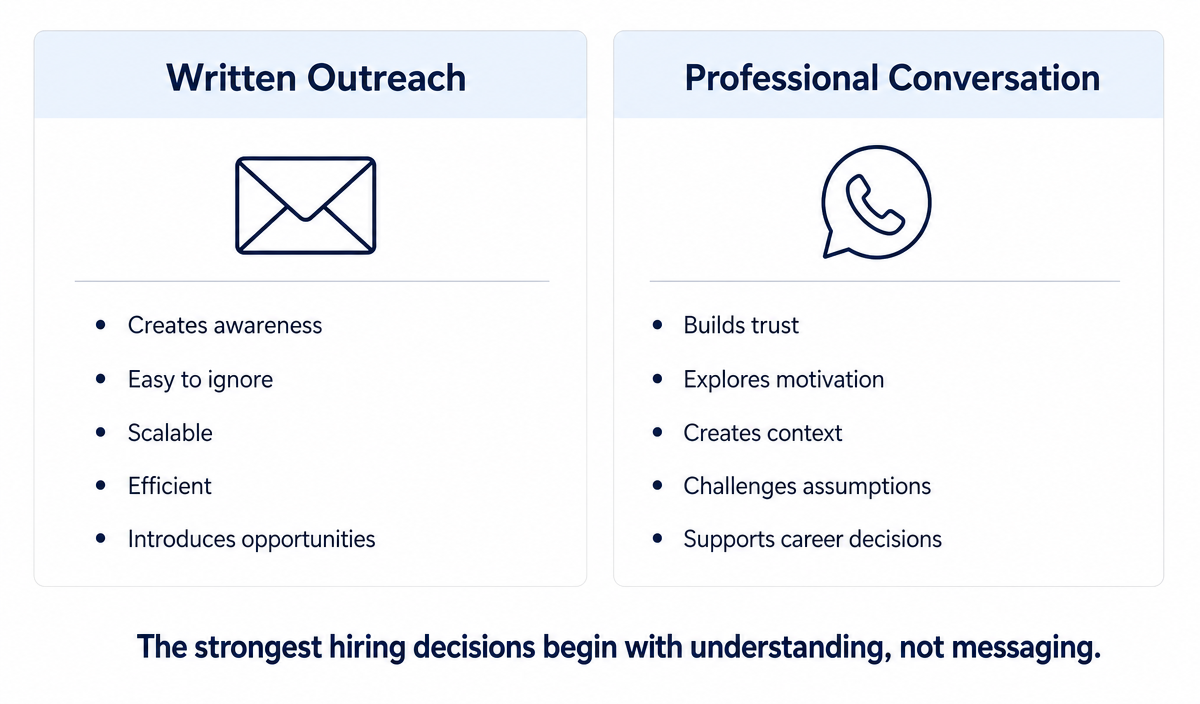
Written outreach is excellent at creating awareness
It is less effective at creating understanding.
This is an important distinction.
LinkedIn messages and emails play an important role within modern recruitment.
They introduce opportunities.
They share information.
They make it easier for people to decide whether they would like to learn more.
Used well, they remain highly valuable.
The limitation is that they rely on the recipient choosing to engage.
Highly inaccessible talent often has very little reason to do so.
A message competes with hundreds of other notifications, meetings and priorities.
Ignoring it requires almost no effort.
A conversation works differently.
Once somebody has agreed to spend a few minutes talking, they naturally become more curious. Questions are asked. Assumptions are challenged. Information flows in both directions. The discussion becomes less about a vacancy and more about whether the opportunity represents a genuinely interesting career move.
That depth of understanding is difficult to achieve through written communication alone.
Professional headhunting is built on dialogue, not persuasion
One misconception about headhunting is that the objective is to convince people to leave their current employer.
That is not how experienced headhunters think.
The purpose of the conversation is to understand.
Why is this person successful?
What motivates them?
What would they need to see before considering a move?
Is this opportunity genuinely capable of improving their career?
Sometimes the answer is no.
A professional headhunter should be comfortable concluding that somebody is better remaining exactly where they are.
The value comes from understanding the market accurately rather than forcing every conversation towards a recruitment outcome.
This is another reason conversations remain so important. They reveal nuance that rarely appears in written correspondence.
Telephone conversations create information that technology cannot
Artificial intelligence is changing almost every part of recruitment.
Research is faster.
Administration is more efficient.
Candidate information is easier to analyse.
These developments make professional headhunters significantly more productive.
What technology still struggles to capture is judgement.
During a conversation, experienced headhunters begin to understand communication style, commercial thinking, curiosity, humility, ambition and self-awareness. They hear how somebody describes success, how they explain setbacks and how they think about the future.
These insights are difficult to infer from a LinkedIn profile or CV.
They emerge through discussion.
That is why conversations remain one of the highest-value activities within professional headhunting.
Cold calling is not about volume
It is about relevance.
There is a significant difference between high-volume sales calling and professional headhunting.
Sales activity often measures success through the number of calls made.
Professional headhunting measures success by the quality of the conversations created.
A carefully researched call to somebody with highly relevant experience is fundamentally different from contacting hundreds of people with little preparation.
Research comes first.
Understanding comes second.
The conversation comes third.
Without those first two stages, it is simply another unsolicited call.
Professional headhunting earns the conversation by demonstrating credibility, relevance and genuine understanding of the candidate's background.
The future is not calls or AI
It is calls supported by AI.
Some commentators have suggested that artificial intelligence will eventually remove the need for direct conversations in recruitment.
We believe the opposite is more likely.
As AI automates research, sourcing and administration, professional headhunters gain more time to prepare for the conversations that matter most.
Technology removes repetitive work.
People spend more time applying judgement.
The conversation therefore becomes more valuable rather than less.
The future of professional headhunting is unlikely to involve fewer conversations.
It will involve better prepared ones.
Why conversations still matter
Saiyō framework
The Conversation Advantage
Real conversations outperform templated outreach by an order of magnitude.
The Saiyō View
We do not believe telephone conversations are valuable because they are traditional.
We believe they are valuable because they create understanding.
The strongest people in the market rarely make career decisions after reading a message.
They make those decisions after understanding why an opportunity matters, how it compares with their current role and whether it genuinely improves the next stage of their career.
Technology should make those conversations more informed.
It should never remove the need for them.
Explored in depth
This topic is explored in more depth within What is the difference between sourcing and headhunting?.
Frequently asked questions
See this in practice
Move from the concept to the way Saiyō delivers it.
Related questions
What does a professional headhunter actually do?
A professional headhunter helps organisations make better hiring decisions by systematically identifying, engaging and assessing exceptional people who are unlikely to enter a conventional recruitment process. Their role is not simply to introduce candidates, it is to ensure hiring decisions are made against the strongest talent available in the market.
Read the answerAnswerWhat is the difference between sourcing and headhunting?
Yes. Professional headhunting is a specialist discipline within the wider field of recruitment, but the two are not the same thing. Recruitment describes the broad process of attracting, assessing and hiring people through many channels. Professional headhunting is a specific methodology designed to identify, engage and assess exceptional people who are unlikely to enter a conventional recruitment process.
Read the answerAnswerHow is embedded recruitment different from a recruitment agency?
Embedded Headhunting is a subscription model in which specialist headhunters work inside your hiring function, whereas agencies typically work on a contingent, per-placement basis. The embedded model provides dedicated capacity, deeper integration and proactive market search rather than competing for the same active candidates.
Read the answerAnswerIs LinkedIn outreach the same as headhunting?
No. LinkedIn outreach and professional headhunting are closely related, but they are not the same thing. LinkedIn is a communication channel. Professional headhunting is a methodology. The distinction is not the platform being used. It is the objective, the methodology and the part of the talent market the recruiter is trying to reach.
Read the answerAnswerWhat makes a good headhunter?
A good headhunter is defined by the ability to understand talent markets, identify exceptional people, assess capability accurately and create conversations that would not otherwise happen. The strongest headhunters help organisations make better hiring decisions because they reduce uncertainty long before interviews begin.
Read the answerAnswerWhat is the difference between executive search and headhunting?
Executive search and headhunting are not the same thing. Executive search describes a type of assignment and the advisory service built around it. Headhunting describes a methodology for finding and engaging people who are hard to reach through conventional recruitment. The two often overlap, but they solve different problems.
Read the answer