Candidate Quality
Authority GuideHow do you reach passive candidates who are not applying?
Co-founder and CEO
Reaching passive candidates starts with accepting that the application pipeline is not the market. It represents only the people willing to become visible at that moment, and for specialist and leadership roles that leaves a structural blind spot: a company can process hundreds of applicants efficiently and still fail to consider the people most capable of changing its performance.
The short answer
You reach passive candidates who are not applying by going to them: map the market to identify the people who genuinely fit, approach them with relevance and credibility, and offer a conversation rather than a job advert. The strongest candidates rarely apply because they have the least reason to enter the recruitment market. They are performing well, progressing where they are and receiving regular approaches, so an advert has to compete with a career that already works.
Why this matters
Application pipelines are often treated as a proxy for the talent market, even though they represent only the people willing to become visible at that moment. For specialist and leadership roles, this creates a structural blind spot because many of the strongest potential hires remain outside the funnel. A company can process hundreds of applicants efficiently and still fail to consider the people most capable of changing its performance.
The central idea
Talent accessibility sits on a spectrum rather than in two simple categories of active and passive. The more successful and settled somebody becomes, the less likely they are to respond to generic recruitment activity, and the more important relevance, credibility and direct conversation become.
The purpose of headhunting is to close the gap between the people a company can easily reach and the stronger market that exists beyond them.
How to apply it
1. Define the business problem and the evidence of success before looking at profiles
Write down the commercial outcome the hire is expected to produce and the evidence that will show it. That converts a vague brief into a shared standard the hiring team, recruiters and any external partners can be measured against.
2. Map the organisations and environments most likely to produce relevant people
Start with the market, not the candidate. Companies solving comparable problems, at a comparable stage, in comparable conditions are usually more predictive of success than familiar logos or well-known job titles.
3. Identify individuals across the full accessibility spectrum
Build a target list that includes people who are actively looking, occasionally curious, quietly successful and fundamentally not looking. If the list only contains people who have signalled interest, the search has already narrowed to the easiest slice of the market.
4. Use research, networks, written outreach and direct conversations to create access
Different tiers of the market respond to different approaches. Written outreach may open doors at the top of the funnel; senior and highly settled people usually need a warm introduction, relevant context and a proper conversation before they engage.
5. Assess inbound and headhunted candidates against the same market-defined standard
Once the market standard is set, apply it evenly. Inbound candidates should not be advantaged by convenience, and headhunted candidates should not be advantaged by scarcity. Both are measured against the evidence the role requires.
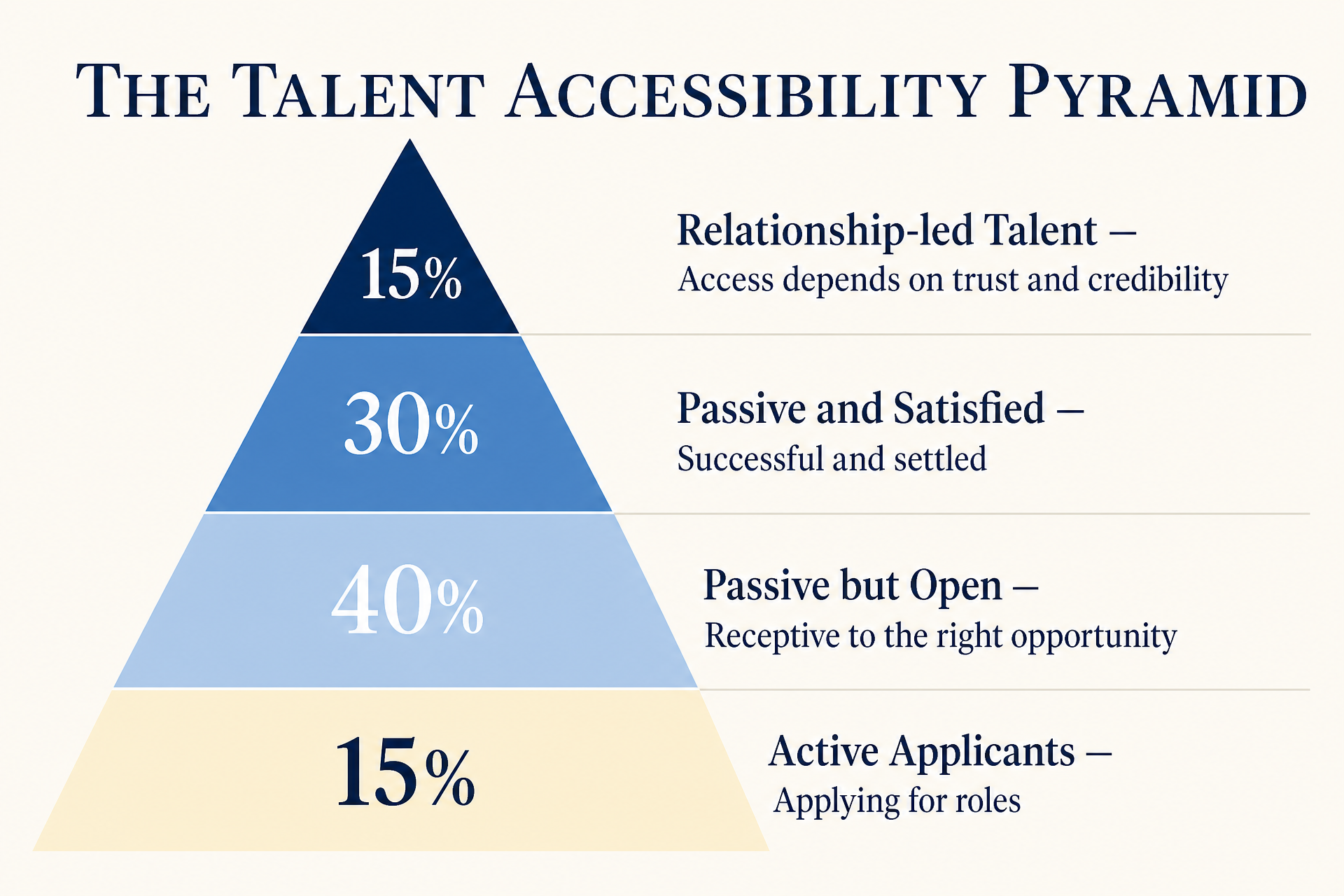
Saiyō framework
The Talent Accessibility Pyramid
The best candidates rarely apply. Access is layered.
Indicative distribution based on analysis of Gallup, LinkedIn and wider talent-market research. Actual accessibility varies by role, seniority, geography and market conditions.
Where organisations usually go wrong
The most common failures are structural rather than a reflection of effort. Recognising the pattern early lets the operating model change before more activity is added.
- Assuming application volume is evidence of candidate quality.
- Using the first credible applicants to define the hiring bar.
- Treating all passive candidates as equally reachable through LinkedIn or email.
- Escalating activity without changing the market being targeted.
- Allowing speed pressure to narrow the search before the market is understood.
Practical application for technology scale-ups
Talent Leaders should ask whether a shortlist represents the market, not merely whether it contains enough interviewable people. That means reviewing market coverage, the proportion of candidates who were not actively looking, the quality of evidence gathered before interview and the reasons strong individuals chose not to engage. Inbound remains valuable, but it should be judged against the best available market rather than allowed to set the standard by default.
Where the idea has limits
Not every outstanding employee is highly inaccessible and not every applicant is weak. Some exceptional people apply because of a change in personal circumstances, a compelling employer brand or a deliberate career decision. The framework is intended to improve market coverage, not to dismiss active candidates.
The Saiyō view
Saiyō believes the best candidates rarely apply because they do not need to. A mature hiring function therefore measures its ability to access the wider market rather than relying on application volume as reassurance. The hiring bar should be defined by the strongest talent available, with applicants and headhunted candidates assessed against the same evidence-based standard.
Key takeaways
- The strongest candidates rarely apply because they have the least reason to enter the recruitment market.
- Talent accessibility is a spectrum, not a binary between active and passive.
- Define the business problem and the evidence of success before looking at profiles.
- Application volume is not evidence of candidate quality.
- Judge every hire against the best available market, not against the pipeline that happened to arrive.
Frequently asked questions
See this in practice
Move from the concept to the way Saiyō delivers it.
Related questions
Why do high performers rarely apply for jobs?
High performers rarely apply because their current role already rewards them with progress, credibility and financial security. They also receive frequent approaches, which makes generic opportunities easy to ignore. They engage when somebody understands their market and presents a credible long-term reason to talk.
Read the answerAnswerHow can an internal talent acquisition team reach more passive candidates?
Passive candidates are attracted through relevance rather than volume. A strong approach begins with understanding their career context, explains why the opportunity is specifically relevant and creates a low-pressure conversation before asking for commitment. Employer credibility, leadership quality, role scope and long-term career value normally matter more than a polished job advert.
Read the answerAnswerIs candidate volume a useful measure of hiring quality?
Candidate volume is useful for understanding workload and channel performance, but it is not a reliable measure of hiring quality. A large pipeline can contain very few people capable of succeeding, while a tightly researched search may produce a small number of exceptional candidates. Quality should be assessed through market coverage, shortlist strength, interview conversion, offer acceptance and eventual performance.
Read the answerAnswerHow should inbound applicants be assessed against headhunted candidates?
Inbound and headhunted candidates should be assessed against the same role scorecard and market-defined standard. The route into the process should not create an advantage or disadvantage. Define what exceptional looks like before applications are reviewed, then compare every candidate using consistent evidence, competencies and context.
Read the answer