Technology Scale-up Hiring
Authority GuideChoosing a Hiring Model for a Technology Scale-up
Co-founder and CEO
Technology companies often select hiring support reactively, adding agencies, recruiters or outsourced capacity after vacancies become urgent. That produces fragmented ownership, inconsistent employer messaging and commercial models that no longer reflect the company's hiring pattern. A hiring operating model should be chosen before the annual plan begins, with clear rules for which work belongs where.
The short answer
The right hiring model depends on the pattern of hiring rather than company size alone. Agencies suit occasional specialist requirements, internal Talent Acquisition provides ownership and continuity, executive search supports selected senior appointments, RPO provides enterprise-scale operations and Embedded Headhunting supports continuous specialist hiring where market access and integration are both important. Most mature scale-ups use a deliberate combination rather than forcing every role through one channel.
Why this matters
Technology companies often select hiring support reactively, adding agencies, recruiters or outsourced capacity after vacancies become urgent. This produces fragmented ownership, inconsistent employer messaging and commercial models that no longer reflect the company's hiring pattern. A hiring operating model should be chosen before the annual plan begins, with clear rules for which work belongs where.
The central idea
Every hiring model solves a different problem and should be evaluated against role complexity, hiring frequency, required integration, market accessibility and cost predictability. The objective is not to identify one universally superior model, but to allocate each hiring challenge to the method best designed to solve it. A coherent portfolio of models is often more effective than a single-provider strategy.
How to apply it
1. Segment annual hiring by volume, scarcity, seniority and strategic importance
Break the annual plan into role families and rate each on how often it recurs, how scarce the market is and how commercially important each hire is. Different segments will suit different delivery models.
2. Assess internal capacity for operations, sourcing, assessment and stakeholder management
Be honest about what the internal team can genuinely own alongside its current workload. Any capability the team cannot sustain becomes an implicit dependency on external support.
3. Define which roles require direct market search and which can rely on attraction
Roles that require access to highly settled or highly specialised talent belong in a search-led model. Roles that can be filled through employer brand and inbound belong in an attraction-led model.
4. Compare commercial models using total annual cost and business impact
A single fee comparison is misleading. Compare projected annual spend, vacancy cost, hiring-manager time and predictability across each option, not just the invoice per hire.
5. Create clear routing rules for internal TA, embedded support, agencies and executive search
Write down the rule for which channel gets which role, and who approves exceptions. Ambiguity is the main reason organisations drift into fragmented supplier use.
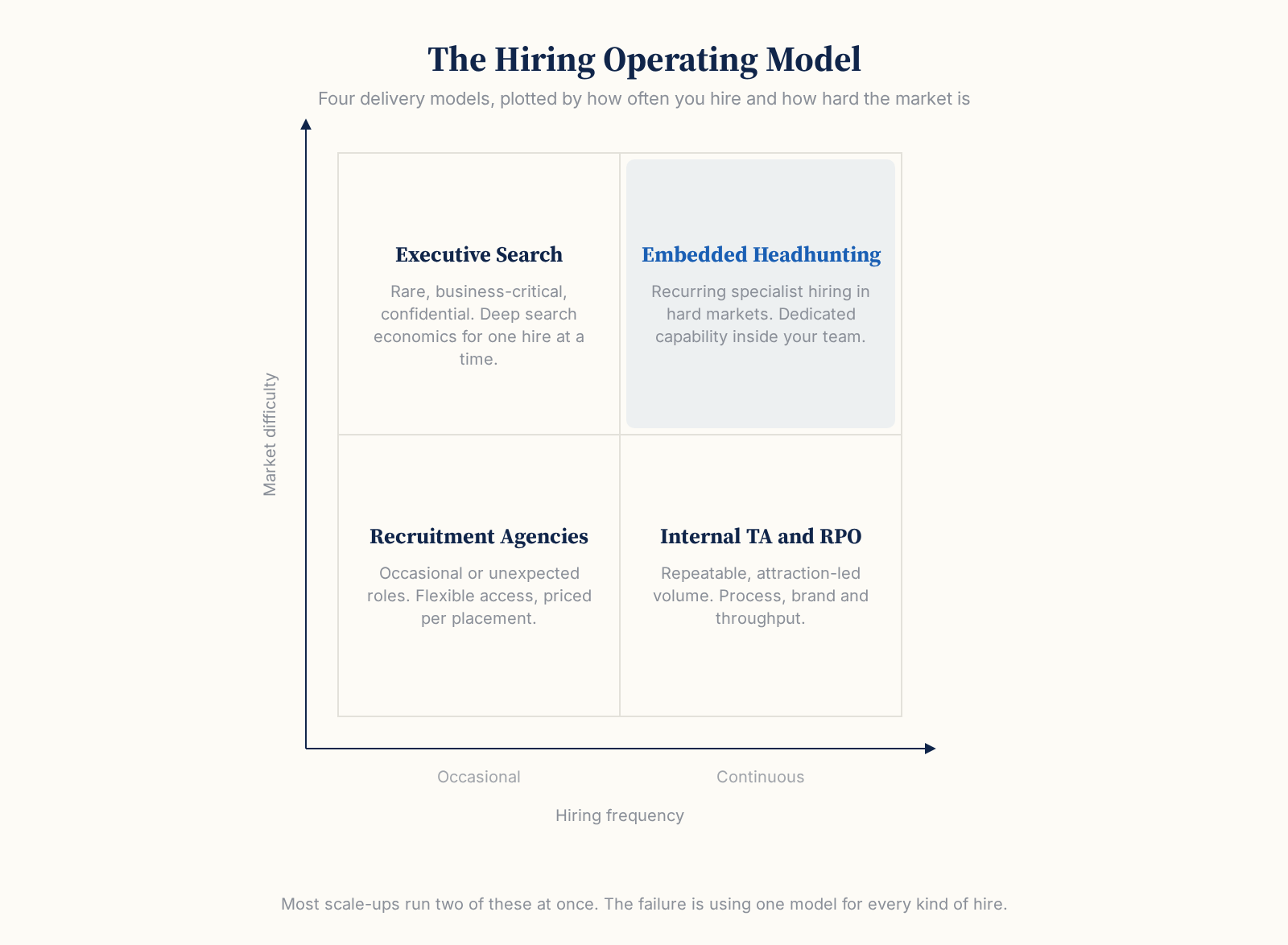
Saiyō framework
The Hiring Operating Model
Four mutually-exclusive delivery models: internal TA, agency, RPO and embedded headhunting.
Where organisations usually go wrong
The most common failures are structural rather than a reflection of effort. Recognising the pattern early lets the operating model change before more activity is added.
- Using agencies by default because the internal team is overloaded.
- Selecting RPO because it appears to be the only alternative to agency spend.
- Building permanent internal capacity for temporary peaks.
- Using executive search economics for recurring specialist roles.
- Measuring providers against incompatible objectives.
Practical application for technology scale-ups
A useful operating model separates recurring specialist hiring from occasional exceptions. Internal TA should retain ownership of strategy, employer brand and process, while dedicated search capability can be added where the market is difficult to reach. Agencies and executive search can then be reserved for genuine exceptions rather than becoming a permanent response to structural gaps.
Where the idea has limits
The model should remain flexible because hiring plans change quickly in technology companies. A structure that is efficient during expansion may become unnecessarily fixed during a hiring slowdown. Annual reviews should test whether capacity, cost and quality still match the company's current stage.
The Saiyō view
Saiyō believes the best hiring teams do not choose one method and defend it for every role. They understand which problem each model solves and build an operating system that combines internal ownership with the right external capability. Embedded Headhunting is most valuable in the space between occasional agency assignments and enterprise-scale RPO.
Key takeaways
- Choose hiring models against the pattern of hiring, not the size of the company.
- Each model solves a different problem; combine them deliberately.
- Compare total annual cost and business impact, not per-hire fees.
- Write down routing rules before the year begins.
- Reserve executive search economics for genuine leadership exceptions, not recurring specialist roles.
Frequently asked questions
See this in practice
Move from the concept to the way Saiyō delivers it.
Related questions
Which hiring model is best for a technology scale-up?
There is no single best hiring model for every scale-up. The correct choice depends on whether hiring is occasional or continuous, whether the talent is accessible, how much operational integration is required and how predictable costs need to be. Most scale-ups benefit from internal ownership supported by a mix of embedded headhunting, selective agencies and executive search.
Read the answerAnswerAgency, RPO or internal TA: how do you choose?
Choose internal TA when the company needs long-term ownership and recurring recruitment capability, agencies when specialist hiring is occasional, and RPO when operational scale and standardisation are the main challenge. Embedded Headhunting fits where continuous specialist hiring requires both proactive market search and integration. The decision should be based on the problem, not on which provider category is most familiar.
Read the answerAnswerWhen should executive search be used?
Executive search should be used when a senior appointment requires confidential market coverage, board-level stakeholder management, leadership assessment or advisory work beyond candidate introduction. It is particularly suitable for chief executive, board and selected C-suite roles. Recurring specialist leadership hiring may be better served by an embedded headhunting model using similar search discipline over a longer period.
Read the answerAnswerCan a company use several hiring models at once?
Yes. Most mature technology companies use several hiring models at the same time. Internal TA may own the function, Embedded Headhunting may support continuous specialist searches, agencies may cover unexpected niche requirements and executive search may handle selected leadership appointments. The important point is to define ownership and avoid duplicated effort.
Read the answer