Saiyō framework
The Specialist Hiring Curve
Market time to hire rises with specialism. It does not have to.
What the framework says
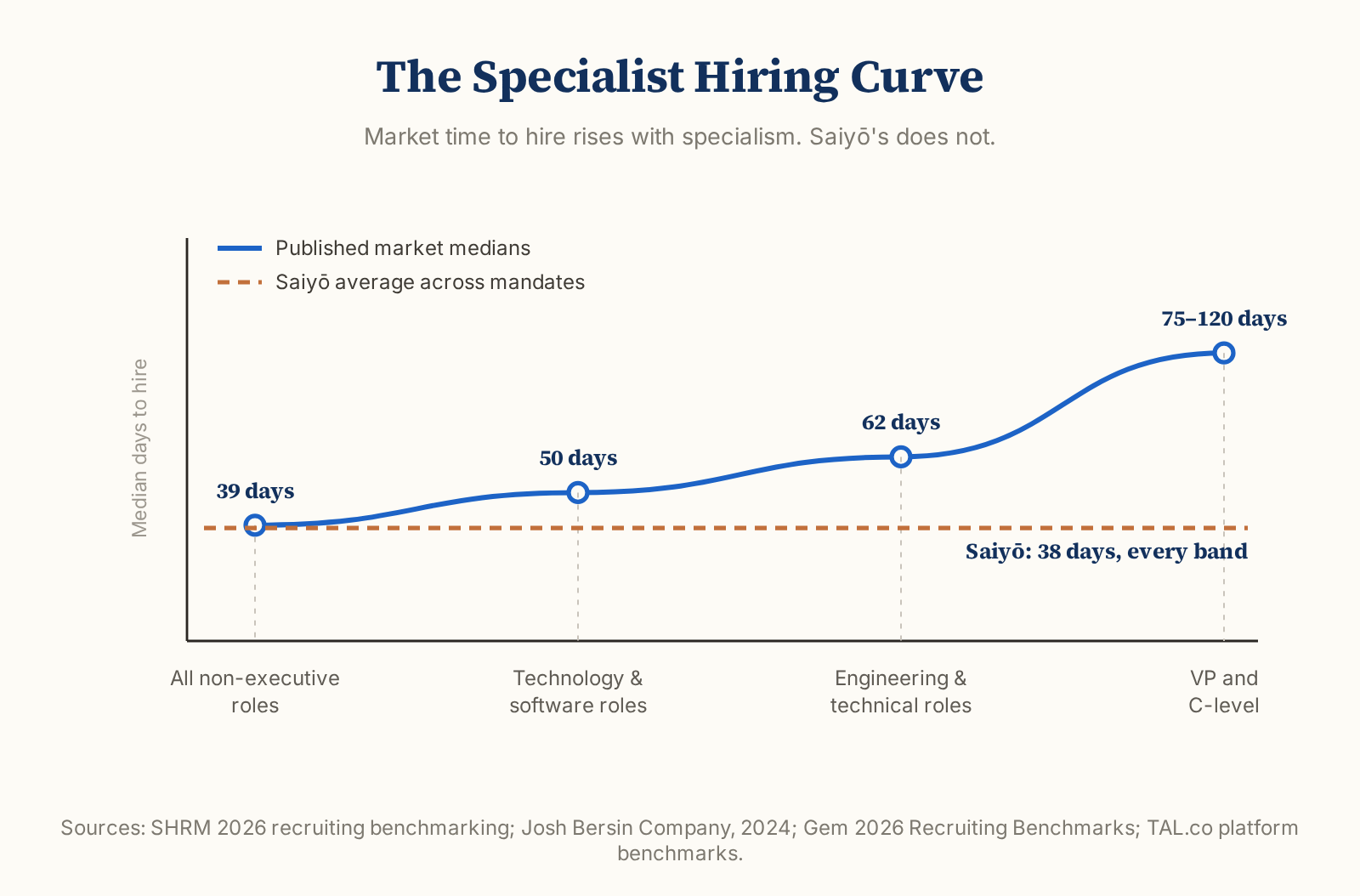
Published benchmarks show time to hire climbing steeply as roles get more specialist. The SHRM 2026 benchmarking puts the median across all non-executive roles at 39 days. The Josh Bersin Company puts technology and software roles at around 50 days, and Gem's 2026 recruiting benchmarks put engineering and technical roles at around 62 days. VP and C-level searches routinely run 75 to 120 days. The curve steepens because the qualified population shrinks and the accessible share of it shrinks faster, so the same team that hits its shortlist target for volume roles misses it consistently for scarce ones. Saiyō's own average across mandates is 38 days regardless of band, because market mapping and headhunting start before the requisition rather than after it. The point of the curve is not that specialist hiring is slow, it is that most of the elapsed time is structural and can be removed.
When to use it
You are setting time-to-hire targets or explaining to leadership why one search is taking three times longer than another.
How to apply it
- 1Group the hiring plan by specialism band rather than by department.
- 2Benchmark each band against the published medians before setting an internal target.
- 3Start scarce roles earlier rather than resourcing them harder later.
- 4Report against the band, so a single VP search does not distort the whole function's average.
- 5Treat the gap between the market line and the 38-day line as recoverable process time, not market reality.
The common mistake
Holding every role to one average time-to-hire, which makes specialist searches look like performance failures.
Market figures: SHRM 2026 recruiting benchmarking (39 days, all non-executive roles); Josh Bersin Company, 2024 (technology and software, circa 50 days); Gem 2026 Recruiting Benchmarks (engineering and technical, circa 62 days); TAL.co platform benchmarks (VP and C-level, 75 to 120 days). The 38-day figure is Saiyō's own average across mandates. Actual timings vary by market, location and compensation band.
Read the full guide
How to Reduce Time to Hire for Specialist Roles
Specialist time to hire is created by the whole hiring system. Faster is earned through calibration, market readiness and decision discipline, not more recruiters.
Open the guide