Frameworks

Saiyō Hiring Frameworks.

Seventeen practical frameworks for specialist hiring: market access, hiring economics, maturity, candidate quality and the headhunting method behind them. Each framework has its own page with the diagram, the thinking behind it and how to apply it to your own hiring plan.
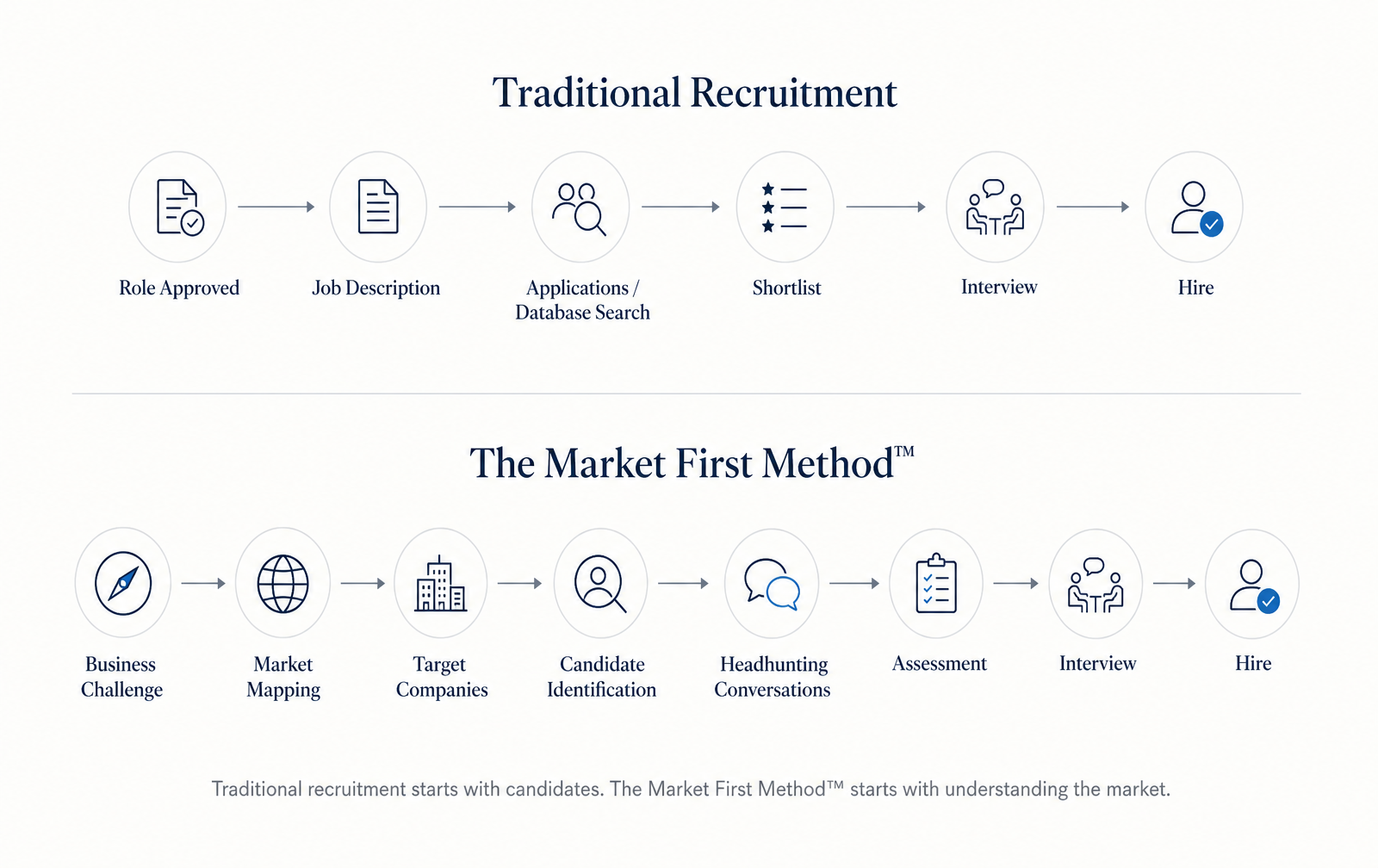
The Market First Method, two-track diagram comparing traditional recruitment (role first, candidates later) with a market-first sequence (business challenge, market mapping, candidate identification, headhunting).

Framework

The Market First Method

Map the entire relevant talent market before writing a single job spec.
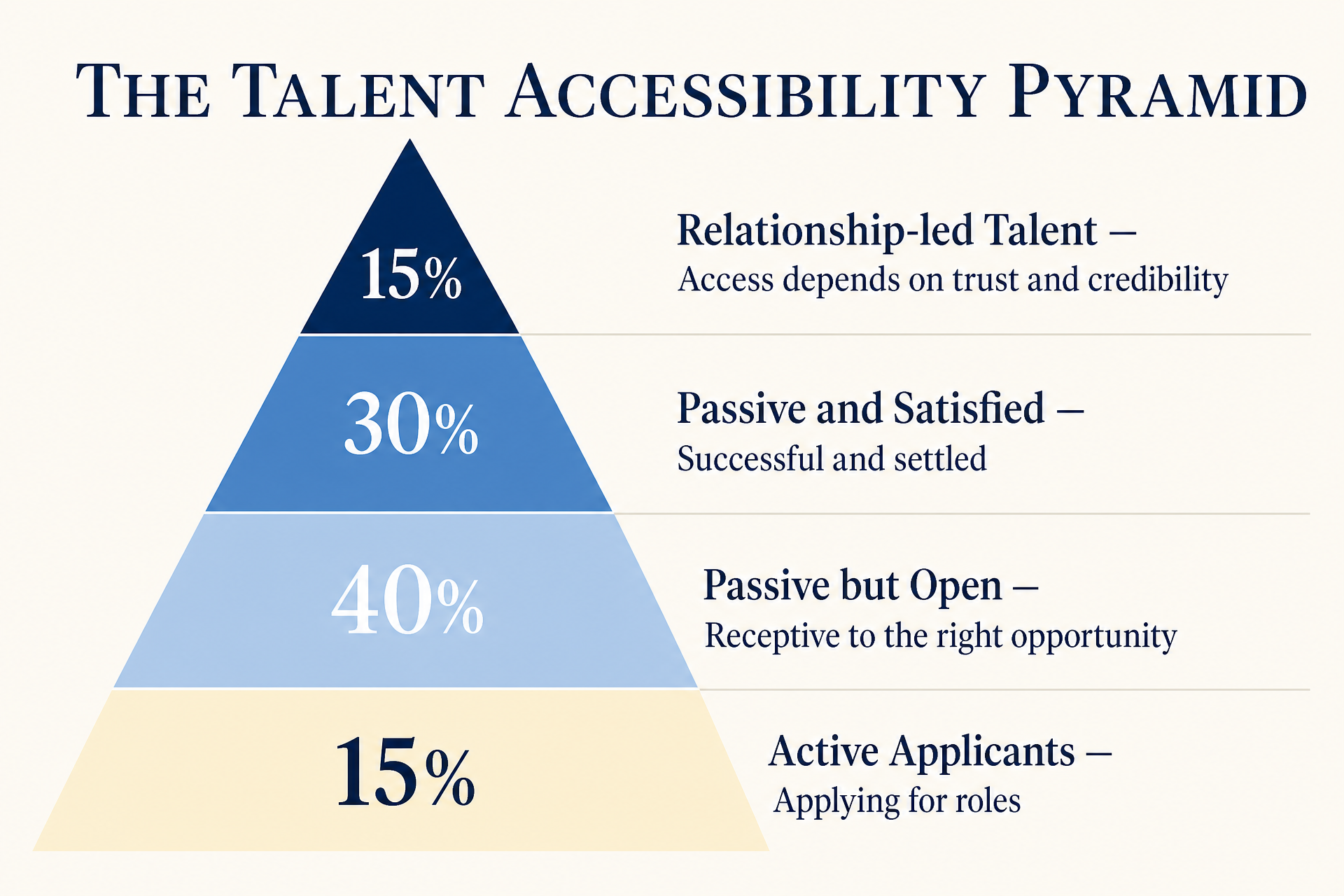
The Talent Accessibility Pyramid, four tiers rising from 15% Active Applicants at the base, through 40% Passive but Open and 30% Passive and Satisfied, to 15% Relationship-led Talent at the peak.

Framework

The Talent Accessibility Pyramid

The best candidates rarely apply. Access is layered.
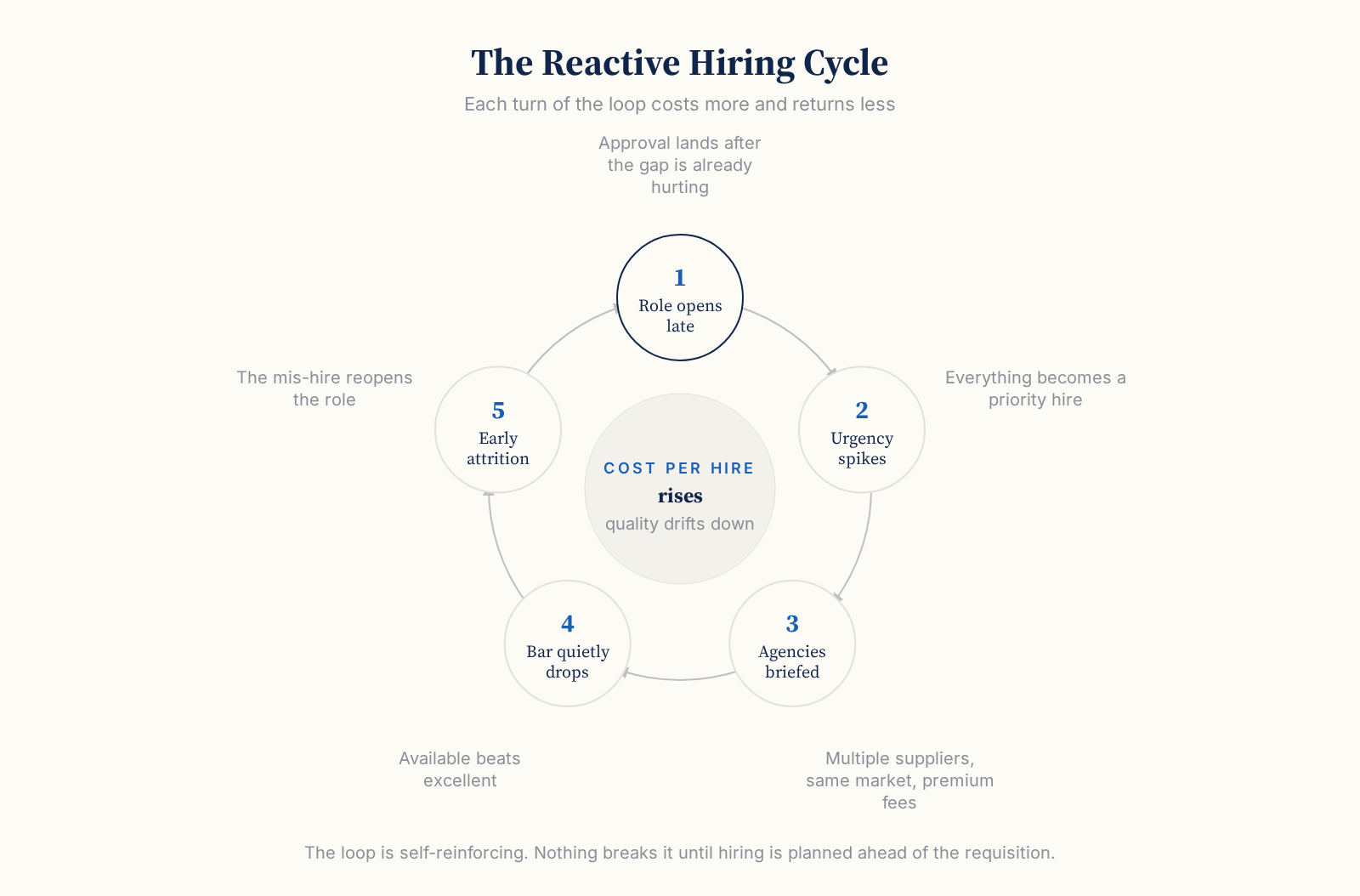
The Reactive Hiring Cycle, a five-step loop: role opens late, urgency spikes, agencies briefed, bar quietly drops, early attrition, with cost per hire rising and quality drifting down at the centre.

Framework

The Reactive Hiring Cycle

The self-reinforcing loop of open roles, agency spend and quality drift.
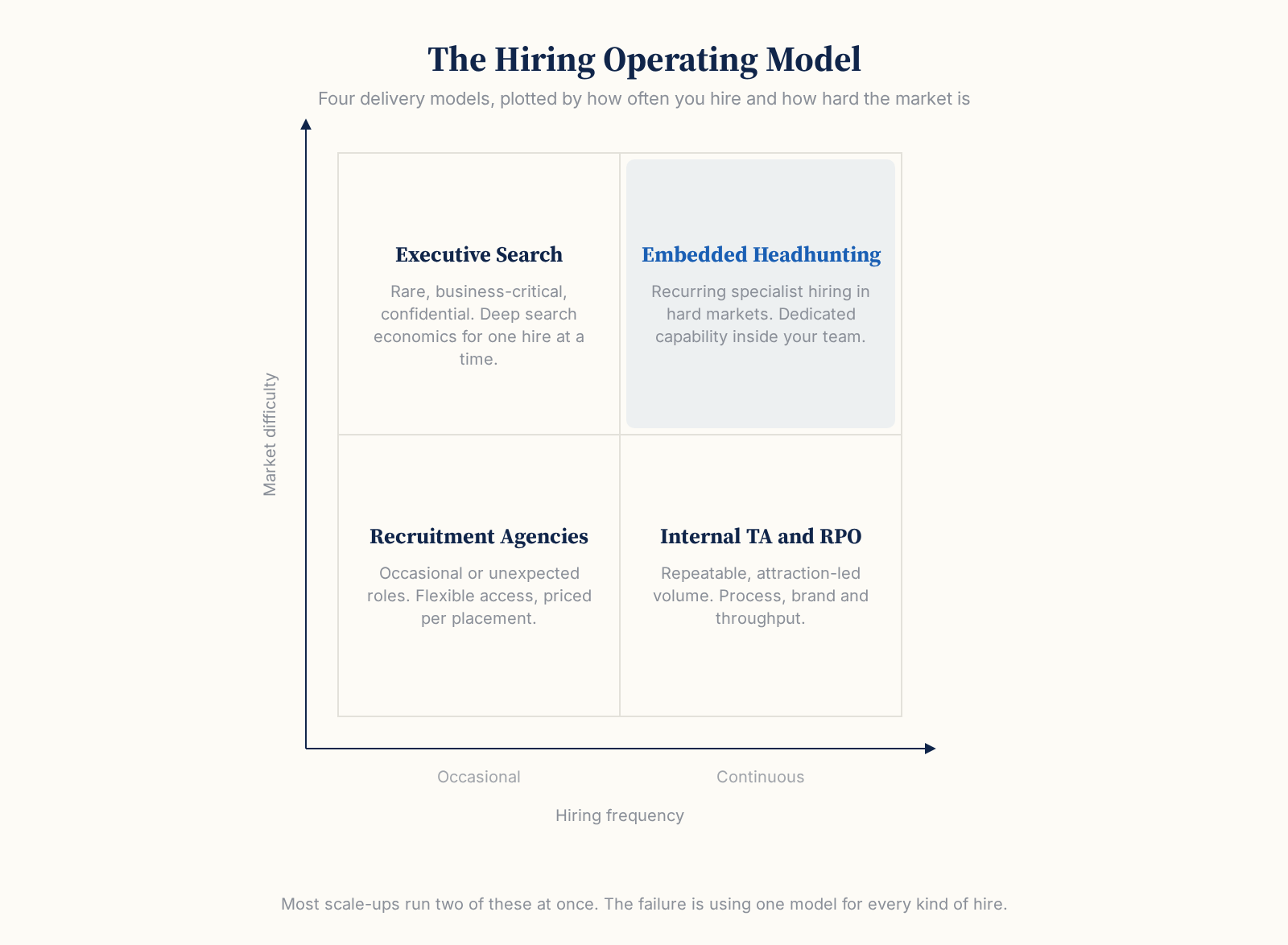
The Hiring Operating Model, a two-by-two matrix of hiring frequency against market difficulty, plotting executive search, embedded headhunting, recruitment agencies and internal TA and RPO.

Framework

The Hiring Operating Model

Four mutually-exclusive delivery models: internal TA, agency, RPO and embedded headhunting.
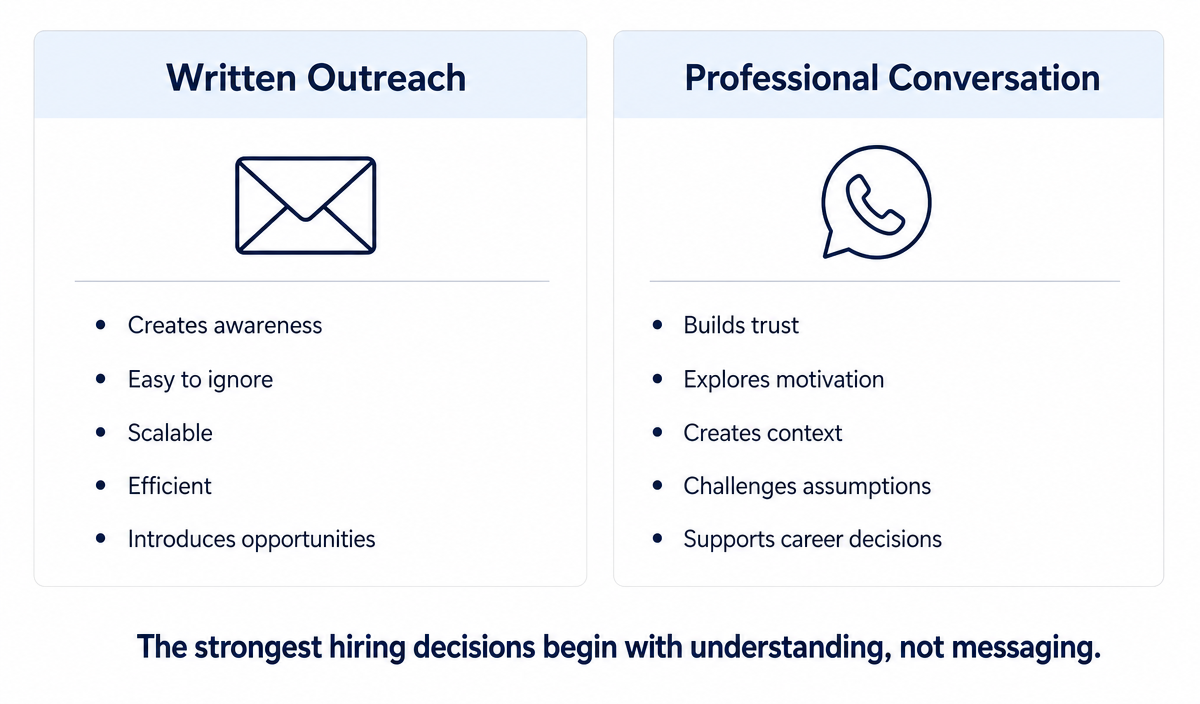
Two-column comparison graphic: Written Outreach (Creates awareness, Easy to ignore, Scalable, Efficient, Introduces opportunities) versus Professional Conversation (Builds trust, Explores motivation, Creates context, Challenges assumptions, Supports career decisions). Below both columns the statement reads 'The strongest hiring decisions begin with understanding, not messaging.'

Framework

The Conversation Advantage

Real conversations outperform templated outreach by an order of magnitude.
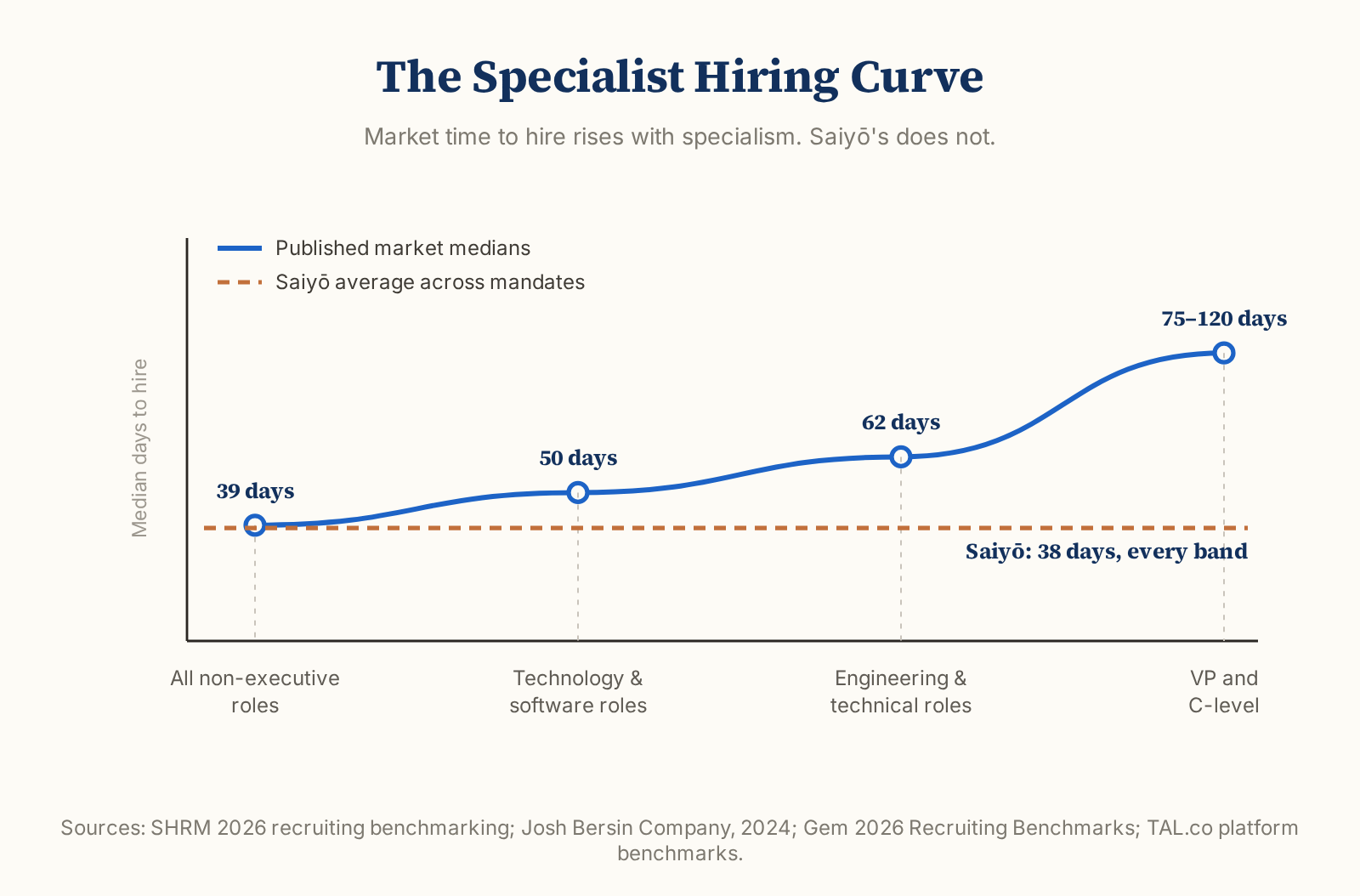
The Specialist Hiring Curve, an exponential curve of time to hire against role specialism, from SDR at two weeks to VP and above at sixteen weeks or more.

Framework

The Specialist Hiring Curve

Time-to-hire rises non-linearly as role specialism increases.

The Cost Per Hire Curve, comparing contingent agency, internal TA and subscription headhunting cost per hire as annual specialist hires rise from five to fifty, with a crossover around fifteen hires.

Framework

The Cost Per Hire Curve

The economics of hiring at 5, 15, 30 and 50 roles per year.

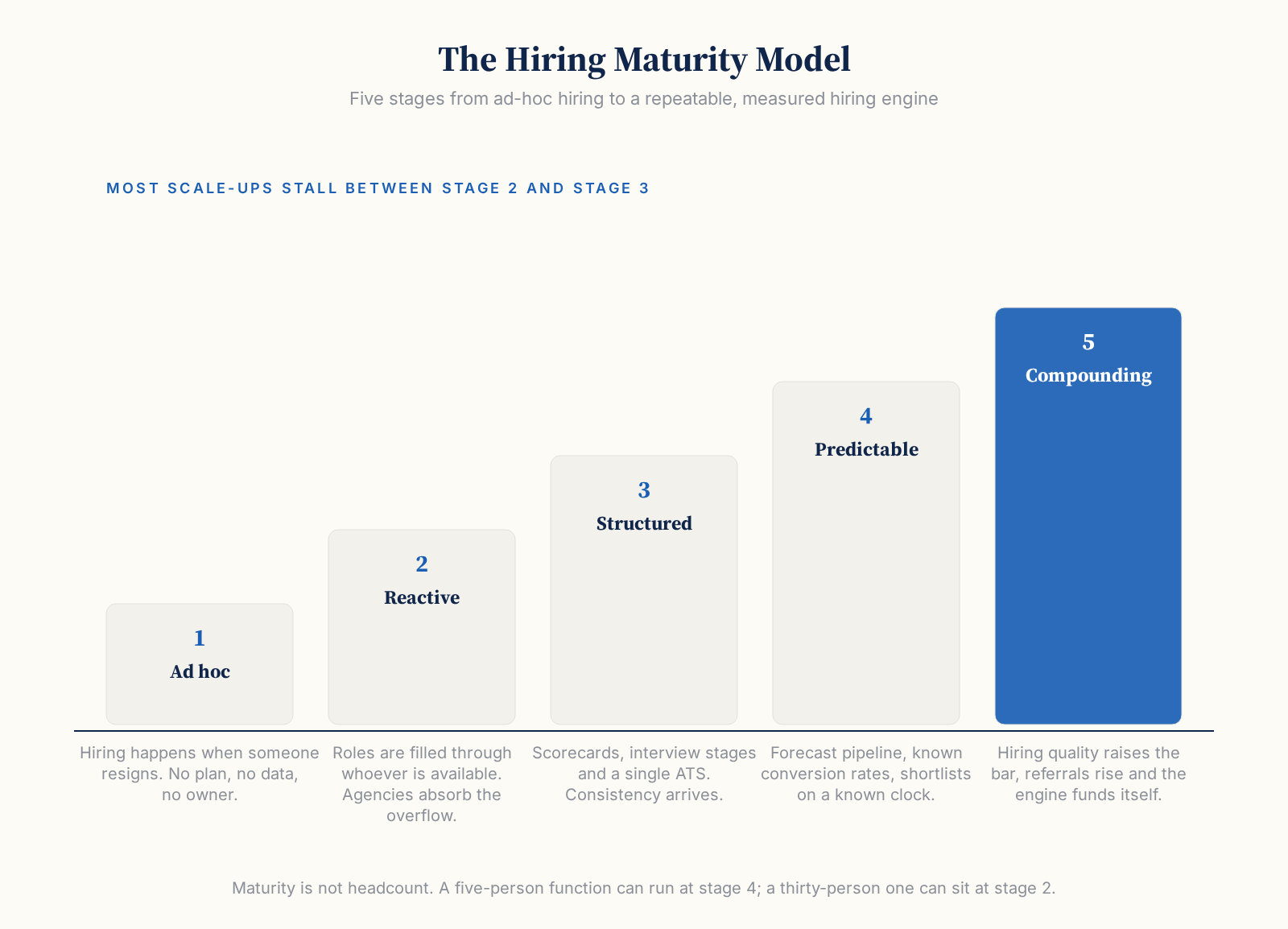
The Hiring Maturity Model, five ascending bars labelled ad hoc, reactive, structured, predictable and compounding, each with a description of that stage.

Framework

The Hiring Maturity Model

Five stages from ad-hoc hiring to a repeatable, measured hiring engine.
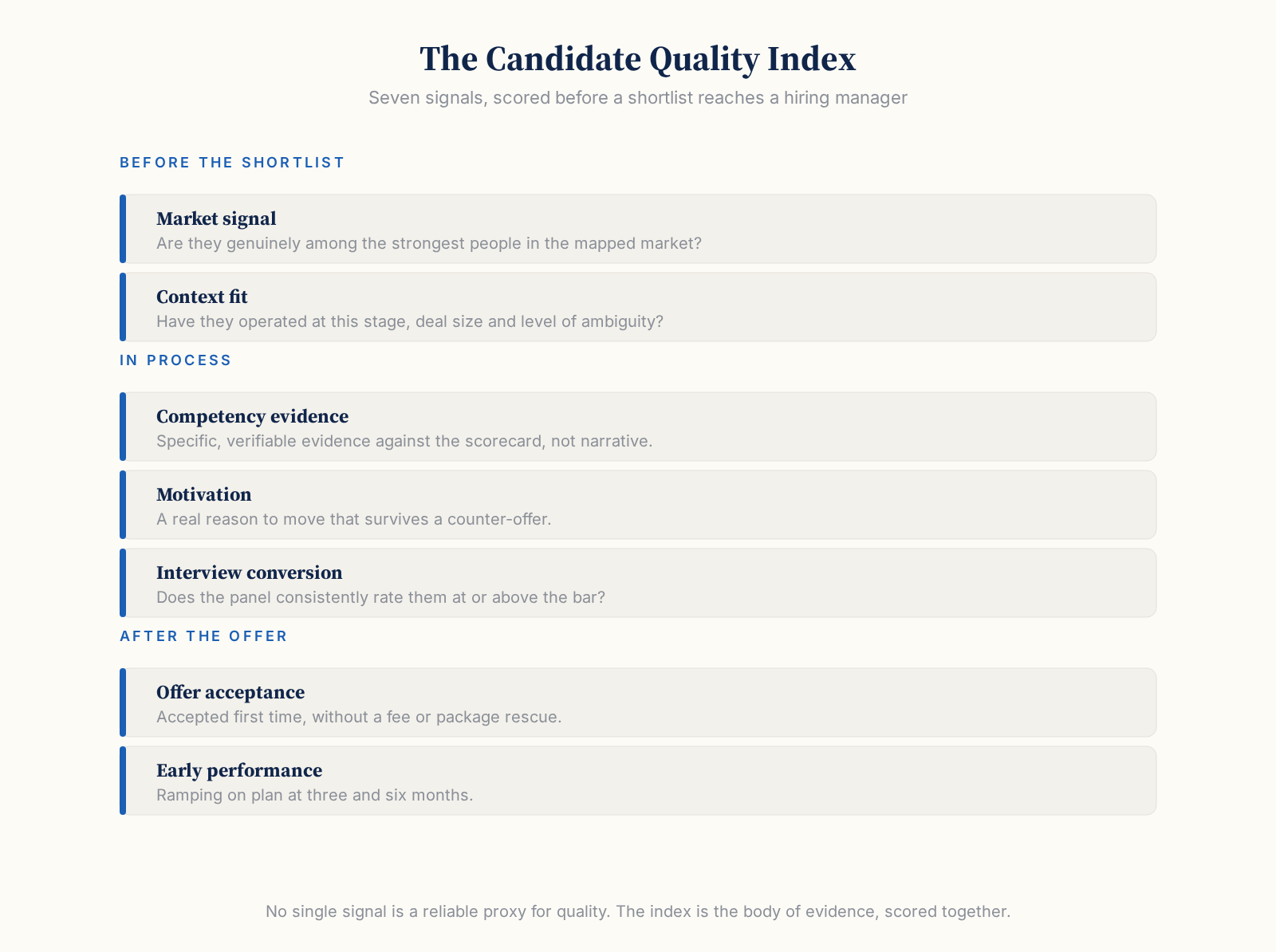
The Candidate Quality Index, seven scored signals grouped into before the shortlist, in process and after the offer.

Framework

The Candidate Quality Index

A calibrated shortlist quality score across signal, evidence and fit.
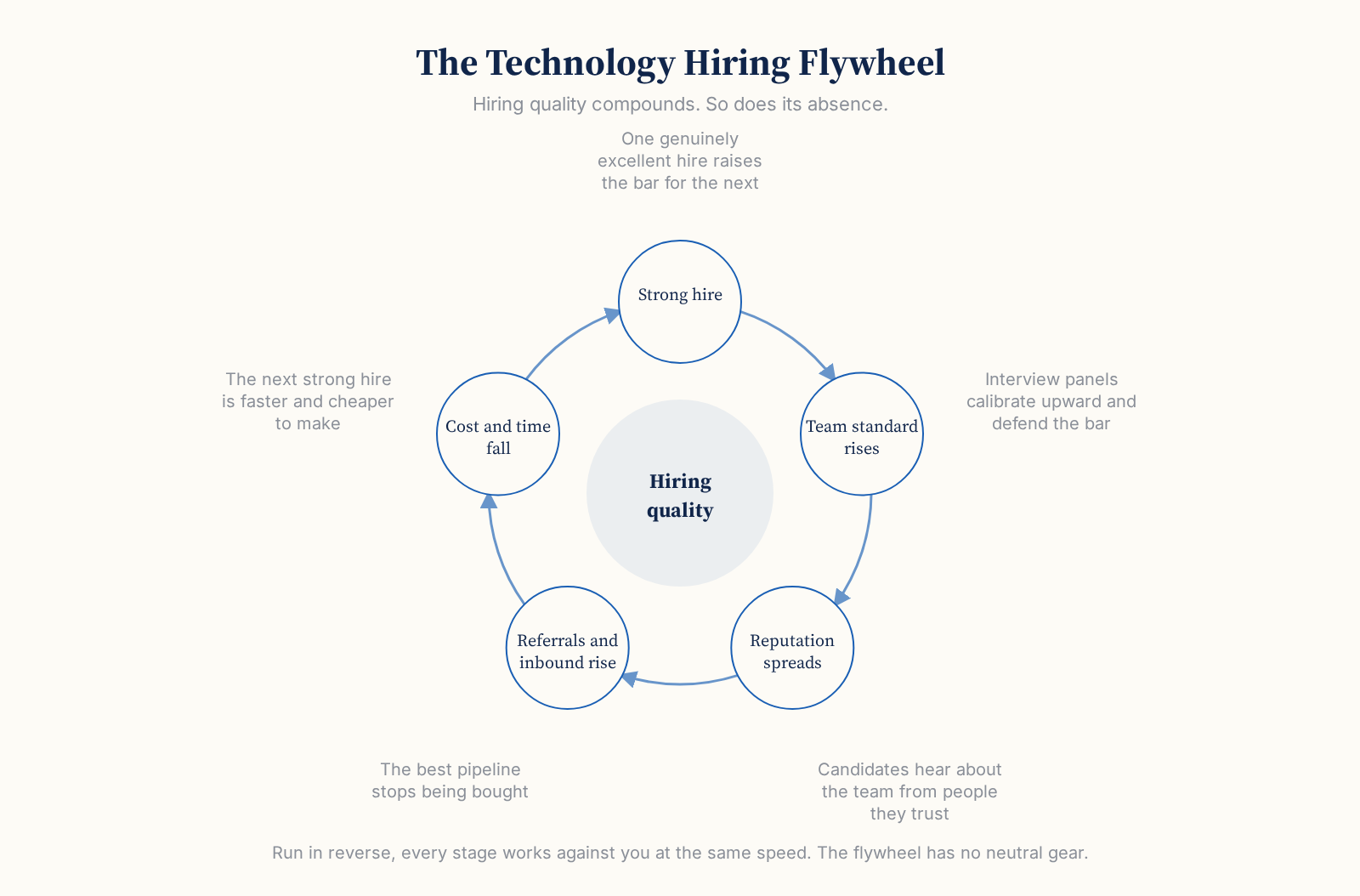
The Technology Hiring Flywheel, a five-stage loop of strong hire, team standard rises, reputation spreads, referrals and inbound rise, and cost and time fall, circling hiring quality.

Framework

The Technology Hiring Flywheel

Great hires attract great candidates. Weak hires repel them. The flywheel compounds either way.
The Accessibility Gap, horizontal spectrum from Job Boards to Professional Headhunting with a shaded band over the upper end marking the passive talent inaccessible through traditional channels.

Framework

The Accessibility Gap

The distance between the talent your current hiring channels can reach and the talent that exists in the wider market.

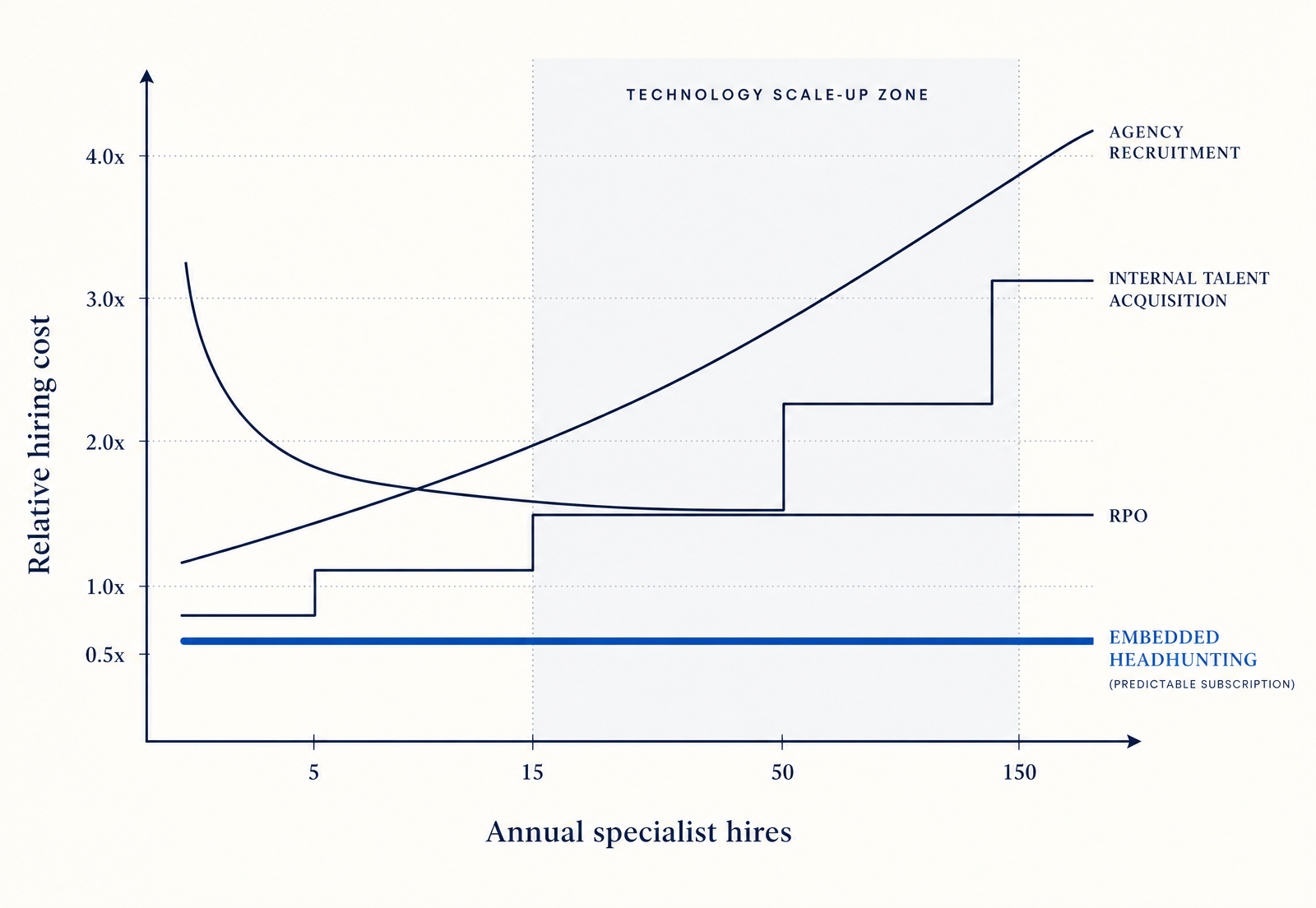
The Hiring Economics Curve, line chart plotting relative hiring cost against annual specialist hires for agency, internal TA, RPO and embedded headhunting, with a Technology Scale-up Zone shaded between 15 and 150 hires.

Framework

The Hiring Economics Curve

Relative cost per specialist hire across agency, internal TA, RPO and embedded headhunting as annual volume grows.
Venn diagram titled 'Embedded Headhunting Explained' with a left circle for a Specialist Headhunting Firm (proactive market mapping, passive candidate outreach, executive search rigour) and a right circle for an Embedded TA Team (works inside your ATS, owns your process, represents your brand), overlapping in a centre labelled 'Embedded Headhunting, proactive search + operational integration'.

Framework

Embedded Headhunting Explained

The intersection of a specialist headhunting firm and an embedded Talent Acquisition team.

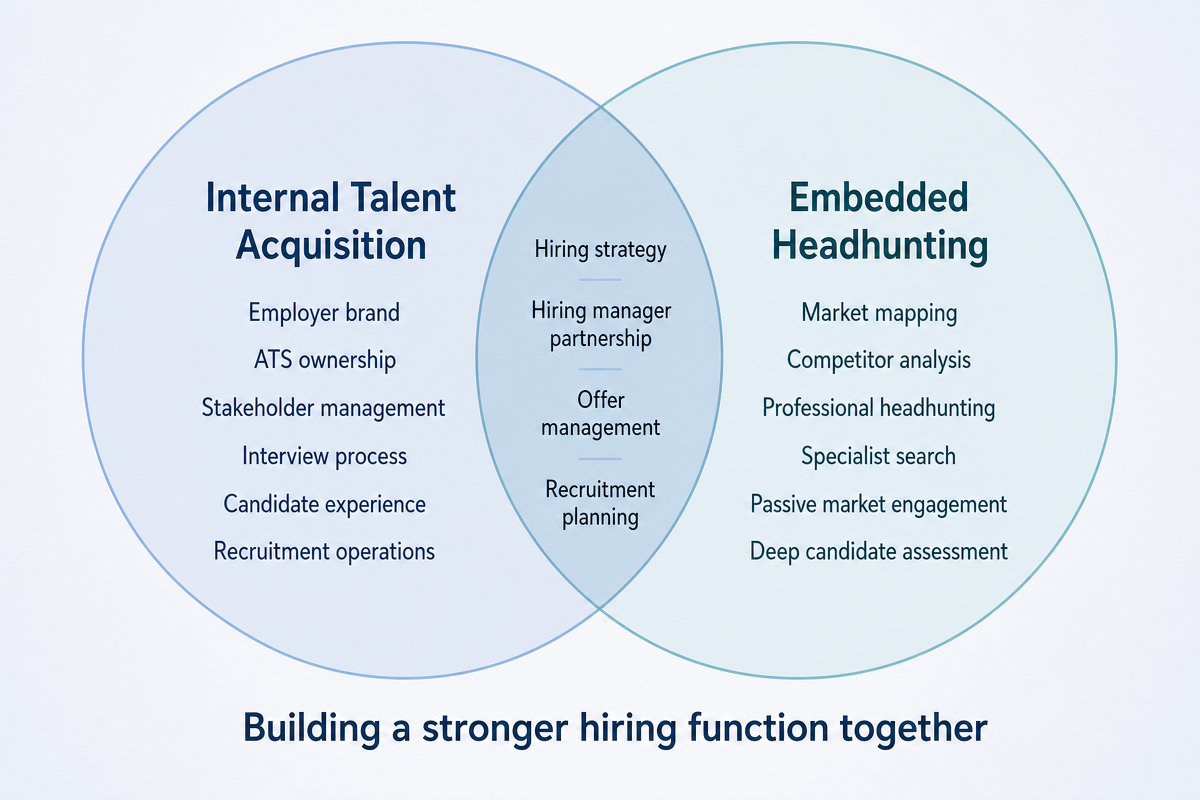
Venn diagram titled 'Building a stronger hiring function together' showing Internal Talent Acquisition (employer brand, ATS ownership, stakeholder management, interview process, candidate experience, recruitment operations) on the left, Embedded Headhunting (market mapping, competitor analysis, professional headhunting, specialist search, passive market engagement, deep candidate assessment) on the right, and an overlapping centre containing hiring strategy, hiring manager partnership, offer management and recruitment planning.

Framework

Complementary Capability Model

Internal Talent Acquisition and Embedded Headhunting are stronger together than either is alone.
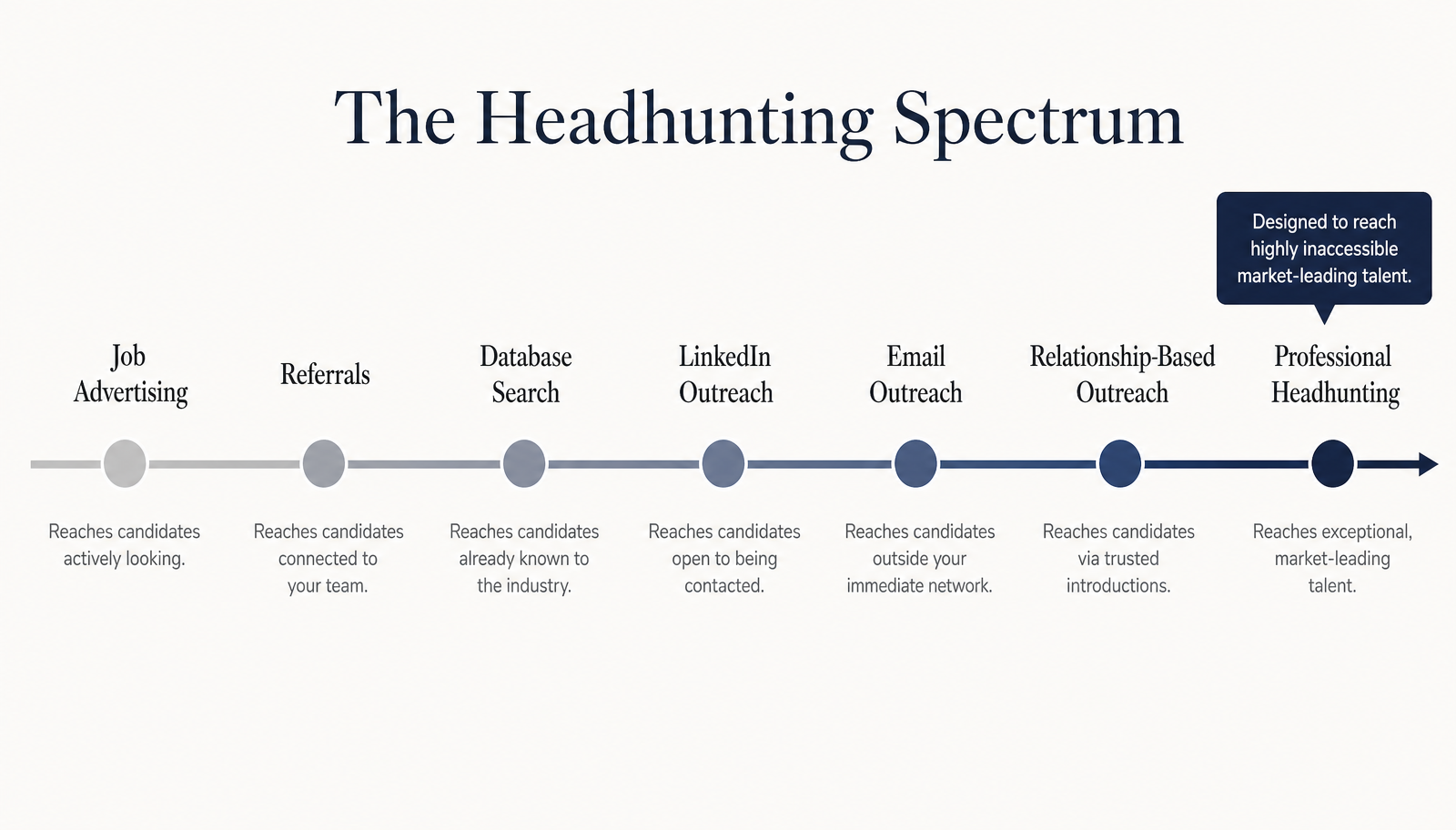
The Headhunting Spectrum, horizontal continuum with seven nodes (Job Advertising, Referrals, Database Search, LinkedIn Outreach, Email Outreach, Relationship-Based Outreach, Professional Headhunting) shading from light grey to deep navy, with a callout above the final node reading 'Designed to reach highly inaccessible market-leading talent.'

Framework

The Headhunting Spectrum

Every hiring method reaches a different part of the market. Professional headhunting sits at the far end of the spectrum.
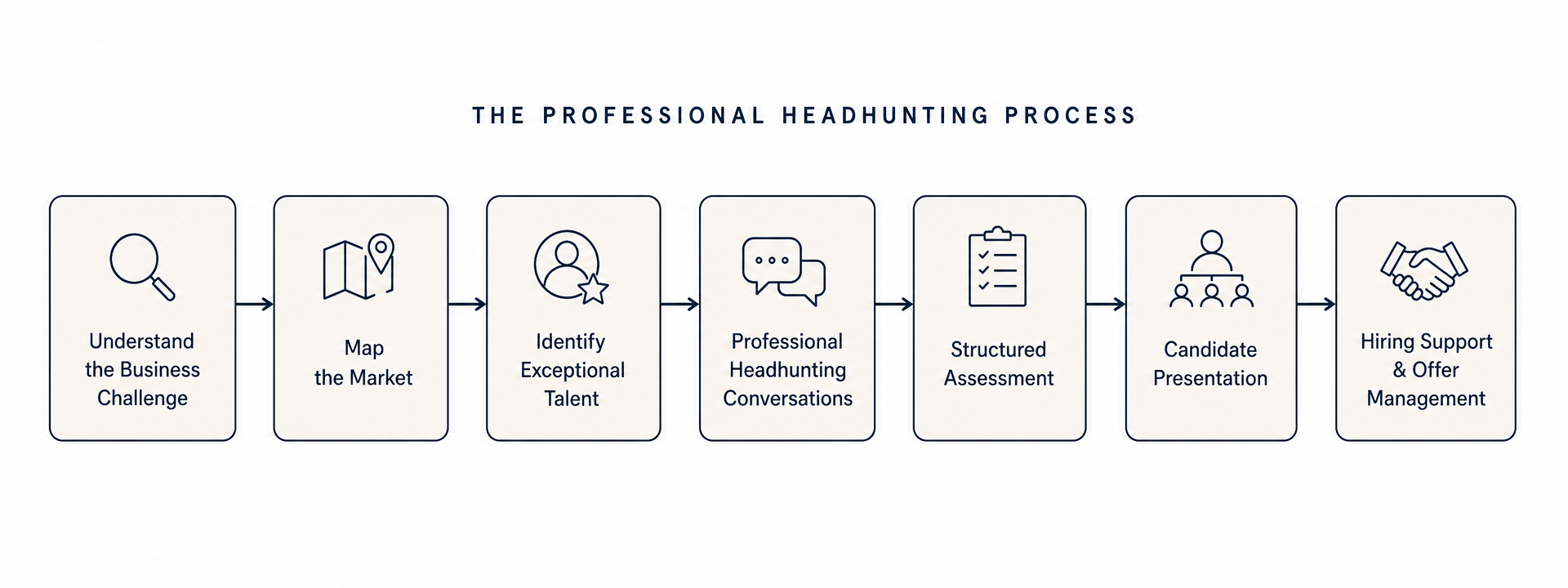
Horizontal seven-stage process diagram titled 'The Professional Headhunting Process' with connected steps: Understand the Business Challenge, Map the Market, Identify Exceptional Talent, Professional Headhunting Conversations, Structured Assessment, Candidate Presentation, and Hiring Support & Offer Management.

Framework

The Professional Headhunting Process

A structured seven-stage methodology designed to improve hiring decisions, not simply generate candidates.
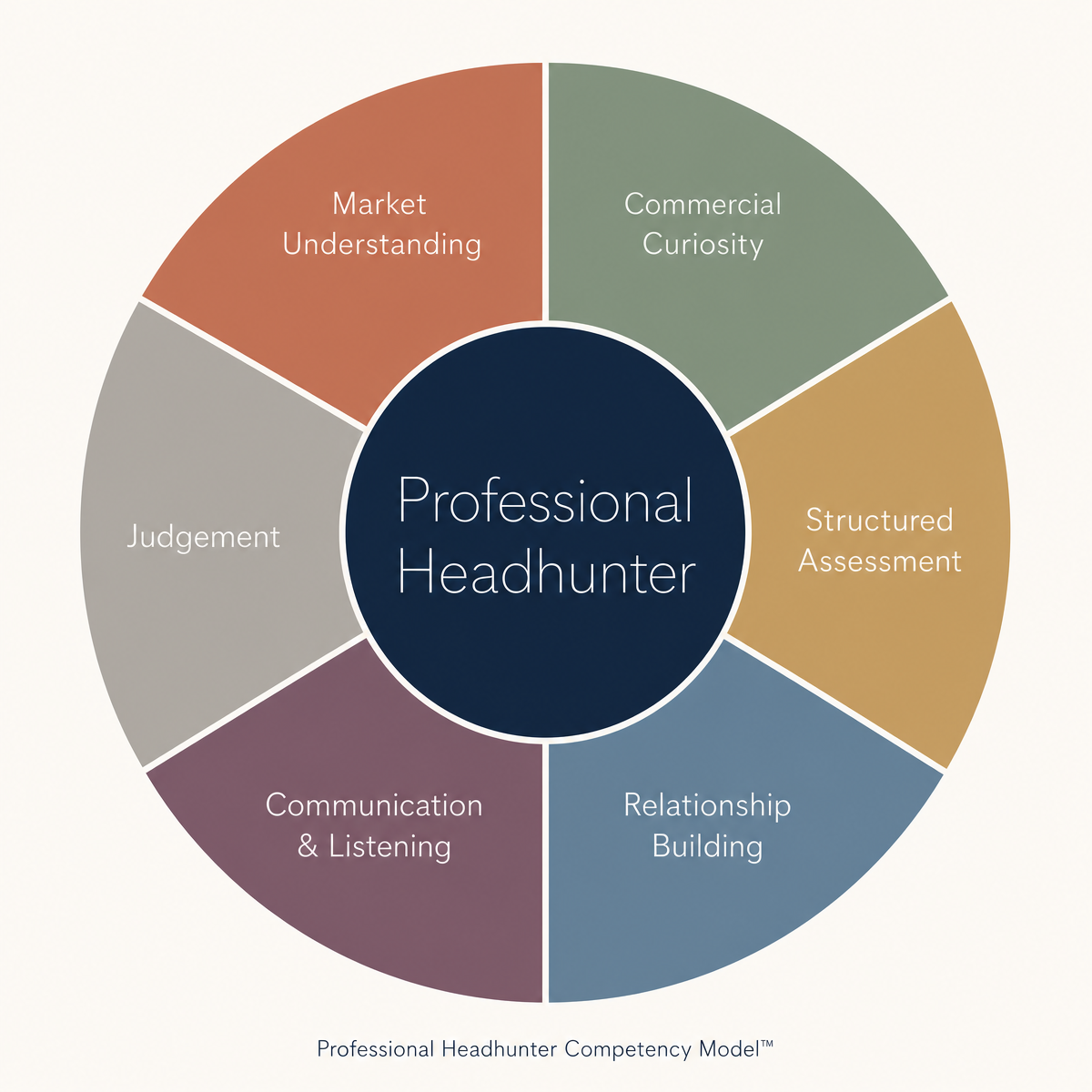
Circular competency model with 'Professional Headhunter' at the centre and six equal segments radiating outward: Market Understanding, Commercial Curiosity, Structured Assessment, Relationship Building, Communication & Listening, and Judgement. The caption reads 'Professional Headhunter Competency Model'.

Framework

Professional Headhunter Competency Model

Great headhunting is the combination of six capabilities rather than excellence in any single one.

Apply the frameworks

Map these to your own hiring plan.

Book a 30-minute call. Senior partner, not an SDR. We'll work through where your hiring function sits today and what the next move should be.

  • Shortlists in under 10 days
  • 96% offer acceptance
  • 100-day replacement guarantee
  • Up to 59% lower cost per hire

30 minutes. Senior partner, not an SDR. No obligation.