Saiyō framework
The Technology Hiring Flywheel
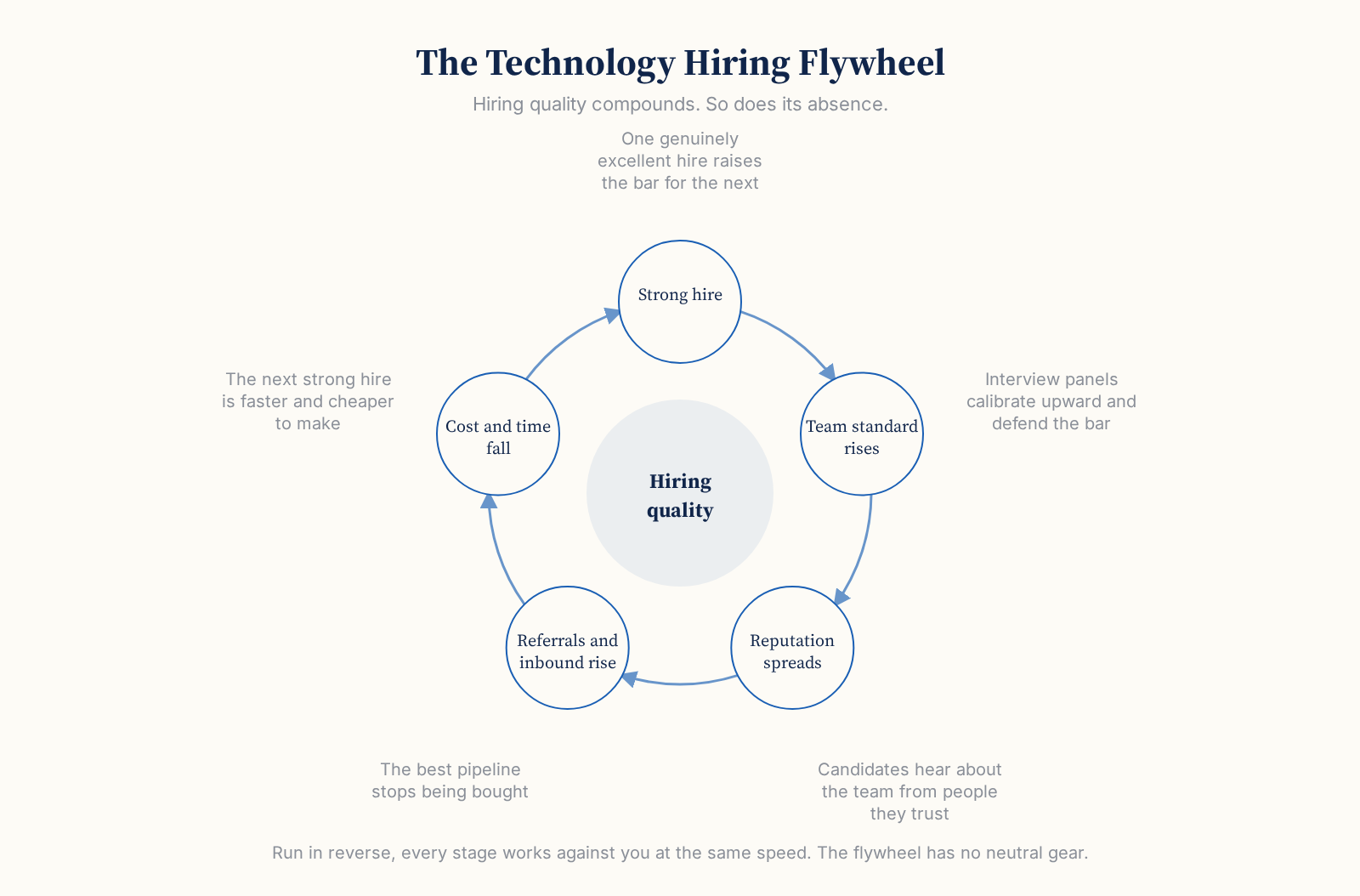
Great hires attract great candidates. Weak hires repel them. The flywheel compounds either way.
What the framework says
One genuinely excellent hire raises the bar for the next. Interview panels calibrate upward and defend that bar. Candidates hear about the team from people they trust, so reputation spreads. Referrals and inbound rise, which means the best pipeline stops being bought. Cost and time per hire fall, which makes the next strong hire easier again. Run in reverse, every stage works against you at the same speed: a weak hire lowers the bar, the panel recalibrates down, reputation follows and pipeline has to be purchased. The flywheel has no neutral gear.
When to use it
You are justifying investment in hiring quality against short-term pressure to fill seats.
How to apply it
- 1Track referral rate and inbound quality as outcome metrics of hiring quality, not as recruitment-marketing metrics.
- 2Protect the bar at the point it is most tested: the role that has been open longest.
- 3Make interview calibration a standing activity, because the bar moves quietly in both directions.
- 4Model the eighteen-month compounding effect when comparing a fast weak hire to a slower strong one.
The common mistake
Assuming the flywheel only spins forward. Every stage works in reverse at the same speed.
Read the full guide
The Complete Guide to Hiring in a Technology Scale-up
Connect workforce planning, internal ownership, market-first search, structured assessment, candidate experience, flexible capacity and performance measurement into one hiring system.
Open the guide